The best solar bird feeder for most backyard setups right now is a solar smart model like the Birdfy Feeder Metal V or the FeatherSnap Scout. Both pair a real solar panel and a 5000+ mAh lithium-ion battery with a built-in camera, motion detection, and a companion app. They stay powered through normal sun conditions, survive rain and cold, and let you watch birds without running extension cords or swapping batteries every week. If you just want a feeder with solar-powered lights or a heated perch and no camera, simpler solar feeders work fine, but the smart solar category gives you the most useful tech without a major power tradeoff.
Best Solar Bird Feeder Guide: What Works and How to Choose
Marcus Hendricks
16 May 2026
What a solar bird feeder actually is (and what 'solar smart' means)
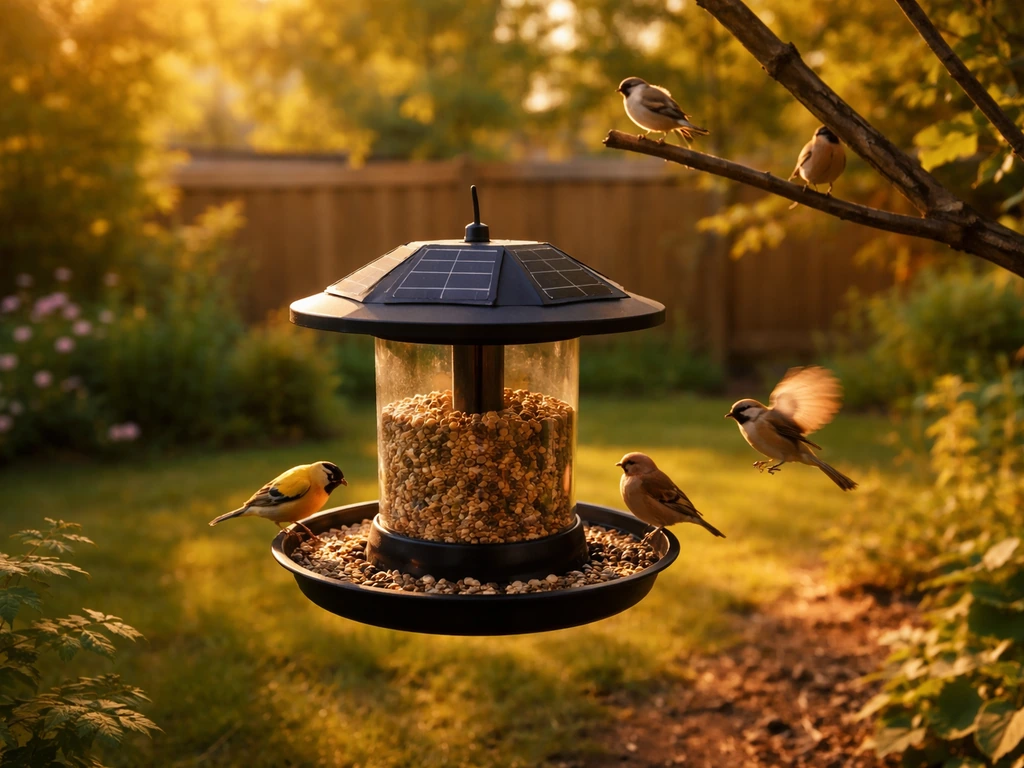
A solar bird feeder has a small photovoltaic panel, usually built into the roof or a separate panel on a mount, that charges a rechargeable battery during daylight hours. That battery then runs whatever electronics are in the feeder: a camera, motion sensor, Wi-Fi radio, LED lights, or a heated perch. The feeder part itself (the seed hopper, mesh cage, perches) doesn't need power at all. Solar just keeps the tech side running.
A standard solar-powered feeder might just use that panel to run a light or a small heater to prevent seed clumping in winter. A solar smart feeder adds a camera and app connectivity. If you are deciding between a regular solar feeder and the best video camera bird feeder options, this is where the camera and app connectivity start to matter most solar smart feeder.
When people search for the best solar smart bird feeder, they almost always mean a unit with a built-in camera that sends motion-triggered notifications to their phone and lets them watch birds live or review clips. If you're looking for the best budget bird feeder camera, focus on reliable motion alerts, storage options, and battery life before the fancy extras best solar smart bird feeder. The solar panel and battery are what make that camera sustainable outdoors without wiring.
The critical thing to understand is what solar does and doesn't do. It keeps the battery topped up during the day. It does not make the camera run indefinitely in all conditions. Birdbuddy, for example, is explicit that without solar input, you can expect 5 to 14 days of battery life depending on bird traffic and whether you use live streaming. The solar panel extends that dramatically under good sun, but in deep winter or a shaded yard it is a supplement, not a miracle.
What to look for when picking the best solar powered bird feeder
There are six things that actually matter when you are comparing models. Everything else on the spec sheet is either marketing or secondary.
Solar panel wattage and placement
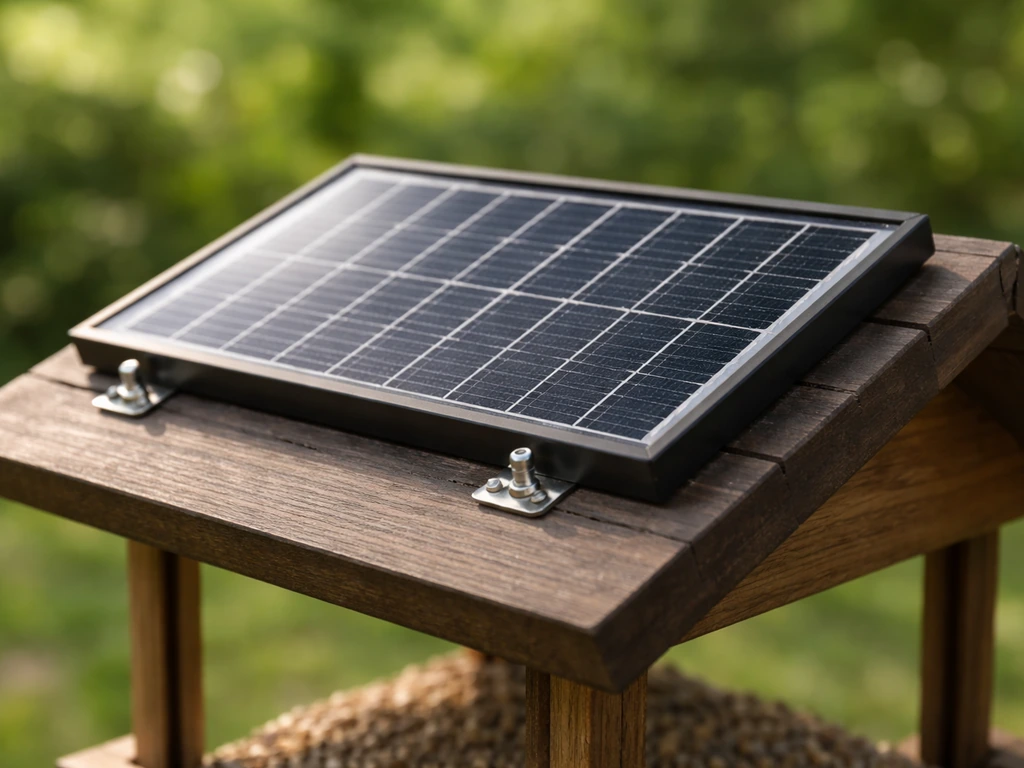
Most solar smart feeders ship with a 2W to 3W panel. The Birdfy Feeder Metal V has a 2W built-in panel; the FeatherSnap Scout is rated at 3W. The Birdfy Feeder Metal (a slightly different model) also uses a 2W panel. Birdbuddy's solar roof uses a 6-inch by 3-inch premium monocrystalline panel. LinkSolar's own charging guides describe 2W as a threshold that can be tight on consistently cloudy days once you account for charging inefficiencies and real-world losses of 30 to 40 percent. A 3W panel gives you more headroom, especially in winter or shaded yards.
Battery capacity
Bigger batteries mean more resilience during cloudy stretches or cold snaps. The Birdfy Feeder Metal V has a 5200mAh battery. The FeatherSnap Scout also hits 5200mAh. The Birdfy Feeder Metal steps up to 9000mAh, which is significant for winter use. The MEHOOM smart feeder offers 5000mAh. Birdbuddy's camera module runs on a 3900mAh battery, which is on the smaller end and why their winter tips specifically flag cold-weather battery drain as something to manage. If you live somewhere with long cloudy winters, prioritize 6000mAh or more.
Weatherproofing rating
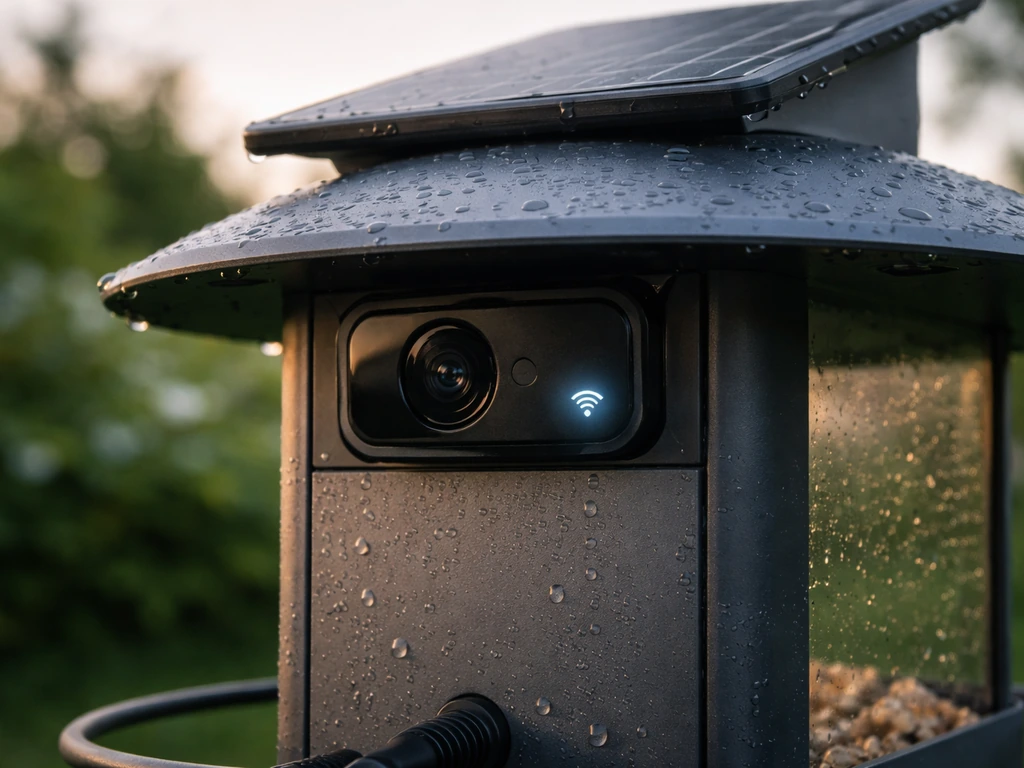
Look for at least IP65. The Birdfy Feeder Metal V is rated IP66, which means it handles powerful water jets from any direction, not just rain. The Ringsee SHRS-BFC-9101 is IP65. These ratings matter in practice: a feeder without a proper waterproof rating will develop camera fogging, sensor failures, or battery corrosion within a season or two of real outdoor use. IP66 is the sweet spot for most climates.
Operating temperature range
The Birdfy Feeder Metal V is rated from 14°F to 113°F (-10°C to 45°C). The Ringsee model covers the same range. If you live in a genuinely cold climate, that lower bound of 14°F (-10°C) is something to pay attention to, because lithium-ion batteries lose capacity significantly in the cold even within their rated range. Birdbuddy specifically warns that extreme temperatures affect battery capacity and can reduce its useful lifetime.
Camera and connectivity specs
Every solar smart feeder on the market right now uses 2.4GHz Wi-Fi. Not 5GHz, not dual-band. That matters for setup: your phone needs to be on 2.4GHz when you pair a Birdfy, and your router needs a 2.4GHz network available. The 2.4GHz band has better range and wall penetration than 5GHz, which is why it is used for outdoor devices. The FeatherSnap Scout has a motion detection distance of 10 feet. Perky-Pet's solar smart feeder uses a 110-degree field of view camera. Those two specs, detection range and field of view, determine how much of your yard the camera actually sees.
Pest and squirrel resistance
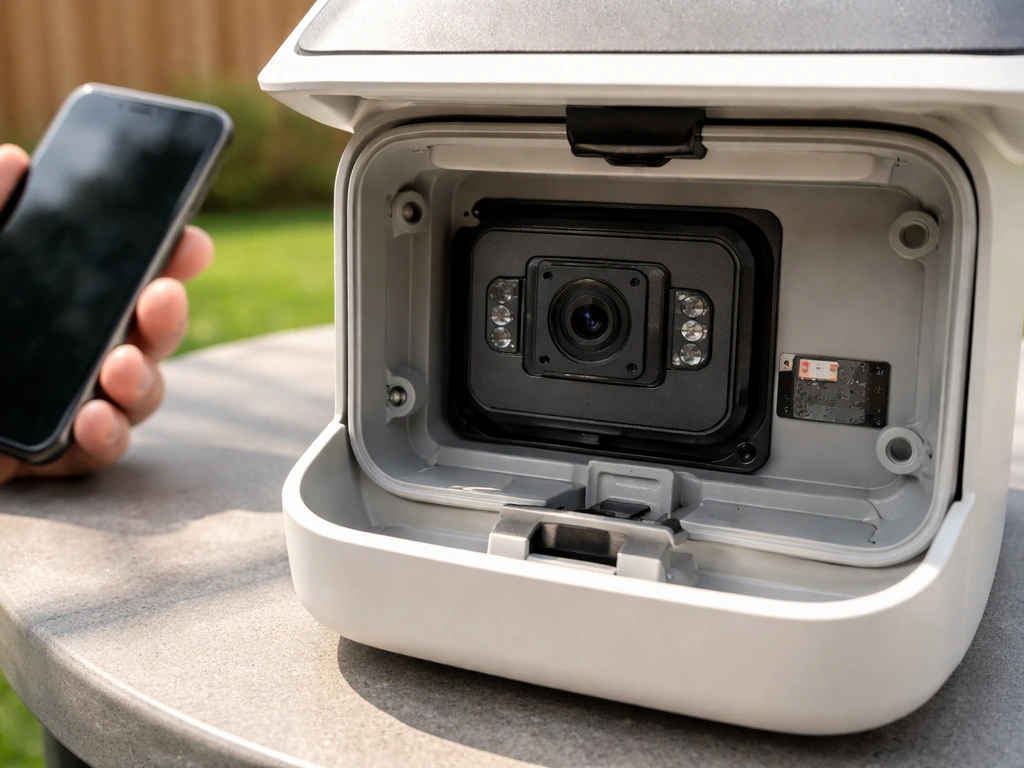
Solar feeders with cameras are expensive enough that losing them to squirrel damage is genuinely painful. Perky-Pet's solar smart feeder is explicitly labeled squirrel-resistant. Look for metal construction, weight-activated perch closures, or a baffle-compatible pole mount. Cheap plastic housings get chewed through fast, and squirrel damage to a solar panel or camera lens is not usually covered under warranty.
Best solar features by bird type and feeder style
Solar power does not change what birds visit, but the feeder style you choose absolutely does. Here is how the main feeder types pair with solar features.
| Feeder Style | Best For | Solar Feature Benefit | Watch Out For |
|---|---|---|---|
| Tube feeder | Finches, chickadees, nuthatches | Camera captures small perch activity well; PIR motion works reliably | Small seed ports can clog; camera angle needs to be close |
| Hopper feeder | Cardinals, jays, sparrows, mixed species | Larger capacity means less refilling; camera gets wide species variety | Heavier birds can drain perch closures faster; squirrel target |
| Platform/tray feeder | Doves, juncos, ground feeders, larger birds | Wide open surface is ideal for camera field of view | Seed gets wet; solar panel placement can be tricky on open trays |
| Suet feeder | Woodpeckers, nuthatches, wrens | Camera at suet cage captures clinging behavior well | Less common as a solar-integrated product; often camera added separately |
| Window feeder | Any species; close-up viewing | Camera built into window feeder gives extreme close-ups | Wi-Fi signal through glass can be weak; limited solar panel space |
For cardinals specifically, a hopper-style solar smart feeder mounted on a pole at about 5 to 6 feet is ideal. Cardinals prefer a covered feeder with perches on multiple sides. For hummingbirds, most solar smart feeders are not designed for nectar, so you would be pairing a standard solar hummingbird feeder with a separate camera, or choosing a model with a separate nectar attachment. Finches do well at tube feeders, and the close feeding distance at a tube port gives the camera excellent framing. Woodpeckers are best served at a suet or log-style feeder, and while dedicated solar smart suet feeders are rare, a pole-mounted smart feeder positioned near a suet cage can catch both.
How solar power actually performs in your backyard conditions
This is where most buyers get surprised. A solar smart feeder is not a set-it-and-forget-it solution in every climate or every yard. Here is what real conditions actually look like.
Sun exposure and panel efficiency
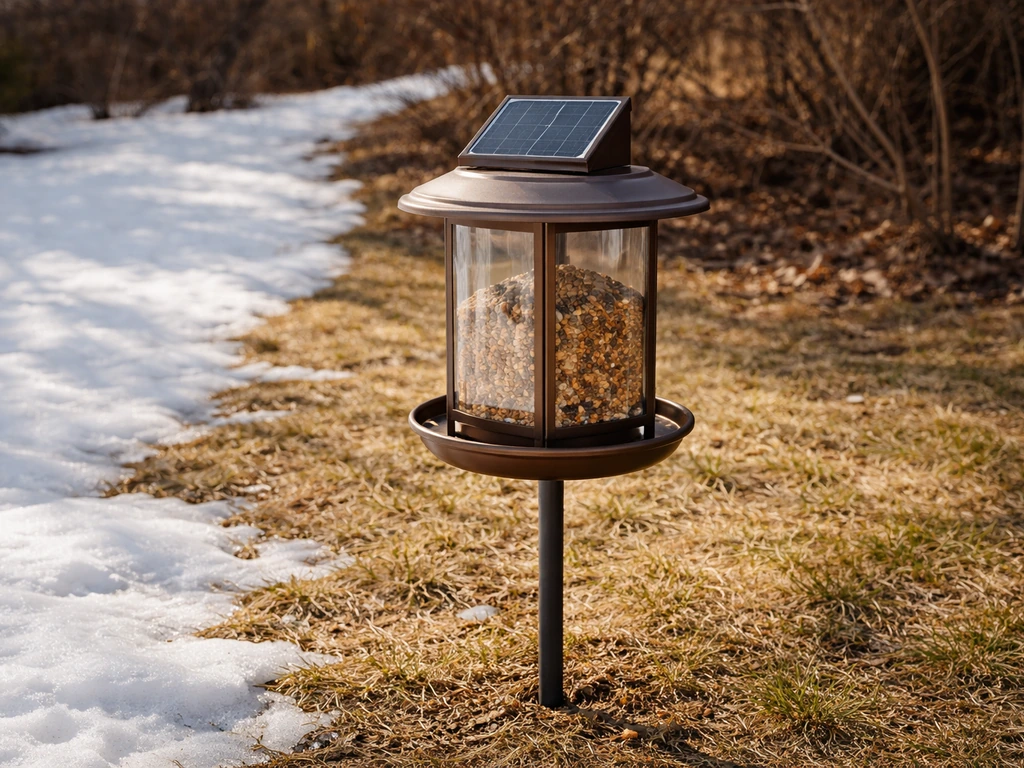
A 2W to 3W panel in full sun can realistically deliver 6 to 10 watt-hours per day, which is enough to keep a 5200mAh battery healthy through normal camera and Wi-Fi use. But those numbers drop fast with shade, cloud cover, or a dirty panel. LinkSolar's guides describe a 30 to 40 percent real-world loss factor even in reasonable conditions. That means a feeder on a north-facing fence in a yard with tree canopy is going to struggle, even in summer. The Camouflage EZ BirdFeed, which uses two solar panels, reportedly stayed above 95 percent battery during TechRadar's testing, which illustrates how much more headroom a dual-panel setup gives you.
Winter and low-light performance
Winter is the hardest season for solar bird feeders, for three reasons: shorter days mean less charging time, lower sun angles mean panels get less direct exposure, and cold temperatures reduce lithium battery capacity even within the rated operating range. Birdbuddy's winter guidance specifically recommends keeping the solar roof clear of snow and ice, and notes that cold actively increases reliance on solar charging at the same time that cold is reducing how much charge the battery can hold. A feeder rated to 14°F with a 5200mAh battery will survive a typical mid-Atlantic or Pacific Northwest winter, but in Minnesota or upstate New York, you should plan to USB-charge the battery periodically from November through February.
Rain, wind, and physical durability
IP65 and IP66 ratings mean rain is not a problem for the electronics. The bigger durability concern is wind, specifically feeders mounted on poles that sway and stress the solar panel connection, or hanging feeders that spin and tangle wiring. Pole-mounted feeders with rigid solar panels fare better than hanging models with flexible cable runs. Metal construction (like the Birdfy Feeder Metal series) holds up significantly better than ABS plastic in freeze-thaw cycles and UV exposure.
Placement and setup for maximum bird activity
Where you put the feeder matters more than almost any spec on the box. Birdfy's quick-start guide treats solar panel orientation as part of the core setup steps, not an afterthought. Here is the approach I recommend.
- Mount the feeder on a pole 5 to 6 feet off the ground, at least 10 feet from the nearest tree or fence that squirrels can launch from.
- Orient the solar panel toward true south (in the northern hemisphere) and angle it at roughly your latitude in degrees for maximum year-round sun exposure. In most of the US, that is somewhere between 30 and 50 degrees from horizontal.
- Keep the feeder within 30 to 50 feet of your Wi-Fi router, or closer if there are thick walls between the feeder and the router. Remember: 2.4GHz is your only option on these devices.
- Place the feeder near natural cover like shrubs or a tree line, but not directly under branches where squirrels have direct access. Birds want an escape route nearby; they will use your feeder more if perching cover is 10 to 15 feet away.
- Angle the camera so the primary perch area fills the center of frame, not the sky. A camera pointed slightly downward at the perch level captures bird detail far better than one aimed at the horizon.
- Clean the solar panel whenever you refill seed. A film of dust, pollen, or bird droppings on the panel can reduce charging output by 20 percent or more.
If your yard has significant shade and you cannot mount in full sun, consider a model with a remote solar panel that can be positioned separately from the feeder itself. Some Birdfy models support this. It gives you flexibility to put the feeder where birds prefer and the panel where the sun is.
Smart tech features: what is worth paying for and what is not
Solar smart feeders are essentially outdoor wildlife cameras that happen to dispense seeds. The camera and app side of these products vary a lot in quality, and the solar battery budget for all those features is limited, so how you configure the software matters.
Motion detection and notifications
PIR (passive infrared) motion detection is standard on all the major models. The Ringsee SHRS-BFC-9101 triggers app push notifications and an LED flash on PIR activation. The FeatherSnap Scout detects motion at up to 10 feet. In practice, PIR detection misses small, slow-moving birds sometimes and false-triggers on shadows or leaves fairly often. Every false trigger consumes battery: the Wi-Fi radio wakes up, the camera records a clip, and the app pushes a notification. If you are getting dozens of false alerts a day, your battery will suffer. Turn down sensitivity or narrow the detection zone in the app before you blame the solar panel.
Video storage: local vs. cloud
The MEHOOM smart feeder supports MicroSD cards up to 128GB and also advertises a 30-day free cloud storage trial. This is a common model: local storage is free and always available, cloud storage is a subscription after the trial. Local MicroSD storage is more private and does not depend on your internet upload speed, but you have to physically remove the card to review older footage.
Cloud storage lets you review clips from anywhere but raises legitimate privacy questions: who has access, where is it stored, and what happens to footage after your subscription lapses. For most backyard bird watchers, a 64GB or 128GB MicroSD card is plenty and keeps things simple. If you want the best backyard bird camera experience, focus on camera quality, field of view, and how you store and review footage backyard bird watchers.
AI species identification
Birdfy and Birdbuddy both offer AI-powered bird species ID in their apps, which is genuinely useful and not just a gimmick. The identification accuracy depends on image quality and lighting, and it works better with sharp daytime footage than with backlit or low-light clips. This feature does use cloud processing, so it requires an internet connection and, depending on the plan, may be paywalled after a trial period.
Connectivity and setup realities
Every solar smart feeder requires your phone to be on a 2.4GHz Wi-Fi network during initial pairing. If your router broadcasts a single combined network name (SSID) for both 2.4GHz and 5GHz, your phone may automatically connect to 5GHz, and the feeder setup will fail. Birdfy specifically flags this in their getting-started guide. The fix is to temporarily split your router into separate SSIDs during setup, or use a phone that lets you manually select 2.4GHz. This trips up a lot of buyers and is worth knowing before you open the box.
A note on privacy
Your solar smart feeder has a live outdoor camera with motion detection. It is pointed at your yard, but it may also capture your neighbors' property, your backyard fence line, or people walking nearby. Check your local rules about outdoor cameras before mounting, especially if the feeder's field of view extends beyond your property line. This is a practical concern, not a reason to avoid these products, but it is worth a five-minute review before installation.
Common problems and how to fix them
Feeder is not charging or battery drains fast
Birdfy's troubleshooting content lists the most common causes of charging failure: a completely drained battery (which some panels cannot recover from and requires USB charging first), a dirty or shaded solar panel, and winter sunlight that is simply not intense enough for consistent solar charging. Check the panel surface first, it takes 30 seconds and fixes the problem more often than you would expect. If the battery drained below the panel's recovery threshold, plug it into USB to get it above 20 percent, then let solar take over. In winter, plan on a USB top-up every few weeks regardless of panel condition.
Camera notifications are unreliable or missing
This is almost always a Wi-Fi issue, not a camera issue. Check that the feeder has a stable 2.4GHz connection and that your router signal reaches the feeder location. Interference from neighbors' networks, thick masonry walls, or a feeder placed at the edge of Wi-Fi range all cause dropped connections and missed notifications. If moving the feeder closer to the router is not practical, a Wi-Fi extender dedicated to 2.4GHz can solve this without requiring a new router.
Squirrels or pests are damaging or emptying the feeder
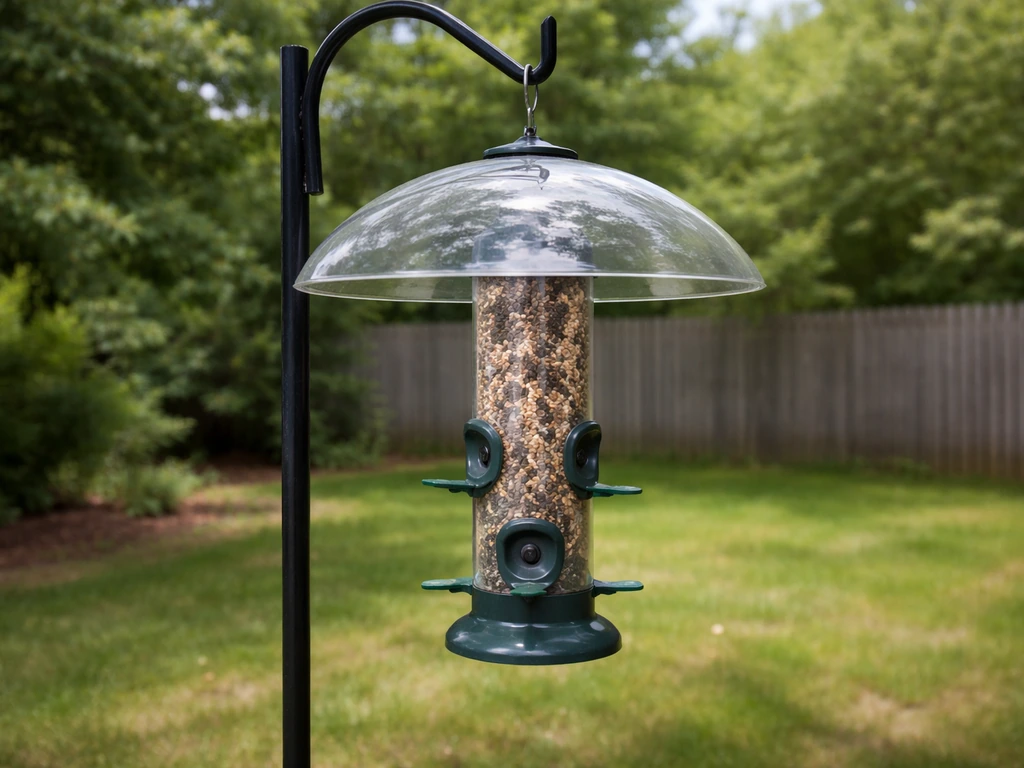
A pole-mounted feeder with a squirrel baffle below the mounting point is the most reliable solution. A weight-activated perch closure handles smaller pests at the seed ports. Solar panels and camera lenses are particularly vulnerable to squirrel chewing if the feeder is accessible from a nearby surface. If you are already dealing with this, move the pole at least 10 feet from any squirrel launch point and add a cone-style baffle. Replacing a chewed solar panel is not cheap or easy.
Seed is clogging or getting wet
Solar feeders with camera housings often have a roof or overhang that partially shelters the seed, but not always. If seed is clumping or going moldy, check that the roof design actually sheds water away from the seed ports. Switching to a no-mess seed blend (hulled sunflower, shelled peanuts) reduces debris and clumping significantly. Clean the feeder thoroughly every two weeks, more often in humid summer months.
Camera lens is fogged or image quality is poor
Internal fogging usually means moisture got inside the housing, which points to a seal failure or a unit operating below its rated temperature. External fogging is just condensation and clears on its own. If internal fogging is persistent, it is a warranty issue. For image quality problems in low light, check whether the camera has night vision or infrared mode and whether it is enabled in the app. Most solar smart feeders are designed for daytime bird watching and produce mediocre footage in dawn or dusk light.
How this compares to a dedicated bird feeder camera setup
Solar smart feeders bundle the feeder and camera into one product, which is convenient but means you are locked into whatever camera quality the manufacturer chose. A separate approach, using a standalone bird feeder and a dedicated wildlife or trail camera nearby, can give you better image quality and more flexibility in feeder choice.
If you are ready to purchase a solar bird feeder with a camera, compare options online to find where to buy bird feeder with camera models that fit your yard and Wi-Fi setup. The tradeoff is more hardware to manage, more potential Wi-Fi complexity, and no built-in solar charging for the camera.
If camera quality and species ID features are your primary goal, it is worth comparing dedicated smart feeder cameras and best-in-class backyard bird cameras alongside the all-in-one solar options before you buy.
FAQ
How much shade is too much for the best solar bird feeder to keep running the camera reliably?
As a rule of thumb, if your feeder location gets less than about 3 to 4 hours of strong direct sun in mid-day for multiple days in a row, you should expect battery drain and more missed clips. In those yards, prioritize a remote solar panel mount (so you can place the panel in full sun) or choose a higher-watt panel plus a larger battery, then aim the camera away from heavy foliage to reduce false motion triggers.
What should I do if the solar panel charges the battery, but the feeder still dies overnight?
First, confirm the battery is actually being topped up daily, then check for “phantom drain” causes like high motion sensitivity, frequent AI processing, or continuous live view. If the feeder has settings for notification frequency or record length, reduce them for the first week and only increase once you confirm the overnight runtime is stable.
Do I need to worry about my feeder running out of power during a multi-day storm?
Yes, especially for single-panel models during long cloudy stretches. Look for dual-panel designs or larger-capacity batteries, and plan for winter by topping up with USB periodically during low-sun periods. If your model supports it, disable nonessential features like frequent cloud backups or aggressive event recording during storms.
Can I install a solar bird feeder camera where it points toward my yard but also captures part of a neighbor’s space?
You should still check local rules and neighbor considerations, because field of view often extends past property lines. A practical fix is to tilt or rotate the mounting pole to keep the camera aimed at your feeder ports and common bird perches, then test by reviewing a few clips to confirm what is being recorded.
Why do I get constant false alerts, and how do I reduce them without missing real birds?
Most false alerts come from motion sensitivity set too high or from nearby movement like swaying branches, moving shadows, or insects near the lens. Reduce sensitivity and narrow the motion detection zone if your app allows it, then keep the feeder area clear of hanging plants or reflective surfaces that can create sudden contrast changes for the PIR sensor.
What MicroSD size do I really need for a solar bird feeder with local recording?
For most backyard birdwatching, 64GB usually covers plenty of short, motion-triggered clips, and 128GB is safer if you get many events or longer recordings. If your feeder supports configurable recording length, set a shorter clip duration first, then scale storage if you find you are frequently overwriting or hitting “storage full” behavior.
Is cloud storage worth it, or should I rely only on local MicroSD?
If privacy and simplicity matter, local storage is usually the better default because you control access and you avoid dependence on upload speed. Choose cloud if you want remote viewing and easier playback, but review what happens after a trial ends, whether clips are retained, and whether motion events are uploaded immediately or only when Wi-Fi is strong.
Why does the Wi-Fi pairing fail even when I have 2.4GHz available?
A common cause is that your phone still connects to the 5GHz network even when both bands share one network name. During setup, temporarily split SSIDs (or manually force 2.4GHz on your phone) and stay near the feeder location until pairing completes, since weak signal during setup can make the process fail even if the feeder is later “compatible.”
My feeder’s camera looks washed out or dim at night. Can I fix that in settings?
Check whether night vision or infrared mode is enabled, and whether the camera uses automatic exposure that struggles with dawn or dusk lighting. If there is an option to switch to a lower-exposure or improve low-light mode, use it, and ensure the camera lens is clean since dust or salt residue can reduce night clarity.
How can I protect the solar panel and camera from squirrels beyond a baffle?
A baffle helps, but positioning matters too. Mount the feeder away from nearby launch points like fences, tree limbs, or shed roofs, and consider a weighted perch closure that limits access to the seed ports. If the feeder uses a separate solar panel, ensure the panel is shielded or out of reach, because chewed wiring and damaged lenses often cost more to replace than the feeder itself.
What’s the best mounting height for different birds, and does it affect camera performance?
Pole-mounted hopper feeders are often most effective around 5 to 6 feet for cardinals, but raising the feeder too high can reduce camera framing of the action if your lens has a narrow field of view. Before final tightening, take a quick test clip and verify that the birds land within the camera’s main detection area at the typical perch height you expect.
Should I clean the solar panel too, and how often?
Yes. Even light dust, pollen, or spiderwebs can reduce charging efficiency enough to cause battery problems. Wipe the panel gently every couple of weeks (more often during pollen season), and clean the feeder ports on a regular schedule to prevent clumping that can increase moisture and mess, which indirectly affects battery health through extra motion events and sensor triggers.