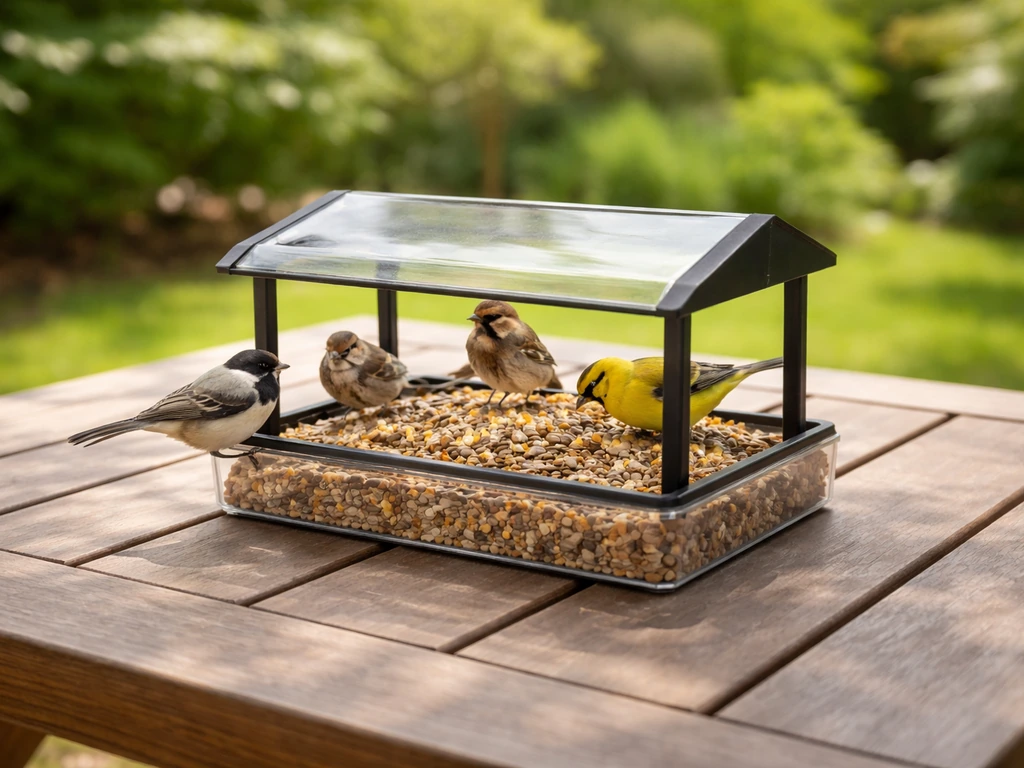
A tabletop bird feeder is exactly what it sounds like: a feeder small enough to sit on a patio table, deck railing, fence post, or any flat surface you already have. They come in every style you can imagine, from a simple open tray to a hopper with a roof to a compact tube feeder, and they're genuinely one of the most flexible options for anyone who wants birds close to their living space without committing to a full pole-and-baffle setup. If you're trying to figure out which type to buy, what to fill it with, and how to keep it clean and squirrel-free, here's everything you need.
Table Top Bird Feeder Guide: Choose, Place, and Fix Problems
Marcus Hendricks
6 May 2026
What a tabletop bird feeder is and where it works best
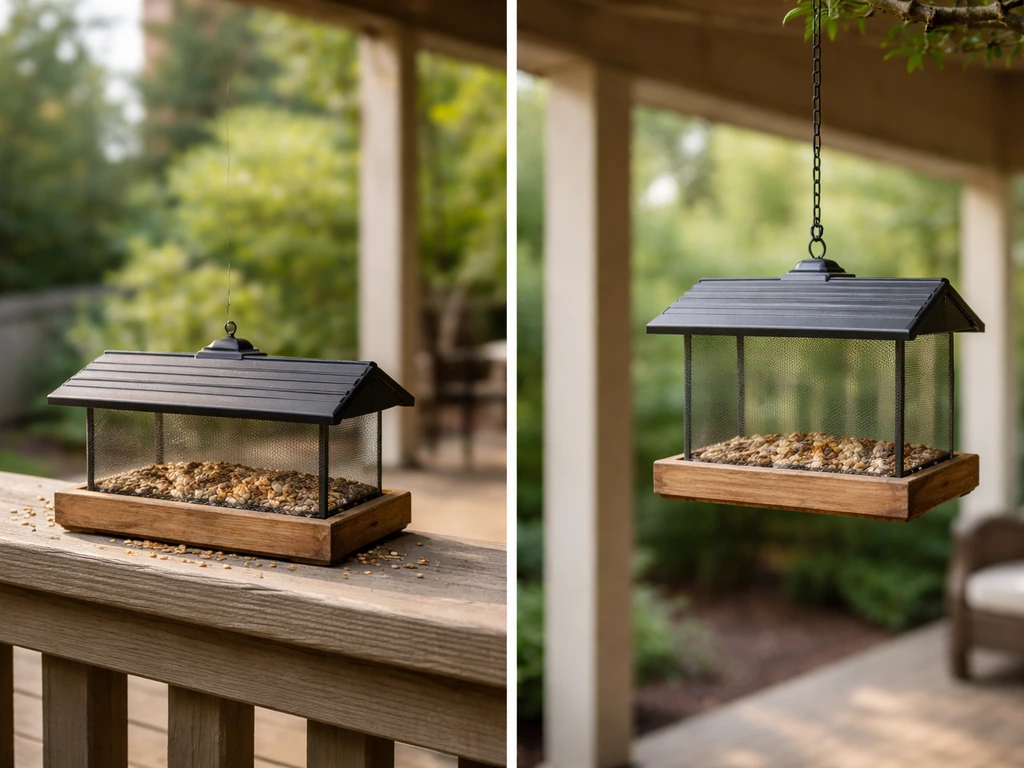
The defining feature of a tabletop feeder isn't its shape or seed type, it's the placement. Instead of hanging from a branch or mounting on a dedicated pole, it sits on a stable flat surface at whatever height your table or railing provides. That makes them ideal for patios, balconies, small urban gardens, and anyone who wants a feeder within easy arm's reach for filling and cleaning. They also work well for people who rent, since you're not driving stakes into the ground.
Where they shine: covered decks and patios where you can watch birds up close, balconies with a small bistro table, fence-top or railing placements that already put you at a good height, and indoor setups right against a window. Where they're less ideal: open lawns with no natural wind cover (seed dries out or blows off fast) and areas with heavy squirrel or raccoon pressure, since a feeder on a table is very easy for mammals to reach.
Choosing the right feeder type and food for your target birds
The feeder style you choose matters more than brand. Each type has a different relationship with seed, weather, and the birds it attracts. Here's how the main styles break down for tabletop use.
Platform (tray) feeders
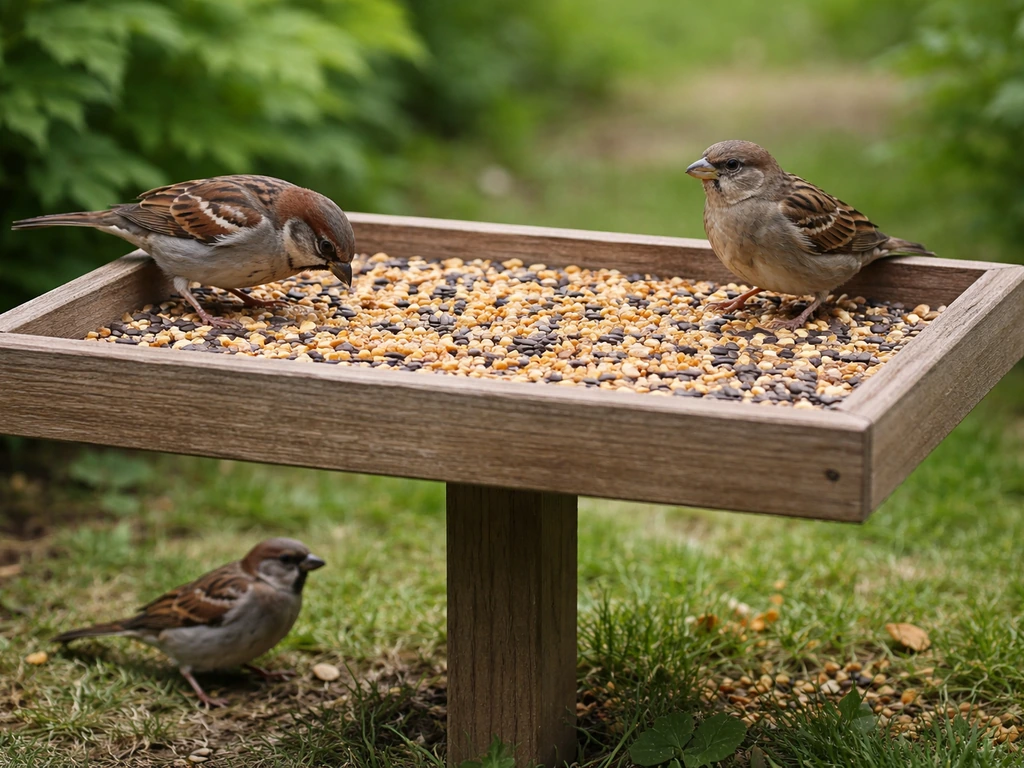
A platform feeder is a flat or slightly raised tray onto which you spread seed. It has no sides or roof, which means every bird can land on it, including ground-feeding species like doves, juncos, sparrows, and blue jays that normally won't perch on a narrow tube. The trade-off is that seed is fully exposed to rain and droppings, so you need to check it after every rain and clean it far more often than other styles. If you're a tray feeder fan, the best tray bird feeder designs add drainage holes in the base to prevent standing water and wet seed mold.
Hopper feeders
A hopper is essentially a platform with walls and a roof protecting the seed inside. Birds feed from the sides through openings, and the roof keeps most rain off. Hoppers hold more seed than open trays, stay drier, and work well for sunflower seeds and mixed blends. Cardinals, chickadees, nuthatches, and finches all use them readily. On a tabletop, look for hoppers that aren't too tall or top-heavy since they'll tip in wind more easily than on a pole.
Tube feeders
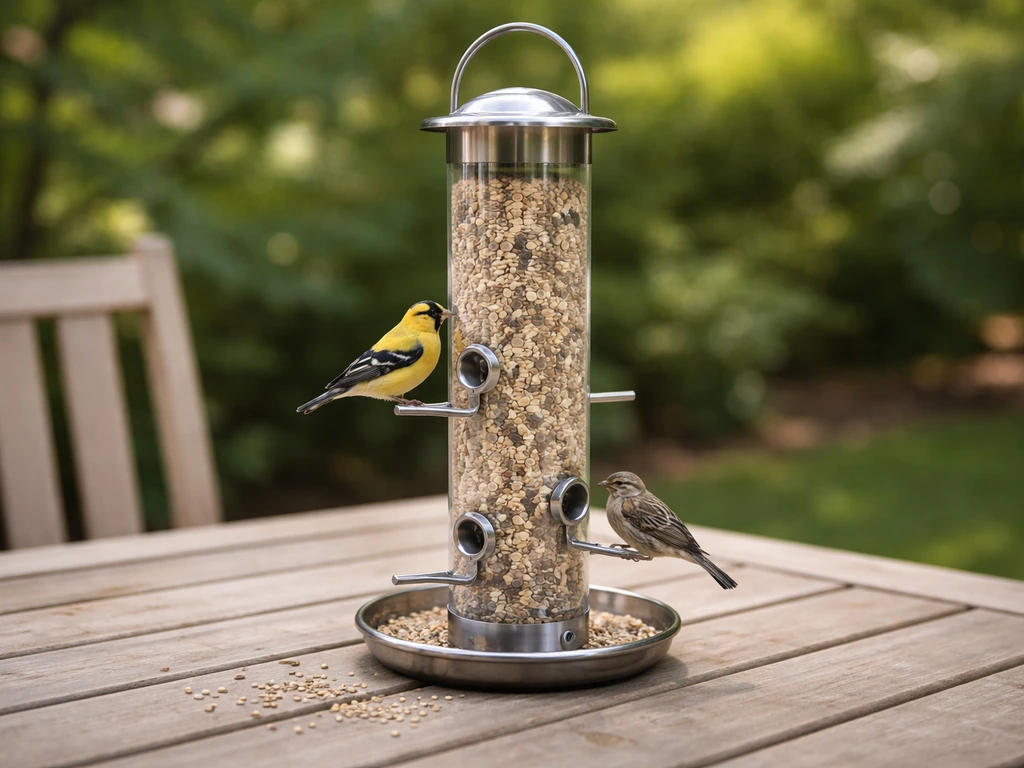
A tube feeder is a hollow cylinder with multiple feeding ports and perches. Port size matters: fine seeds like nyjer (thistle) need small ports so seed doesn't pour out, while black-oil sunflower needs wider ports. Some feeders offer 2-in-1 ports that handle both. Tube feeders work brilliantly for finches, chickadees, and titmice. On a tabletop, a small 4-6 port tube feeder is easy to manage and can be weighted at the base to prevent tipping.
Specialty feeders: suet, nectar, and fruit
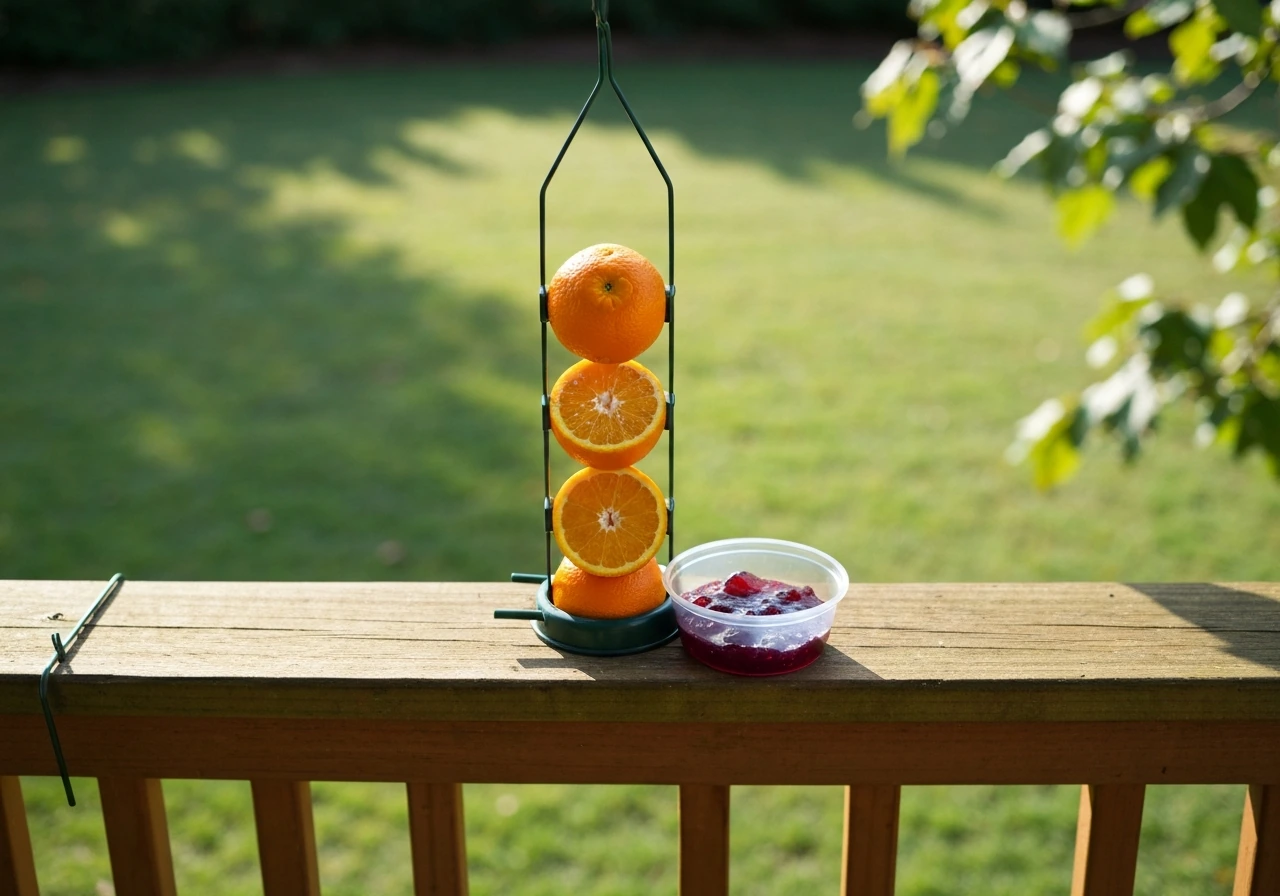
Suet cages can sit on or attach to a table edge and are great for woodpeckers, wrens, and nuthatches. Hummingbird nectar feeders designed for tabletop use are compact and usually bottle-style, and they need an ant moat (a small water-filled cup the feeder hangs from) to keep ants out of the nectar. Oriole and fruit feeders work on tables too, but fruit and nectar both attract bees and ants more aggressively than seed, so plan for that upfront.
| Feeder Type | Best For | Food Used | Weather Resistance | Mess Level |
|---|---|---|---|---|
| Platform/Tray | Doves, jays, sparrows, juncos | Mixed seed, sunflower, millet | Low (fully exposed) | High |
| Hopper | Cardinals, chickadees, finches, nuthatches | Sunflower, mixed blends | Medium (roof protects) | Medium |
| Tube | Finches, chickadees, titmice | Nyjer, sunflower chips | Medium-High | Low |
| Suet Cage | Woodpeckers, wrens, nuthatches | Suet cakes | Medium | Low |
| Nectar/Hummingbird | Hummingbirds | Liquid nectar | Low (must be shaded) | Medium (bees/ants) |
| Fruit/Oriole | Orioles, mockingbirds | Orange halves, jelly | Low | High (insects) |
Placement, height, and attracting specific species safely
Height is less critical for tabletop feeders than for hanging ones, but distance from windows is something you really need to think about. Bird strikes on glass are common near feeders. The safest option is to place the feeder either very close to the window (under 3 feet) so birds can't build up speed if they flush, or at least 10 feet away so they have enough room to spot the glass and avoid it. The dangerous middle ground is roughly 3 to 25 feet from a window. If you're stuck in that range, apply UV-reflective or frosted window decals to break up the reflection.
For attracting specific species, location relative to cover matters a lot. Cardinals prefer feeders near shrubs or low trees they can retreat to quickly. Juncos and doves like ground-level or low-table feeders with open space around them. Finches will use a tube feeder almost anywhere. Hummingbirds are drawn to red feeders placed in partial shade where nectar stays cooler and ferments more slowly. Woodpeckers prefer suet on a surface that lets them brace vertically, so a cage feeder at the table edge or attached to a post nearby works better than a flat tray.
Predator protection is real even at table height. Cats and squirrels can both jump onto a patio table easily. If you have outdoor cats nearby, position the feeder where birds have clear sightlines in multiple directions and aren't funneled into a corner. At minimum, the table should be away from furniture or fences a cat can use as a launch pad.
Key features to compare when buying
Weatherproofing
On a tabletop, your feeder is more exposed than a feeder hanging under a tree canopy. Hopper-style feeders with overhanging roofs do the best job shedding rain. Look for roof overhangs that extend at least an inch or two past the seed openings. UV-stabilized plastic or cedar wood holds up better than painted pine, which cracks and fades fast. Metal components should be powder-coated or stainless to avoid rust after winter and wet seasons.
Capacity
Bigger isn't always better on a tabletop. A feeder that holds more seed than birds can eat in 2 to 3 days in warm weather means the bottom seed gets wet, clumps, and molts. In summer, I'd rather have a smaller feeder I refill every other day than a huge hopper where half the seed goes bad. In winter, when birds consume more and cold air slows mold, you can get away with larger capacity.
Ease of cleaning
This is the feature most people underestimate until they're scrubbing dried millet out of a feeder with a toothbrush. Look for feeders that fully disassemble into flat or simple pieces. Wide openings you can fit your hand into are far easier to clean than narrow tubes. Smooth plastic interiors are easier to scrub than wood. If a feeder is dishwasher-safe, that's a genuine bonus.
Pest resistance
Squirrels can easily jump onto a tabletop, so a tabletop feeder on its own offers almost no squirrel resistance. Your options are: use a feeder with a weight-sensitive closing mechanism (designed so a squirrel's heavier weight closes off the seed ports), fill it only with seeds squirrels dislike (nyjer thistle is a good example, as squirrels typically ignore it), or accept that you'll lose some seed to squirrels and position accordingly. For insects, nectar feeders need an ant moat, and any feeder using fruit or jelly should be checked daily since those attract bees heavily.
Smart feeders and solar power
Camera-equipped smart feeders like Bird Buddy have become genuinely popular over the past few years. The built-in camera pairs with an app that uses AI to identify species and sends you alerts and photos of each visit. The solar-powered version (Bird Buddy PRO Solar) uses a solar roof panel so you're not constantly charging or running cables to a table. These feeders require a 2.4GHz Wi-Fi connection and don't store footage locally, so they only work if your outdoor Wi-Fi coverage is solid. If your patio is right next to your router, they're fantastic. If you're at the edge of your signal, you'll deal with constant disconnects. For a tabletop setup where the feeder is right outside a window or sliding door, this is usually fine.
How to fill, maintain, and prevent mess and spoilage
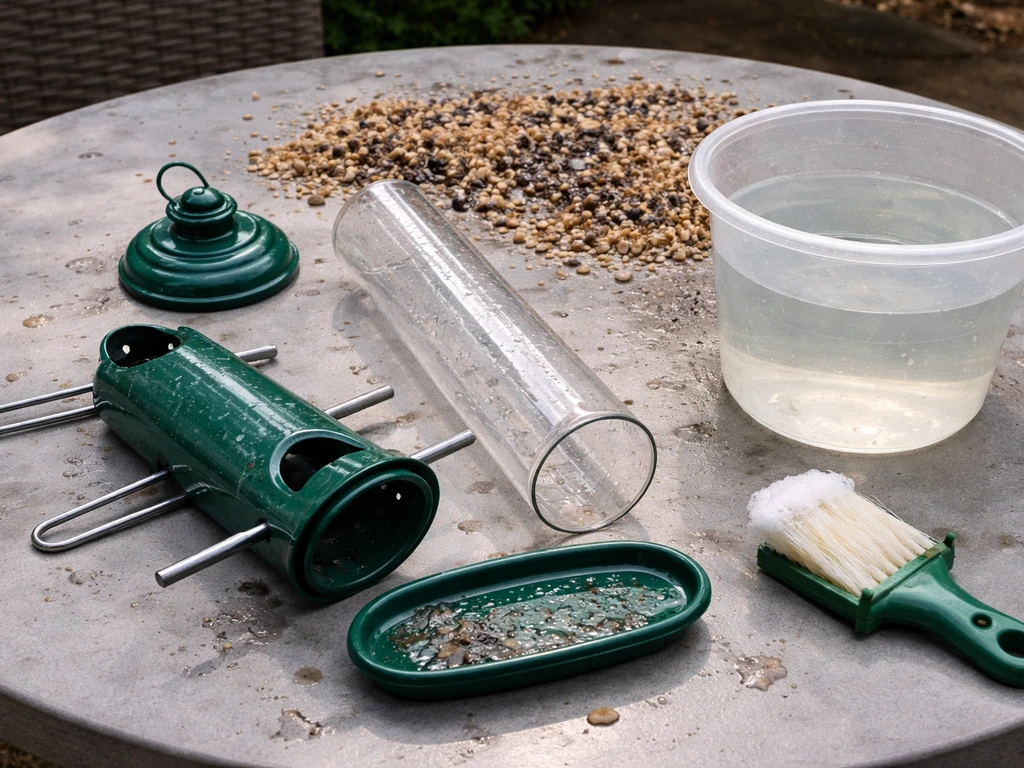
Cleaning is the part people do least often and matters most. Audubon recommends cleaning feeders at least every other week, more often in wet weather or if you notice sick birds, and every single time the feeder is emptied before refilling. That last part is the one most people skip. Old seed and hull dust left at the bottom of a feeder is where salmonella and other pathogens concentrate.
The cleaning method that works best: take the feeder fully apart, rinse off loose debris, then soak or scrub with a dilute bleach solution. The right ratio is no more than 1 part bleach to 9 parts water. Rinse thoroughly afterward, and here's the step that really matters: let the feeder dry completely before adding new seed. A damp feeder molds new seed within days. In summer I usually clean on a sunny morning and leave pieces out to air dry for a few hours before reassembling.
Don't forget the ground below. Spilled seed and bird droppings under the feeder accumulate fast, especially on a patio table or deck. Brush or vacuum them off every few days. Leaving wet hulls and droppings on a wooden deck causes staining and mold. A seed tray or catch-tray accessory under the feeder helps a lot and also reduces seed waste.
For filling, match the seed to the season and species. Black-oil sunflower is the best all-around seed for most songbirds year-round. Nyjer is best for goldfinches and siskins. Safflower deters squirrels and starlings and appeals to cardinals. Avoid cheap mixes with lots of red millet, wheat, or oats since most desirable backyard birds ignore those and they just pile up and rot. In winter, add a suet cake nearby for fat and protein, which birds need more of in cold weather.
Troubleshooting pests and common problems
Squirrels
A feeder sitting on a table is about as easy to reach as a squirrel buffet gets. Your best bets: switch to nyjer or safflower (squirrels rarely touch them), choose a feeder with a squirrel-defeating weight-closing mechanism, or move the feeder to a pole with a proper squirrel baffle. On a patio, you can also try a cayenne-treated seed blend since birds don't detect capsaicin but squirrels dislike it. This won't completely stop determined squirrels, but it reduces their interest.
Ants and bees
Ants are a major problem at nectar feeders. An ant moat, a small cup of water mounted above the feeder that ants can't cross, is the most effective solution. Keep the moat filled with water and clean it weekly so it doesn't become a mosquito breeding spot. Bees are attracted to both nectar and fruit feeders. Bee guards over the nectar ports help, but if bees are swarming the feeder in large numbers, temporarily take it down for a day or two since bees don't learn to wait like birds do.
Mold and wet seed
This is the most common problem with tabletop feeders because they're often in more open, exposed spots. Signs of mold: seed clumping together, a musty smell, or seed that looks darker than usual at the bottom. Fix it by cleaning the feeder immediately (bleach solution, full dry before refilling) and switching to smaller fills so seed is eaten within 2 to 3 days. In rainy weeks, check daily.
Window strikes
If birds are hitting your windows after flushing from a nearby tabletop feeder, the first fix is placement. Move the feeder to either under 3 feet from the glass or beyond 10 feet. If that's not possible, add window decals, frosted film, or external screens. Even moving the feeder a foot to one side can change the angle birds launch from and reduce strikes.
Birds not coming
Give a new feeder at least 2 weeks before worrying. Birds need time to discover a new food source. Make sure the seed is fresh (old seed smells off and birds avoid it), that the feeder is visible from the air (not buried under a canopy), and that there's some cover nearby for birds to retreat to when spooked. If nothing visits after a month, try adding a birdbath nearby since water attracts birds faster than almost anything.
DIY tabletop feeder ideas and when to upgrade
A DIY tabletop feeder can be as simple as a ceramic or terracotta saucer placed on a flat surface with seed spread across it. This works fine for ground-feeding birds like doves and sparrows, costs almost nothing, and is easy to clean. Drill a drainage hole if you use a deep saucer so water doesn't pool. A step up: use a repurposed wooden tray or shallow bin with drainage holes drilled in, sanded smooth, and given a coat of non-toxic sealant. These make decent platform feeders with a bit more capacity.
For something closer to a proper tabletop hopper, you can build a small cedar box with a plexiglass or acrylic roof and seed openings cut at the sides. Cedar is naturally rot-resistant and weathers well. Keep it simple: the more complex the design, the harder it is to clean, and cleaning is where most DIY feeders fail long-term.
Know when to stop DIY-ing and just buy a purpose-built feeder. If you're dealing with persistent mold issues (a manufactured feeder with drainage and tight-fitting parts almost always outperforms a homemade tray in this regard), or if you want smart camera features, solar power, or genuine squirrel resistance from a weight mechanism, those are not easy to replicate at home. Similarly, if you want a flip-top or screw-top design for fast, clean refilling without spilling, manufactured feeders have that built in and it genuinely speeds up the maintenance routine. A common upgrade is switching to screw top bird feeders, which let you open and close the seed container quickly for cleaner refills. A gardman flip top bird feeder is one example of a manufactured design that’s made for quick, mess-free refilling and easier maintenance flip-top or screw-top design.
If you find yourself wanting more shelter for seed without committing to a full platform setup, a dome-top feeder design offers a nice middle ground, keeping rain off while still giving birds easy access from all sides. A bird feeder dome top is essentially a tabletop hopper-style option that uses a rounded roof to keep seed drier than open trays dome-top feeder design. And if your focus eventually shifts toward more dedicated bird feeding stations, exploring a proper tray bird feeder on a pole with a baffle gives you all the tabletop benefits with real squirrel protection built in.
The honest bottom line: start with whatever style matches your target birds and your cleaning commitment. A hopper or tube feeder on a railing is the most practical all-weather tabletop setup for most people. Keep the seed fresh, clean the feeder every two weeks minimum, and place it thoughtfully relative to your windows. Do those three things and you'll have active, happy birds at your table within a few weeks.
FAQ
How can I choose a table top bird feeder that is actually easy to refill without spilling seed?
Before you buy, check whether the feeder uses a sliding seed door or a screw-top container. Tablet feeders that only rely on a lid with a loose seal can leak hull dust and get messy during refills, especially on deck railings where you tip the feeder slightly.
What should I do if my table top bird feeder keeps getting wet or the seed clumps?
If you notice water pooling or seed clumping, the fix is not just “clean more,” it is to switch to a model with drainage holes (for platform styles) or an overhanging-roof design with protected openings (for hopper styles). Without drainage or roof overhang, wet seed keeps cycling back into the mix even after you empty it.
Can I fill one table top bird feeder with a mixed seed blend year-round?
Mixing seed types is fine for many hopper and tube feeders, but do not blend fine seeds like nyjer with blends meant for larger ports. Nyjer needs small ports to prevent spillage, and ports that are too wide will cause waste, mess, and faster contamination.
How do I reduce ants and bees around table top nectar or fruit feeders?
When insects are a problem, treat nectar or fruit differently than seed. For nectar, an ant moat and daily checks help; for fruit, shorten the visit window (top up small amounts) and remove leftovers within 24 hours to reduce bees and wasps.
The feeder is already placed near my window, but birds still hit the glass. What else can I change?
Bird strikes often happen because birds flush toward cover, then hit glass at the same launch angle repeatedly. Even if the feeder is “far,” small changes help, try moving it a foot to the side, lowering it slightly, or adding an external screen or net so birds see the surface as a barrier.
Why do birds visit briefly and then stop coming to my table top bird feeder?
Yes, but set expectations. Table top feeders may not attract large numbers if there is no nearby escape cover. Add a small shrub, dense plant pot nearby, or place the feeder so birds can reach a branch or railing within a few seconds after landing.
Do I need a catch tray under a table top bird feeder, and how often should I clean it?
Consider a drip-edge or catch-tray accessory, then empty it on a schedule. Seed hulls and droppings trapped under the feeder become moldy, and on wood decks they can stain. A simple tray also makes cleaning faster and reduces seed waste.
Is it okay to use larger capacity on a table top bird feeder in winter?
For winter, prioritize frequent dry inspection over “bigger storage.” Cold slows spoilage, but wet snowmelt and condensed humidity still cause mold. Keep seed sheltered with a roof style, and refill smaller batches that get eaten in 2 to 3 days.
I cleaned the feeder, but mold comes back quickly. How do I prevent repeat problems?
If you get mold, stop using the seed immediately, clean, fully dry, and then switch the feeder style or roof coverage. Open platform feeders in rainy weather will usually relapse unless you either change placement to more sheltered areas or move to a hopper/dome design with protected openings.
What is the most effective way to clean a table top bird feeder without missing the problem spots?
Avoid harsh “spot cleaning” that leaves residues inside corners and port edges. If the feeder fully disassembles, take it apart and ensure all parts dry completely before reloading, damp plastic or damp wood inserts are a common cause of renewed contamination.
How should I place a table top bird feeder if outdoor cats are around?
Yes, but do it strategically. If you have outdoor cats, place the feeder so birds have clear escape paths rather than a single corner, and avoid putting it directly beside a wall or fence where a cat can ambush. A multi-direction sightline setup reduces the chance birds land and freeze in place.
What are the best practical ways to stop squirrels from taking a table top bird feeder?
If squirrels keep emptying the feeder, switch away from purely open trays and toward weighted closing or smaller port designs. Also avoid placing the feeder where squirrels can gain momentum, like stacking items near the table or placing it flush against a surface that provides a launch point.
Next Article
Best Oriole Bird Feeders: Buying, Setup, and Tips
Choose the best orioles feeders and set up jelly or nectar for backyard success, with pest-proofing and troubleshooting.