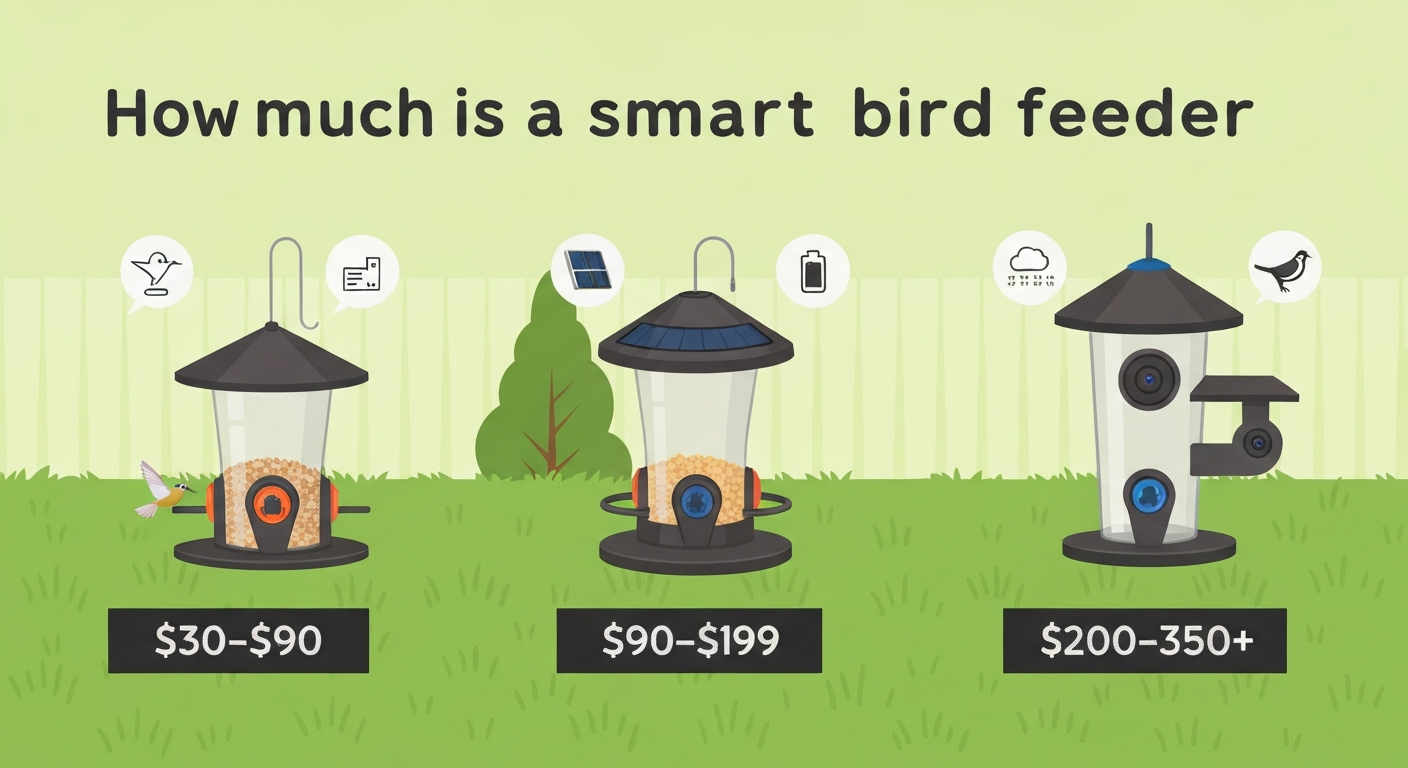
Smart bird feeders typically cost between $30 and $350 depending on camera quality, AI features, and power source. Budget models with basic Wi-Fi cameras run $30 to $90, midrange feeders with better optics and some AI land between $90 and $199, and premium options with 4K cameras, solar roofs, and advanced species recognition push $200 to $350 or more. On top of the purchase price, many models charge monthly or annual subscription fees for cloud storage and AI identification, which can add $30 to $100 per year to your running costs.
How Much Is a Smart Bird Feeder: Costs, Tiers & Tips

Marcus Hendricks
23 Jul 2026
Who this guide is for and what you'll find here
If you're trying to figure out whether a smart feeder fits your budget before you buy, or you already own one and want to understand what the ongoing fees will actually look like, this is the guide for you. I'll walk through every price tier with real model examples, break down which features actually drive the cost, show you a sample total cost of ownership calculation for each tier, and flag where subscriptions and AI extras quietly inflate the long-term price. I'll also cover DIY alternatives, winter considerations, and what kind of warranty and support you can realistically expect. Whether you're shopping for a window feeder, a pole-mounted seed setup, or a hummingbird camera feeder, the numbers and trade-offs here apply directly.
Price ranges at a glance
These bands reflect actual street prices and sale prices I've seen in summer 2026. MSRP is often inflated and models frequently go on sale during Prime Day and holiday promotions, so treat the lower end of each range as what you can realistically pay if you're patient.
- Budget ($30–$90): Basic 1080p or 2K Wi-Fi camera feeders, often solar-included on some SKUs, limited or no AI species ID, minimal app features, plastic construction.
- Midrange ($90–$199): Better camera quality (2K standard), improved AI species recognition, more reliable app ecosystems, hybrid solar and battery power, sturdier materials.
- Premium ($200–$350+): 4K cameras, portrait or multi-lens modes, on-device or advanced cloud AI, solar roof kits, metal or high-grade weatherproof housings, stronger warranty support.
Budget vs. midrange vs. premium: a direct comparison
| Tier | Example Models | Typical Price (2026) | Camera | AI Species ID | Power | Subscription Needed? |
|---|---|---|---|---|---|---|
| Budget | SOLIOM BF08, HARYMOR, Generic 2K Amazon models | $30–$90 | 1080p–2K | Basic or none | Solar + battery on some SKUs | No, but limited features |
| Midrange | NETVUE/Birdfy standard, SOLIOM metal/solar editions | $90–$199 | 2K | Yes (app subscription optional) | Solar + 5,200 mAh battery | Optional (~$57–$80/yr for full AI) |
| Premium | Bird Buddy Pro, Kiwibit 4K/Beako | $199–$350+ | 2K–4K, multi-lens | Advanced, portrait mode | Solar roof + large battery (up to 9,000 mAh) | Often yes (~$70–$100/yr) |
A few notes on these examples: the Bird Buddy Pro commonly retails around $199 but frequently drops to $160–$189 on sale. Chewy lists the Bird Buddy Pro Solar around $199 (Bird Buddy PRO Solar listing, Chewy (retail price snapshot)) Bird Buddy PRO Solar listing — Chewy (retail price snapshot). The Kiwibit 4K has an MSRP around $269 and often gets discounted in promotional windows. NETVUE/Birdfy single-lens models typically sit around $119.98–$159.99 depending on the SKU and retailer. SOLIOM models vary widely by version, with basic units under $70 and metal solar editions creeping toward $130.
What actually drives the price
When I look at two feeders sitting at $69 and $269 respectively, the gap isn't random. Here's where the money goes, line by line.
Camera resolution and frame rate
Most budget feeders shoot 1080p video, which is fine for identifying common backyard birds but blurry when a wren moves fast or lighting is poor. Midrange models standardize on 2K, which is a meaningful improvement. Premium models like the Kiwibit 4K push to true 4K resolution, and the Bird Buddy Nature Cam Pro claims up to 120 fps, which matters when you're capturing fast wing movement. Higher resolution sensors cost more to manufacture and require more processing power, both of which land in the price.
Connectivity and subscription model
All consumer smart feeders currently use 2.4 GHz Wi-Fi as the primary connection (some use Bluetooth for initial setup only). The connectivity hardware itself is cheap. What you're really paying for in this category is the cloud infrastructure behind it. Every brand structures this differently. Birdfy's app offers tiered in-app purchases: bird recognition runs roughly $5.89–$7.99 per month or $57.99–$79.99 per year, and cloud video recording (MVR) adds another $2.39–$8.99 per month depending on the tier. Bird Buddy's premium membership has been cited by users and press around $69. Tech news coverage notes Bird Buddy has marketed a paid premium membership around $69.99 per year, with some family or higher-tier plans reported closer to $100 per year Bird Buddy premium plan pricing. 99 per year, with family or higher-tier plans reaching roughly $100 per year. If you skip the subscription, you usually get live view and basic motion alerts but lose species ID history, longer clip archives, and highlight reels.
Power source
A feeder that includes a solar panel costs more upfront but saves you from constantly pulling the unit inside to charge. Budget feeders often include a small solar panel on certain SKUs but use a modest battery. Midrange Birdfy/Netvue models typically ship with a 5,200 mAh battery and a solar panel, which in my experience gets through a busy migration week without needing a charge if you have reasonable sun. The Pro variants list up to 9,000 mAh, which makes a real difference in winter when solar input drops. USB-C wall charging is the alternative, and all manufacturers recommend it as a backup.
Materials and build quality
Budget feeders are almost always plastic, which means UV degradation over a few seasons, cracking in cold climates, and warping in direct sun. Midrange models mix plastic with metal reinforcement, particularly around the mounting hardware and camera housing. Premium feeders more often use coated metal or high-grade weatherproof polymers designed to hold up through multiple winters. This isn't just aesthetics: a feeder that cracks or fogged its camera lens by year two is not a value purchase regardless of its initial price.
Pest-proofing and weatherproofing
Neither feature is standard on budget smart feeders. You're mostly getting a camera in a seed hopper at that price point. Midrange feeders may include a roof overhang and basic moisture protection, but dedicated squirrel baffles, weight-sensitive perch mechanisms, and IP-rated weatherproofing are more common at the premium end. If pest-proofing is a priority for your setup, factor in the cost of a separate baffle or pole system (typically $15–$40) regardless of which smart feeder you choose.
Mounting and hardware
Most smart feeders ship with either a hanging hook or a basic suction cup for window mounting. Pole-mounted setups typically require a separate pole system, which adds $20–$60 depending on whether you want a single pole or a multi-arm setup with a baffle. Window mounting is simple but limits where the camera can point. If you're doing a pole-mounted seed feeder setup, budget for the hardware separately since it's rarely included even in premium kits.
Upfront vs. ongoing expenses: what to expect
Purchase day is straightforward: you pay the product price plus any accessories like a solar roof add-on, replacement battery, or mounting pole. What catches people off guard is the subscription layer that reveals itself after setup. Here's how to think about both buckets.
| Expense Category | Budget Tier | Midrange Tier | Premium Tier |
|---|---|---|---|
| Initial feeder cost | $30–$90 | $90–$199 | $199–$350+ |
| Solar panel/roof (if not included) | $15–$40 | Often included | Often included or $20–$50 add-on |
| Mounting pole/hardware | $0–$60 (optional) | $0–$60 (optional) | $0–$60 (optional) |
| Replacement battery (year 2–3) | $10–$25 | $15–$30 | $20–$40 |
| AI/species ID subscription (annual) | $0 (basic only) | $0–$80/yr | $0–$100/yr |
| Cloud storage/video subscription (annual) | $0 (local SD only) | $29–$96/yr | $29–$120/yr |
| Seed (annual, varies by traffic) | $50–$150 | $50–$150 | $50–$150 |
One thing I always recommend: before you commit to a model, download the app and look at the in-app purchase page in the App Store or Google Play. The feature-to-subscription mapping changes frequently, and some brands gate things like extended clip length or multi-feeder support behind paid tiers that aren't obvious at the time of purchase.
Sample total cost of ownership over three years
These calculations use realistic purchase prices (not inflated MSRP), include a subscription at the mid-tier level for models that offer them, and add seed and one minor maintenance item like a battery replacement in year two. Mounting hardware is excluded since it varies so much by setup.
| Cost Item | Budget (3 Years) | Midrange (3 Years) | Premium (3 Years) |
|---|---|---|---|
| Initial feeder purchase | $60 | $140 | $250 |
| Solar panel (if separate) | $25 | $0 (included) | $0 (included) |
| AI species ID subscription (x3 yrs) | $0 | $180 ($60/yr avg) | $210 ($70/yr avg) |
| Cloud storage subscription (x3 yrs) | $0 (SD card only) | $90 ($30/yr avg) | $135 ($45/yr avg) |
| Battery replacement (once) | $15 | $20 | $30 |
| Seed (x3 yrs at $80/yr) | $240 | $240 | $240 |
| TOTAL (approx.) | $340 | $670 | $865 |
The gap between budget and premium is roughly $525 over three years in this model. Whether that gap is worth it depends entirely on how much you use the AI and camera features. A budget feeder with a local SD card and no subscription delivers real value if you just want to capture bird visits and identify species manually. If you want species ID pushed to your phone automatically and a searchable cloud archive of visits, the midrange or premium subscription models earn their cost. It's also worth noting that a budget feeder replaced every 18–24 months due to weather damage can easily eclipse the cost of a well-built midrange model that lasts five-plus years.
How subscriptions, AI features, and cloud storage change your long-term costs
This is where smart feeders diverge most sharply from traditional feeders, and it's worth being honest about the math. The subscription model is not a one-time fee. It compounds annually, and the features it unlocks vary considerably between brands.
Birdfy's tiered approach splits AI bird recognition and cloud video recording into separate subscriptions. You could end up paying $7.99 per month for recognition and another $3.59 per month for basic video storage, which totals roughly $138 per year if you subscribe to both at that level. Their annual bundles bring this closer to $80–$110 per year, which is still significant over three years. Bird Buddy's premium plan hovers around $69.99 per year based on user reports, with higher family tiers cited closer to $100 annually.
Some manufacturers offer lifetime AI bundles at checkout or as an upgrade. Kiwibit, for example, has been seen promoting optional lifetime AI packages alongside their premium SKUs. If you plan to use a feeder for five or more years, a lifetime AI license can be cheaper than paying annually. Run the math before dismissing it: two years of a $70 annual plan equals $140, so a $100 lifetime option pays off quickly.
One practical workaround is local SD card storage. Most smart feeders support a microSD card (typically 32GB–128GB), which stores video locally without any recurring fee. You lose the cloud archive, remote access to past clips, and automatic AI logging, but if your goal is just watching birds on demand from nearby, it's a legitimate zero-subscription path. This is actually the approach I'd recommend for anyone primarily using the feeder as a camera from home rather than checking it remotely.
It's also worth keeping an eye on what the free tier actually includes. Most apps give you live view, real-time motion alerts, and a short clip history for free. That's a usable experience for casual watchers. The paid tiers add longer video archives, species recognition accuracy improvements, unlimited feeder profiles, and sharing features. If you're just starting out, use the free tier for a month before committing to any subscription to see whether the paid features actually change how you use the app.
Are smart bird feeders worth it? Community and practical take
This question comes up constantly, including in birding forums and Reddit threads where experienced backyard birders are often skeptical of the value proposition. The honest answer is: it depends on how you feed birds. Read our detailed take on whether smart bird feeders are worth it are smart bird feeders worth it. If you're already deeply engaged with identifying species, the AI ID feature is genuinely useful and saves real time versus looking up every visitor manually. If you mostly want to enjoy birds in the garden and don't need a digital log, a great traditional feeder at $30–$60 will outperform a mediocre smart feeder at $150 in terms of actual bird traffic.
Community feedback consistently flags a few pain points: app reliability varies significantly between brands, some AI species ID is overconfident on difficult identifications, and subscription pricing has increased for some brands since initial launch. The feeders with the strongest community reputations tend to be those with responsive manufacturer support and stable app updates. Checking recent Reddit threads and app store reviews for the specific model you're considering is genuinely useful research, not just a nice-to-have step. Search 'best ai bird feeder reddit' to see long-running community discussions comparing models and subscriptions.
For specific use cases, here's where smart feeders add the most value: hummingbird feeders benefit from camera monitoring because hummingbirds visit briefly and unpredictably, so a motion-triggered camera captures visits you'd miss entirely. Window feeders are natural candidates because you're already watching from up close and can use the camera to share footage easily. Pole-mounted seed feeders benefit least from smart features in my experience because you can observe those birds directly from most windows without needing a dedicated camera.
DIY and lower-cost alternatives
You can build a reasonably capable camera bird feeder setup for $40–$70 by pairing a budget traditional feeder ($10–$20) with a dedicated wildlife or security camera ($25–$50) pointed at it. For specific low-cost recommendations and model comparisons, see our guide to the best budget smart bird feeder. You lose the integrated app experience, automatic species ID, and the aesthetic of a purpose-built unit, but you gain flexibility in camera placement and avoid any subscription fees. Some birders in Reddit communities prefer this route specifically because it decouples the camera hardware lifespan from the feeder lifespan. When the camera needs replacing, you replace the camera. When the feeder gets dirty or damaged, you replace the feeder. No single point of failure.
Winter feeding and seasonal cost notes
Winter is when smart feeder ownership gets more expensive and more complicated. Solar panels generate significantly less power in short winter days, especially in northern climates, so you'll be charging more frequently via USB-C. Cold temperatures also reduce lithium battery capacity noticeably: a 5,200 mAh battery that lasts two weeks in summer may need charging every four to five days in January. If you're using a smart feeder year-round, a model with a 9,000 mAh battery or a reliable solar roof is a practical investment rather than a luxury. Seed consumption also spikes in winter as birds increase feeding frequency, so factor $20–$40 in additional seed costs per winter month depending on your region and bird traffic.
Warranty, support, and realistic lifespan
Smart feeder warranties are short by outdoor electronics standards. Most brands offer a one-year limited warranty covering manufacturing defects, and a handful offer 18-month coverage. What this means practically is that if your camera module fails in month 14, you're likely paying out of pocket for a replacement. I've seen this come up repeatedly in user reviews, particularly for models in the $100–$150 range where the camera hardware is working hard in outdoor conditions without premium weatherproofing.
Realistic lifespan estimates depend heavily on climate and build quality. In mild climates with covered placement, a well-built midrange or premium feeder should last four to six years before the camera degrades meaningfully or the housing becomes brittle. In harsh climates with freeze-thaw cycles, direct sun exposure, and high humidity, budget plastic feeders often show significant wear by year two. The camera sensor tends to outlast the feeder body in most cases, with lens fogging being the most common failure mode after extended outdoor exposure.
App and cloud support is a separate longevity risk that doesn't get discussed enough. Smart feeders depend on manufacturer-maintained app ecosystems and cloud servers. If a brand discontinues or pivots, the smart features stop working even if the feeder hardware is physically fine. This is a real concern for smaller brands and has happened in the broader smart home camera market. Brands with larger user bases and established revenue from subscriptions (like Birdfy/Netvue and Bird Buddy) are more likely to maintain their ecosystems long-term, but it's not guaranteed. Local SD card storage becomes more valuable as a hedge against this scenario.
When evaluating support quality before buying, I look for three things: active app updates within the last 90 days, a responsive customer service track record in app reviews, and a manufacturer community (Discord, Facebook group, or subreddit) where users actually get answers. Models with strong community ecosystems tend to get firmware improvements and bug fixes faster than those without.
Buying checklist before you commit
- Set a three-year budget, not just a purchase price. Include the subscription tier you actually want and realistic seed costs.
- Download the app before buying and check the current in-app purchase page for subscription pricing.
- Check the battery capacity and whether a solar panel is included in the specific SKU you're buying, not just in some versions of the model.
- Confirm the camera resolution and whether AI species ID is free, subscription-only, or a one-time unlock.
- Look at app store reviews from the last 90 days for connectivity complaints and update frequency.
- Check whether the feeder supports a microSD card if you want a no-subscription local storage option.
- Factor in mounting hardware costs separately, especially for pole-mounted setups.
- If you're in a cold climate, verify battery size and solar panel wattage are adequate for winter use.
- Look at warranty terms and what's actually covered before purchase, not after.
FAQ
What are realistic price ranges for smart bird feeders in 2026 (budget, midrange, premium)?
Typical retail bands (street prices vary with sales): budget about $30–$90; midrange about $90–$199; premium $200–$350+ (some premium SKUs list higher MSRP but are often discounted). These ranges reflect common consumer models and sale pricing seen in 2026.
What features most strongly drive a smart feeder's price?
Primary cost drivers: camera quality (resolution, frame rate, low‑light sensor), connectivity & cloud/AI (on‑device vs cloud processing and subscriptions), power system (built‑in battery size, solar roof included or optional), materials & build (metal vs plastic, capacity), pest‑proofing (squirrel guards, metal ports), weatherproofing (IP rating, seals), and mounting/hardware (pole kits, window mounts, integrated perches). Higher specs or bundled accessories raise MSRP.
Can you show a concise price comparison table for typical models by tier?
Price comparison (representative examples, sale prices vary): - Budget: SOLIOM BF08 $39–$69; HARYMOR camera feeders $69–$90 - Midrange: NETVUE / Birdfy feeder $119–$159; SOLIOM metal/solar editions $60–$130 - Premium: Bird Buddy Pro $199–$299; Kiwibit 4K models ~$269 MSRP These are sample listings and reflect common retail/sale ranges in 2026—not guaranteed prices.
What additional recurring costs should I expect (subscriptions, cloud, accessories)?
Common recurring costs: optional AI species recognition subscriptions (~$5–$8/month or $58–$80/year), cloud/video storage tiers (~$2–$9/month depending on retention), replacement batteries or solar accessories (one‑time, varies by brand), and periodic maintenance (cleaning supplies, feeder seed refills). Many vendors separate free core features (live view, basic alerts) from paid features (long clips, AI ID, extended cloud). Check each app's in‑app purchase list for exact pricing.
Please provide sample total cost of ownership (TCO) calculations for 1 year across tiers.
Sample 1‑year TCO (initial + one year recurring estimate, rounded): - Budget feeder: $60 initial (mid‑budget) + $0–$30 accessories + $0 subscription = $60–$90 - Midrange feeder: $140 initial + $20–$50 accessories + $36–$72/year subscription = $196–$262 - Premium feeder: $260 initial + $30–$80 accessories + $58–$80/year subscription = $348–$420 These examples use typical sale prices and common subscription tiers (see vendor app listings). Adjust for local sales or added mounting hardware.
Which models are good recommendations by tier and by use case (seed, hummingbird, window, pole‑mounted)?
Practical, commonly cited picks (examples from 2026 listings): - Best budget smart bird feeder: SOLIOM BF08 or HARYMOR camera feeder — good for general seed feeders and basic camera viewing, often solar included - Best midrange: NETVUE / Birdfy standard feeders — good all‑around (seed feeders, pole or hanging), solid camera 1080p–2K and optional cloud/AI - Best premium: Bird Buddy Pro or Kiwibit 4K — better camera fidelity, improved low‑light and AI options; suited to enthusiasts wanting species ID and high‑quality photos - Hummingbirds: look for nectar/hummingbird‑specific feeders with camera compatibility (many manufacturers sell dedicated nectar ports or compatible mounts) - Window feeders: choose window‑mount SKUs or feeders with short focal length/portrait camera modes (Birdfy/Bird Buddy offer window‑friendly variants) - Pole‑mounted: metal, weatherproof bodies with pole kits (midrange to premium typically include or offer compatible mounting hardware) Always verify the SKU supports the intended mounting and feeder type.
Next Article
Best Bird Feeder for Baltimore Orioles: Buyer Guide
Choose the best bird feeder for Baltimore orioles: styles, features, placement tips, and fixes for heat, pests, and acce