
A screw-top bird feeder is exactly what it sounds like: the reservoir is sealed by a threaded cap you unscrew to fill and screw back down to seal. That single design choice makes refilling cleaner, reduces spillage, and keeps moisture out better than most hinged-lid alternatives. If you've ever tipped a flip-top feeder and watched seed cascade across the patio, you'll immediately appreciate why the threaded seal exists. For an alternative design, a flip top bird feeder (item 6f3fa145-b8c7-4676-827b-a2e2923d5459) uses a hinged lid that flips open rather than a threaded screw cap.
Screw Top Bird Feeders: Choosing, Installing & Maintaining

Marcus Hendricks
14 Jul 2026
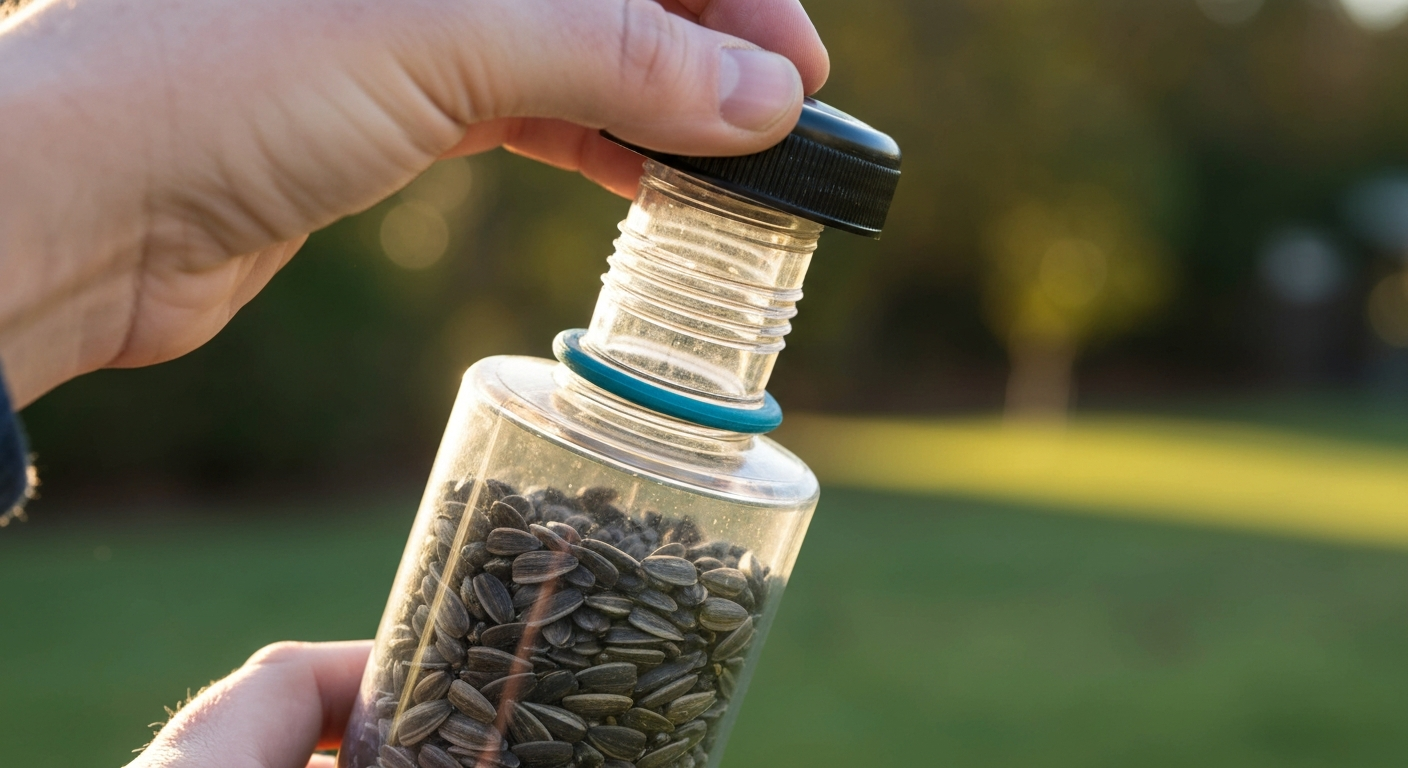
What exactly is a screw-top bird feeder?
A screw-top bird feeder is a seed or nectar feeder whose reservoir is closed at the top (or base, in some nectar designs) by a threaded cap that forms a sealed closure when fully tightened. The threading compresses a gasket or sealing surface against the reservoir opening, preventing leaks and blocking moisture entry. This is the same basic principle Perky-Pet uses on their Crystal Top-Fill hummingbird feeder line, where the instructions literally say 'unscrew cap to fill, screw cap back on securely to form an airtight seal.' The design is most common in tube feeders and nectar feeders, though screw-cap assemblies also appear as purpose-built bottle-cap hardware that converts a standard bottle into a feeder (more on that in the section on bottle-top kits below).
How the screw-top mechanism actually works
The core engineering is straightforward. The reservoir's fill opening has molded or machined threads. The cap has matching internal threads and usually incorporates a rubber or silicone gasket seated in a channel on the underside. When you rotate the cap clockwise, the threads pull it down and compress the gasket against the reservoir rim, forming a seal that blocks air and liquid exchange. Unscrew it counter-clockwise, the compression releases, and you have full access to pour in seed or nectar.
On nectar feeders, the engineering goes a step further. Several patented top-fill designs (including mechanisms described in US patent US8522717) add a biased sealing rod or actuator inside the reservoir. When the cap is in place and tightened, the cap depresses the rod to open a small valve, allowing nectar to flow to the ports. Remove the cap and the spring-loaded rod closes the valve automatically, so nectar doesn't free-flow all over you during refilling. It's a clever solution that makes top-fill hummingbird feeders genuinely less messy than inverted-bottle designs.
For seed tube feeders, the mechanism is simpler: no internal valve, just a cap that seals the fill opening. Some designs include a ventilation channel or small drainage holes molded into the base to prevent moisture buildup inside the tube, which would otherwise cause seed to clump and bridge across the ports.
The real advantages (and honest drawbacks)
Where screw-top feeders genuinely shine
- Spillage control: the threaded seal stays closed under vibration, wind, and squirrel jostling far better than a friction-fit lid
- Moisture resistance: a compressed gasket keeps rain from entering the reservoir from the top, which directly reduces mold and seed spoilage
- Nectar leak prevention: on hummingbird feeders, the sealed top eliminates the drip-and-attract-ants problem common with open-top reservoir designs
- Tamper resistance: a fully threaded cap requires deliberate rotational force to open, which most squirrels and raccoons cannot easily produce
- Cleaner refilling: you fill from the top into a stable, upright reservoir rather than inverting a bottle or juggling a hinged lid one-handed
Drawbacks worth knowing before you buy
- Glove-unfriendly in winter: threaded caps require grip and rotation, which becomes frustrating when you're wearing thick gloves in freezing weather
- Gasket wear: the rubber or silicone gasket is the first component to degrade; UV exposure and repeated temperature cycling crack or flatten gaskets over one to three seasons, causing leaks
- Thread crevices trap seed: fine seed particles, seed hulls, and sticky nectar residue accumulate in the thread channel and are harder to flush clean than a flat hinged lid
- Cap cross-threading risk: rushing the refill and forcing a cap on at a slight angle can strip the threads, especially on cheaper plastic models
- Replacement parts availability: when a gasket fails or a cap cracks, you need the exact replacement part for that brand and model; not all manufacturers stock spares
Screw-top vs. other feeder top styles: which design fits your situation?
The top-access mechanism on a feeder affects refill ease, seal quality, weather performance, and pest resistance in meaningfully different ways. Here's how screw-top compares to the designs you'll most commonly encounter, including flip-top and dome-top options covered in detail elsewhere on this site, as well as tray and bottle-top kit designs.
| Design type | Seal quality | Refill ease | Weather protection | Pest resistance | Cleaning ease | Best use case |
|---|---|---|---|---|---|---|
| Screw-top (threaded cap) | Excellent (gasket-compressed) | Moderate (two-hand rotation) | Excellent (airtight when sealed) | Good (rotation barrier) | Moderate (threads trap residue) | Nectar feeders, tube seed feeders, wet climates |
| Flip-top (hinged lid) | Good (form-fit, not airtight) | Excellent (one-hand, quick) | Good (lid deflects rain) | Moderate (hinges loosen over time) | Easy (flat surfaces) | Frequent-refill situations, quick top-ups |
| Gardman flip-top style | Good (standard hinge closure) | Excellent (quick-release latch) | Good | Moderate | Easy | Garden-style tube feeders, UK bird species |
| Dome-top (external baffle) | N/A (dome is a shield, not a seal) | Varies by base feeder type | Excellent (sheds rain and squirrels) | Excellent (blocks squirrel approach) | Easy (dome lifts off) | Squirrel-heavy yards, rain-exposed locations |
| Tray/table-top | None (open platform) | Excellent (just pour in seed) | Poor (seed exposed to rain) | Poor (fully open to pests) | Very easy (wipe down) | Ground-feeding species, observation decks |
| Bottle-top kit (screw-cap hardware) | Good (depends on bottle thread quality) | Moderate (unscrew base cap or top) | Good (sealed bottle reservoir) | Moderate | Moderate (bottle interior) | DIY conversions, starter setups, gifting |
A flip-top design (like the Gardman flip-top feeder, which uses a spring-latched hinged lid) beats a screw-top on raw refill speed. If you're filling five feeders every other day during a migration push, that one-hand operation adds up. But in a wet autumn or winter, I've consistently found that hinged lids allow more moisture intrusion than a properly gasketed screw cap. The Gardman-style feeder's hinge also accumulates grime where it pivots, while a screw-top has no moving pivot point to corrode or seize.
Dome-top feeders are a different category entirely. The dome is a weather and squirrel baffle mounted above the feeder, not a filling mechanism. You can pair a dome with a screw-top tube feeder to get the best of both: the dome sheds rain and discourages squirrels from dropping down, while the threaded cap seals the reservoir below. Tray and table-top feeders, by contrast, offer no reservoir seal at all since seed sits openly on a platform, which makes them useless for wet-climate situations but excellent for attracting ground-preferring species like doves and sparrows. Bottle-top kit designs (sold as conversion hardware for standard bottles) use a screw-cap assembly with integrated ports, essentially making any threaded bottle a feeder, which is a practical DIY option but depends entirely on the thread quality of the bottle you pair it with.
Which seeds work best in screw-top feeders
Seed choice interacts directly with port size and tube diameter, and screw-top tube feeders are no exception. The wrong seed in the wrong port leads to either bridging (seed clumps and blocks flow) or excessive waste (seed pours out freely). Here's how the three main seed types perform.
Black-oil sunflower seed
This is the workhorse seed for most screw-top tube feeders. Black-oil sunflower seeds typically range from about 4.5 mm to 12 mm in their longest dimension depending on variety and growing conditions. For reliable flow without excessive waste, ports sized around 7 mm work well for these seeds. Screw-top tube feeders with mid-size ports handle black-oil sunflower cleanly and attract the widest range of feeder species. The seed's low hull fragment ratio also means less debris accumulating in the thread channel at the cap.
Nyjer (thistle)
Nyjer is where port sizing becomes critical. These tiny seeds need ports in the 1 to 2 mm range or fine mesh to prevent waste. Most screw-top nyjer feeders are purpose-built finch tubes with very narrow slots or mesh panels rather than circular ports. The screw-top mechanism works well here because nyjer is vulnerable to moisture: a tight-sealing cap prevents the seed from absorbing humidity through the top opening, which would cause it to clump and stick in the ports. If nyjer goes damp and bridges across a port, you'll spend twenty minutes poking it loose. A good gasket seal at the top is genuinely worth having.
Mixed seed blends
Mixed seed is the trickiest option for screw-top tube feeders. Blends contain seeds of varying sizes along with husk fragments and fines (fine powdery residue from cracked seeds). The fines accumulate in thread crevices faster than whole seeds do, requiring more frequent cap cleaning. Blends with millet benefit from slightly larger ports (around 3 mm suits millet's roughly 3x2x2 mm dimensions). I'd honestly recommend reserving mixed blends for tray or hopper feeders and keeping screw-top tube feeders loaded with single-species seed for cleaner operation and easier maintenance.
| Seed type | Recommended port size | Moisture sensitivity | Thread crevice debris | Best feeder pairing |
|---|---|---|---|---|
| Black-oil sunflower | ~7 mm circular port | Moderate | Low (few fines) | Standard screw-top tube feeder |
| Nyjer/thistle | 1–2 mm slot or mesh | High | Low (tiny but dry) | Purpose-built nyjer screw-top tube |
| Mixed seed blend | 3–7 mm depending on blend | Moderate to high | High (fines accumulate in threads) | Hopper or tray feeder preferred |
| Safflower | ~6–7 mm | Low | Low | Screw-top tube or hopper |
| White millet | ~3 mm | Moderate | Moderate | Screw-top tube or platform feeder |
Which birds are actually drawn to screw-top feeders
Screw-top feeders are most common in tube feeder form, and tube feeders primarily attract small to medium perching birds. The species that show up depend heavily on port size, perch diameter, and the seed inside, not the cap mechanism itself. That said, the cap style influences feeder design choices that cascade into species targeting.
Small finches and chickadees
House finches, purple finches, pine siskins, American goldfinches, black-capped chickadees, and titmice are the core audience for screw-top tube feeders. They're comfortable perching on small dowel or wire perches, can reach into narrow ports, and don't need a large landing platform. A nyjer screw-top tube with 1 to 2 mm mesh or slots will concentrate goldfinches and siskins almost exclusively, which is useful if you want to attract finches without subsidizing house sparrows.
Cardinals and larger songbirds
Northern cardinals can feed from tube feeders but prefer wider perches and larger ports. Some manufacturers (notably Brome with their cardinal ring accessory for the Squirrel Buster line) offer add-on rings that allow a cardinal to perch and face a standard tube port. Without that accommodation, cardinals typically prefer hopper or platform feeders. If attracting cardinals to a screw-top tube feeder is your goal, look specifically for models with extended perch trays or cardinal-compatible port spacing.
Nuthatches and woodpeckers
White-breasted and red-breasted nuthatches feed readily from tube feeders and are comfortable on small perches. Downy woodpeckers, the smallest North American woodpecker, will visit tube feeders with sunflower seed but prefer suet. Hairy woodpeckers generally bypass tube designs. Screw-top tube feeders loaded with black-oil sunflower will see nuthatches and downy woodpeckers regularly in yards with mature trees nearby.
What screw-top feeders generally don't attract
Blue jays, doves, dark-eyed juncos, white-throated sparrows, and towhees are ground or platform feeders that rarely use tube feeders effectively. If these species are your priority, a tray feeder or a hopper with a wide platform will serve you better than any tube design regardless of the cap mechanism. Hummingbirds are the exception: screw-top nectar feeders are specifically engineered for them and work excellently.
How to install, refill, and clean a screw-top feeder
Installation
- Choose your mounting method first: most screw-top tube feeders hang via a top hook or wire loop, but some accept pole-mount adapters through a bottom port; decide before you fill so you can test the hang angle
- For hanging mount, attach the included wire or S-hook to a shepherd's crook or feeder hanger at least 5 feet off the ground and at least 10 feet from fence lines or tree branches to reduce squirrel access
- If using a pole mount, thread the feeder's base into the pole adapter finger-tight, confirm it doesn't wobble, then add seed before raising the pole to full height
- For window-mount versions, clean the glass with rubbing alcohol before attaching suction cups; press each cup firmly and hold for 30 seconds; screw-top tube feeders are heavier than flat window feeders, so use feeders designed with four suction cups rather than two for stability
- Check that the feeder hangs plumb (vertical): a tilted screw-top tube can cause seed to bridge on one side of the ports
Refilling step by step
- Remove the feeder from its hook or pole mount and bring it to your fill area
- Rotate the cap counter-clockwise until it releases from the threads; if it's stiff, use both hands or a rubber grip pad, not pliers (pliers crack plastic caps)
- Inspect the cap gasket: if it looks flattened, cracked, or has visible seed debris in the groove, clean or replace it before refilling
- Pour seed directly from a scoop or bag; fill to about 80% capacity in wet weather to leave airspace that reduces moisture condensation inside the tube
- Brush seed off the thread channel on the reservoir opening with a dry brush before replacing the cap
- Thread the cap on slowly by hand, turning clockwise until you feel the gasket compress and the cap stops rotating without force; do not over-tighten, which can deform the gasket
Cleaning the feeder
- Empty any remaining seed and dispose of it; do not reuse seed that has been in a damp feeder
- Disassemble completely: remove the cap, pull out any perch rods or port inserts if the design allows it
- Soak the tube and cap in a solution of one part white vinegar to four parts hot water for 15 to 20 minutes; this loosens mold, seed oil residue, and dried nectar without leaving harmful chemical traces
- Use a feeder cleaning brush (long-handled bottle brush) to scrub the interior tube walls and the bottom of the reservoir; use a small bristle brush or old toothbrush to clean the thread channel on both the reservoir opening and the cap
- Rinse thoroughly with clean water until no vinegar smell remains
- Allow all parts to air dry completely before reassembling; moisture trapped inside a reassembled feeder causes mold within 48 hours in warm weather
- Inspect the gasket during every cleaning; replace it at the first sign of cracking or permanent compression
Seasonal tips: winter care and wet-weather management
Winter is where the screw-top design earns its keep and also where it frustrates the most. In sub-freezing temperatures, the gasket can stiffen and bond slightly to the reservoir rim, making the cap genuinely hard to unscrew barehanded. I keep a rubber grip pad dedicated to feeder duty during winter months. Running warm water over the cap for 30 seconds before twisting will free a frozen gasket without cracking the plastic.
In freezing climates, nyjer seed is particularly prone to freezing solid inside the tube if moisture has entered before a hard freeze. A tight screw-top cap helps prevent this, but I still recommend bringing nyjer feeders inside overnight when temperatures are expected to drop below about 20 degrees Fahrenheit for extended periods. For nectar hummingbird feeders in early spring, the sealed top helps retain the overnight warmth of the sugar solution slightly longer than open-top designs, but it won't prevent freezing on its own; you'll still need to bring the feeder in below about 28 degrees Fahrenheit.
In wet seasons, the sealed screw-top cap is a genuine advantage over hinged lids. That said, moisture can still enter through the ports from driving rain. Make sure your feeder's base has drainage holes: if they're present but clogged with seed debris, clear them with a toothpick at each refill. If the feeder hangs under a roof overhang or you've paired it with a dome baffle, moisture intrusion through the ports drops significantly.
Troubleshooting common problems
Seed clogging at the ports
Bridging occurs when seed forms an arch across a port opening and blocks flow. It's most common with nyjer in humid conditions and with mixed blends containing fine particles. Fix: empty the feeder completely, clear each port with a toothpick or port-cleaning tool, and let the interior dry before refilling. Prevention: in humid climates, fill only to 50 to 60% capacity so seed cycles through faster, and switch to fresh seed more frequently rather than letting partially full feeders sit for more than a week.
Leaking cap
If a properly tightened cap is still leaking, the gasket has failed or is missing seed debris that's preventing full compression. Remove the cap, clean the thread channel and gasket seat thoroughly, inspect the gasket for cracks or flat spots, and replace it if compromised. Many manufacturers sell gasket replacement kits; for Perky-Pet feeders, replacement gaskets are available directly through their website. A temporary fix is a thin wrap of plumber's thread seal tape (PTFE tape) around the reservoir threads, which adds a soft compressible layer until the proper gasket arrives.
Pest intrusion (squirrels, rats, raccoons)
A screw-top cap alone isn't a pest deterrent: squirrels will chew through plastic tube walls to access seed regardless of the cap mechanism. The cap's rotation requirement does slow raccoons, but doesn't stop determined ones. Real pest resistance comes from the feeder's mounting setup (pole with a baffle, not hanging from a tree branch), the tube material (metal-reinforced ports or all-metal construction resists chewing), and cage accessories that surround the feeder with openings sized to exclude large animals. If rats are the concern, pole mounting with a cone baffle below the feeder and removing any spillage from the ground daily is more effective than any cap design.
Cap cross-threading or stripping
If the cap feels loose or won't tighten properly, the threads may be stripped. This usually happens from forcing a cap on at an angle or from impact damage. On plastic feeders with stripped threads, the practical fix is replacement of the cap if spares are available, or replacement of the whole feeder if they're not. This is why I recommend buying feeders from brands that stock spare parts. On metal-threaded designs (glass reservoir with metal cap), stripped threads are rare but can sometimes be re-cut with a thread chaser tool if you're comfortable with that kind of repair.
DIY and bottle-top kit options
If you want to experiment with a screw-top feeder before committing to a purpose-built model, bottle-top feeder kits are a low-cost entry point. These are screw-cap assemblies with integrated feeding ports that thread onto the mouth of a standard plastic or glass bottle (think a recycled soda bottle or juice container). Patent designs for this hardware (including US7958845B2) document integrated port geometry and angled port channels inside the cap that meter seed flow from the attached bottle reservoir. The practical result is a functional tube feeder you can build for a few dollars in hardware.
The limitations are real: bottle-top kit thread quality varies, and a loose fit between the cap and bottle causes leaks and potential separation in wind. Glass bottles are heavier but more durable and easier to clean than plastic. If you go the bottle-top route, choose a bottle with a standardized neck thread (most standard neck soda bottles work), pick a kit with multiple ports rather than a single opening, and replace the bottle every season rather than trying to clean years of seed oil buildup from inside the reservoir.
What to look for when buying a screw-top feeder
After testing a range of feeders over multiple seasons, these are the specifications and features that actually make a practical difference in day-to-day use.
Materials
UV-stabilized polycarbonate or ABS plastic is the most common tube material and performs well when it's genuinely UV-stabilized (look for this stated explicitly in specs, not implied). Unstabilized clear plastic yellows and becomes brittle within two seasons in direct sun. Glass tubes (borosilicate or standard glass) are heavier but never yellow, are easier to clean, and let you clearly see how much seed remains. Metal tubes (steel or aluminum) offer the best chew resistance but can conduct cold in winter, causing condensation inside. For caps and hardware, look for metal components where possible: metal threads outlast plastic threads significantly. If you're in a coastal environment with salt air, stainless steel hardware in 316 grade (molybdenum-alloyed, higher corrosion resistance than standard 304 grade) is worth seeking out.
Capacity
Standard tube feeders for seed typically hold between about 1 lb and 1.5 lbs of black-oil sunflower, which suits most backyard situations where you're refilling every three to seven days depending on bird traffic. Larger capacity models (like the Squirrel Buster Plus at approximately 5.1 lbs) reduce refill frequency but can lead to stale seed if bird traffic doesn't turn the full load over within ten days or so. For nectar hummingbird feeders with screw-top caps, a 28 oz capacity (like Perky-Pet's Crystal Top-Fill model) is appropriate for yards with active hummingbird traffic in peak summer; go smaller (8 to 16 oz) in lower-traffic situations so you're replacing nectar every two to three days rather than letting it ferment in a large reservoir.
Port size and number
Match port size to your target seed: approximately 7 mm for black-oil sunflower, approximately 3 mm for millet, and 1 to 2 mm slot or mesh for nyjer. More ports mean more birds feeding simultaneously, which increases seed consumption and can lead to feeder aggression in high-traffic feeders. For a yard with moderate finch traffic, four to six ports is a practical starting point. For a dedicated nyjer station during peak migration, a long tube with eight or more mesh panels or slots maximizes simultaneous feeding.
Perch design and species targeting
Standard small dowel perches (about 3 to 4 mm diameter) suit finches, chickadees, and nuthatches. Wider tray-style perches or extended perch rings allow cardinals to feed comfortably. Some designs deliberately omit perches (clinging feeders) to restrict access to birds that can cling, which excludes house sparrows in many cases. Perch placement matters too: below-port perches require birds to feed upright (natural for most species); above-port perches require hanging/upside-down feeding, which goldfinches and chickadees handle easily but many other species avoid.
Quick buying checklist
- UV-stabilized plastic or glass tube (stated explicitly in product specs)
- Replaceable gasket with spare parts available from the manufacturer
- Metal cap or metal-reinforced cap threads for longevity
- Port sizes matched to your target seed type
- Drainage holes in the base (confirm they're present before buying)
- Mounting hardware compatible with your intended setup (hook, pole, window)
- Capacity sized to your expected bird traffic (avoid oversizing for low-traffic yards)
- 316-grade stainless hardware if you're in a coastal or high-humidity environment
FAQ
What primary definition and mechanical explanation should be included for 'screw‑top' or 'top‑fill' bird feeders?
Include a plain definition: screw‑top/top‑fill feeders use a threaded cap that unscrews to admit seed or nectar and reseals—typically compressing a gasket or actuator to form a leak‑resistant closure. Cite manufacturer product pages (e.g., Perky‑Pet top‑fill instructions) for user workflow and common gasket/seal designs, and at least one patent (e.g., US8522717B2) to explain engineered sealing/valving mechanisms and variations (biased seals, actuator rods).
Which authoritative sources document the engineering and patented mechanisms behind screw‑top designs?
Cite patents and patent applications that describe threaded cap seals and port geometries (e.g., US8522717B2, US7958845B2, relevant patent applications such as 2024 port‑sizing filings). Patents show internal sealing, valve biasing and bottle‑conversion cap hardware and are primary evidence for mechanism design choices.
What trusted birding/ornithology sources should be used to compare feeder styles and species suitability?
Use Cornell Lab/AllAboutBirds and Audubon guidance to define feeder style functions and link feeder form to species attracted (tube/nyjer for finches, platform/hopper for cardinals and jays). These are high‑authority sources for matching feeder types and bird ecology.
What manufacturer/product documentation is useful for practical selection and user‑workflow details?
Manufacturer product pages, manuals and spec sheets (Perky‑Pet, Droll Yankees/Prince Corp, Brome/Squirrel Buster) provide capacity specs, materials, gasket and port notes, top‑fill instructions, and accessory options (baffles, cardinal rings). Use these for real‑world specs and recommended usage.
Which sources explain port sizing and seed‑flow engineering (seed dimensions, aperture guidance)?
Cite patent filings that link port diameters to seed geometry (e.g., the 2024 Justia patent application), seed/agrarian references for typical seed sizes (black‑oil sunflower dimensions from horticulture sources), and specialist feeder guides (AvianBliss, Avian/finch feeder reviews) for practical port‑size recommendations (nyjer 1–2 mm, millet ~3 mm, sunflower larger apertures).
What evidence is needed for claims about advantages and disadvantages of screw‑top feeders vs flip‑top, dome and platform styles?
Combine comparative summaries from Cornell Lab/AllAboutBirds with manufacturer notes (Perky‑Pet product descriptions) and independent reviewer findings (aboutbirdfeeders and specialist review sites) to support claims: screw‑top advantages—better leak control and tidy refills; disadvantages—threads trap seed, gasket wear, gloved operation difficulty. Use mixed sources (trust + independent reviews) for balanced evaluation.