When people search for Audubon-recommended bird feeders, they're really asking a practical question: which feeders actually work, for which birds, and how do I set them up without creating a squirrel buffet or a mold farm? If you're still narrowing down what to buy, the bird feeder best guidance can help you compare feeder types and seed choices quickly. The Audubon Society doesn't publish a single ranked product list, but their published guidance across feeding guides, winter feeding articles, and species-specific resources adds up to a very clear picture. This guide pulls all of that together and gives you direct answers: which feeder type to buy, which bird it attracts, where to put it, and what to do when things go wrong.
Audubon Recommended Bird Feeders: Picks by Species
Marcus Hendricks
23 Mar 2026
What Audubon-style recommendations actually look for
Audubon's feeding guidance isn't about brand loyalty. It's grounded in a few consistent principles that repeat across all of their resources. Understanding those principles helps you evaluate any feeder you're considering, regardless of what's on the label.
- Species targeting: match the feeder type and seed to the birds you actually want to attract, not a generic blend that appeals to no one in particular
- Bird safety: reduce window collision risk through correct placement, clean feeders often enough to prevent disease, and design setups that don't invite predators
- Pest resistance: use baffles, weight-activated mechanisms, and correct spacing to keep squirrels, rats, ants, and bees from taking over
- Waste reduction: offer specific seeds in specific feeders instead of cheap mixed blends full of filler seeds like milo that birds reject and that rot under feeders
- Durability and hygiene: choose feeders that are easy to disassemble, clean, and fully dry before refilling, because a feeder that's hard to clean will eventually harm birds
Audubon explicitly says black-oil sunflower seed "appeals to the greatest number of birds" and recommends offering sunflower, Nyjer (thistle), and peanuts in separate feeders rather than mixing them together. That one piece of advice alone eliminates most of the cheap mixed-seed blends you'll see at hardware stores. Get the right seed into the right feeder and you're already ahead of most backyard setups.
Best feeder types matched to common backyard birds
Audubon organizes feeder recommendations around foraging zones: where a bird naturally looks for food (ground, shrubs, tree trunks) determines which feeder style it will actually use. Here's how each major type maps to the common backyard birds people most want to attract.
Tube feeders: the one feeder to own if you own only one
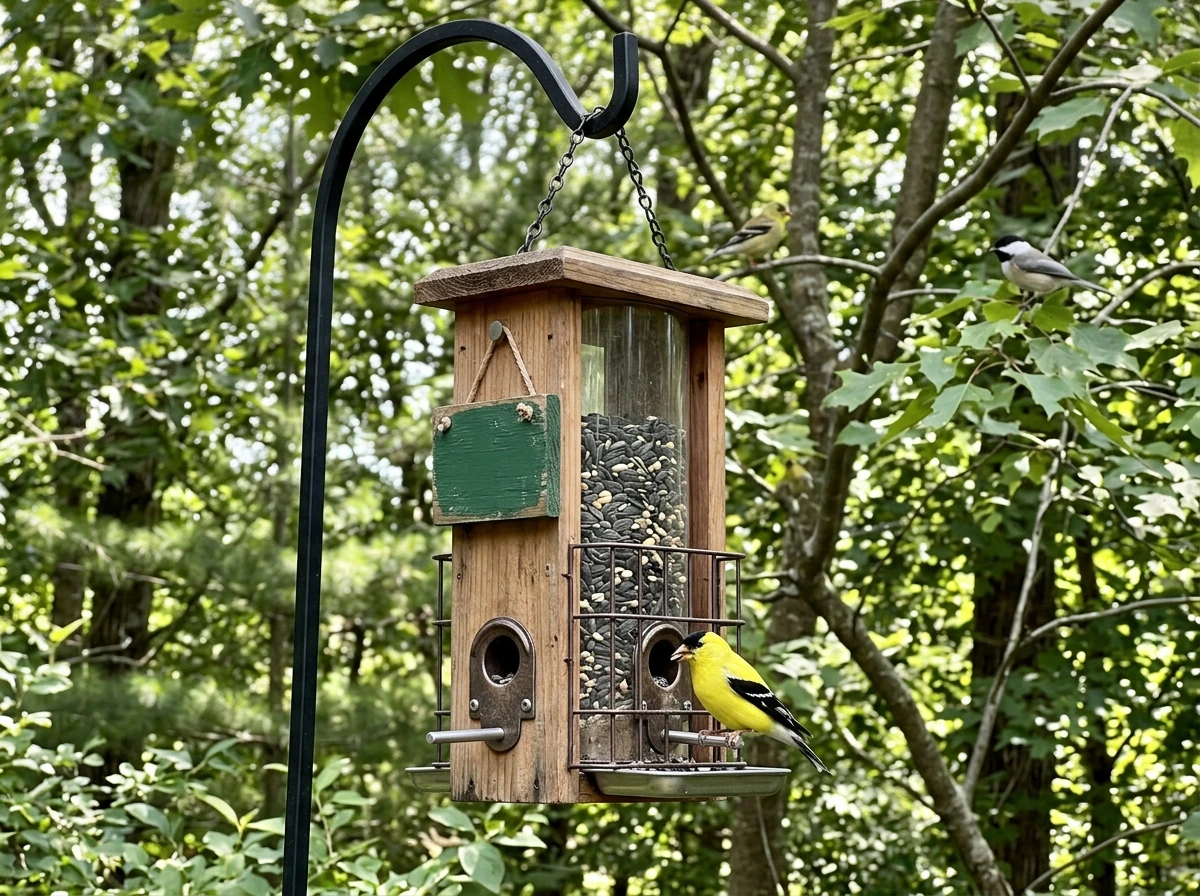
Audubon says outright that if you're only putting out one feeder, a tube feeder is your best choice. Tube feeders handle black-oil sunflower seed, mixed seed, safflower, and peanuts well. They attract chickadees, nuthatches, titmice, finches, and cardinals. The key feature to look for is metal ports around the seed dispensers, which resist squirrel chewing and protect the openings from being gnawed wide enough to spill seed. Hang tube feeders at least 5 feet off the ground.
Nyjer (thistle) tube feeders: built for finches
Goldfinches, pine siskins, and common redpolls all respond strongly to Nyjer seed, and Audubon notes there are feeders designed specifically for it. These are narrow tube feeders with tiny ports that dispense the small thistle seed without spilling it. One important warning from Audubon: avoid mesh or sock-style thistle bags. Squirrels can tear holes in them and waste expensive seed fast. Hang a purpose-built thistle tube feeder on a 5-foot pole with a squirrel baffle, or from a tree branch where squirrels can't easily reach.
Hopper feeders: best for cardinals, blue jays, and mixed groups
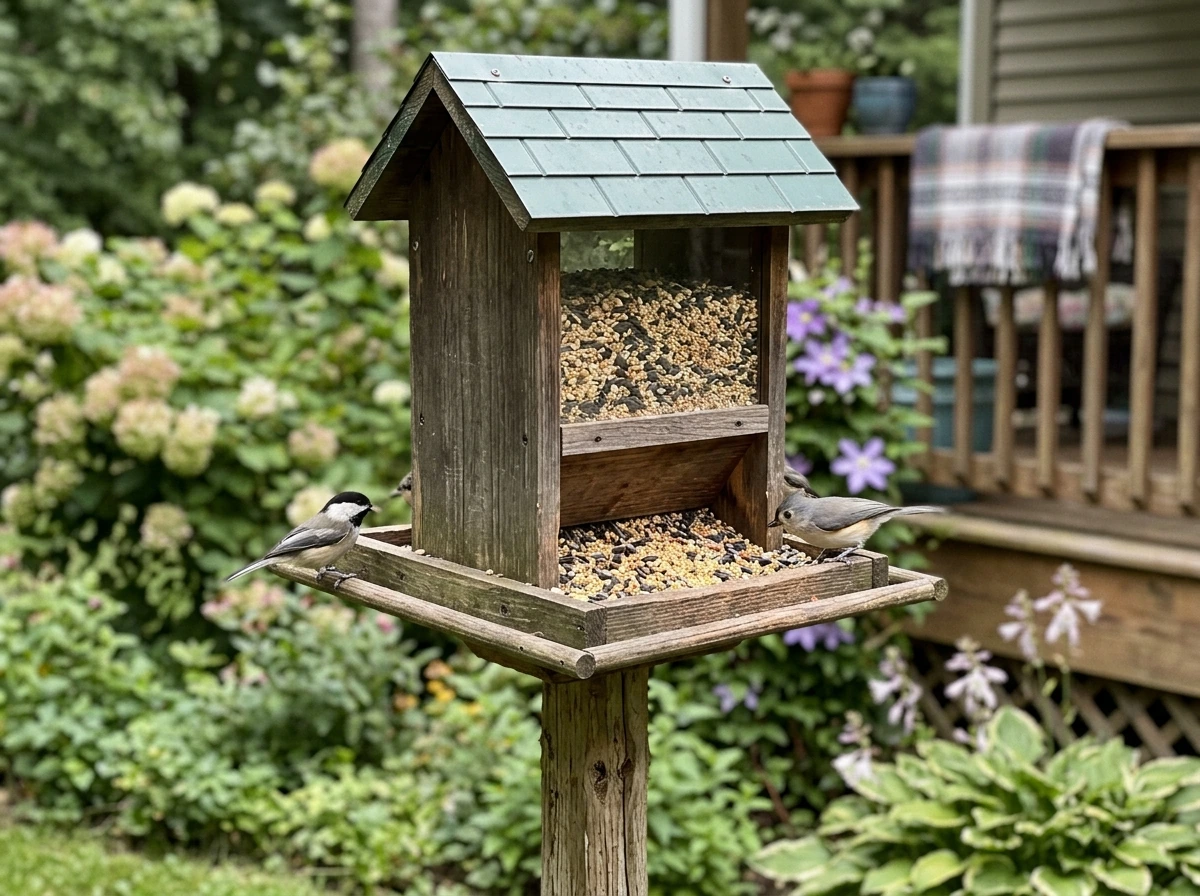
Hopper feeders look like little houses with a seed reservoir that gravity-feeds into a tray. They're larger than tubes, which makes them attractive to bigger birds like cardinals, blue jays, and mourning doves in addition to the smaller tube-feeder species. Audubon's winter guidance specifically pairs hopper feeders with safflower, sunflower, and cracked corn, noting they keep seed drier than open platform feeders. The roof is important here: a well-designed hopper feeder keeps seed from getting soaked in rain, which dramatically reduces spoilage and mold. Do not place hopper feeders directly on the ground.
Platform and ground feeders: doves, juncos, sparrows, and towhees
Some birds feed naturally on or near the ground: mourning doves, dark-eyed juncos, white-throated sparrows, towhees, and even cardinals and goldfinches will visit low platform feeders. Audubon recommends placing ground feeding tables in open areas at least 10 feet from the nearest tree or shrub so birds can spot and flee from predators. Cracked corn scattered at ground level specifically invites doves. One caveat from Audubon Great Lakes: platform feeders can attract deer and other unwanted animals, so elevated platform trays (mounted a few feet up on a pole) are a better choice than placing seed directly on the soil.
Suet feeders: woodpeckers, nuthatches, chickadees, and titmice
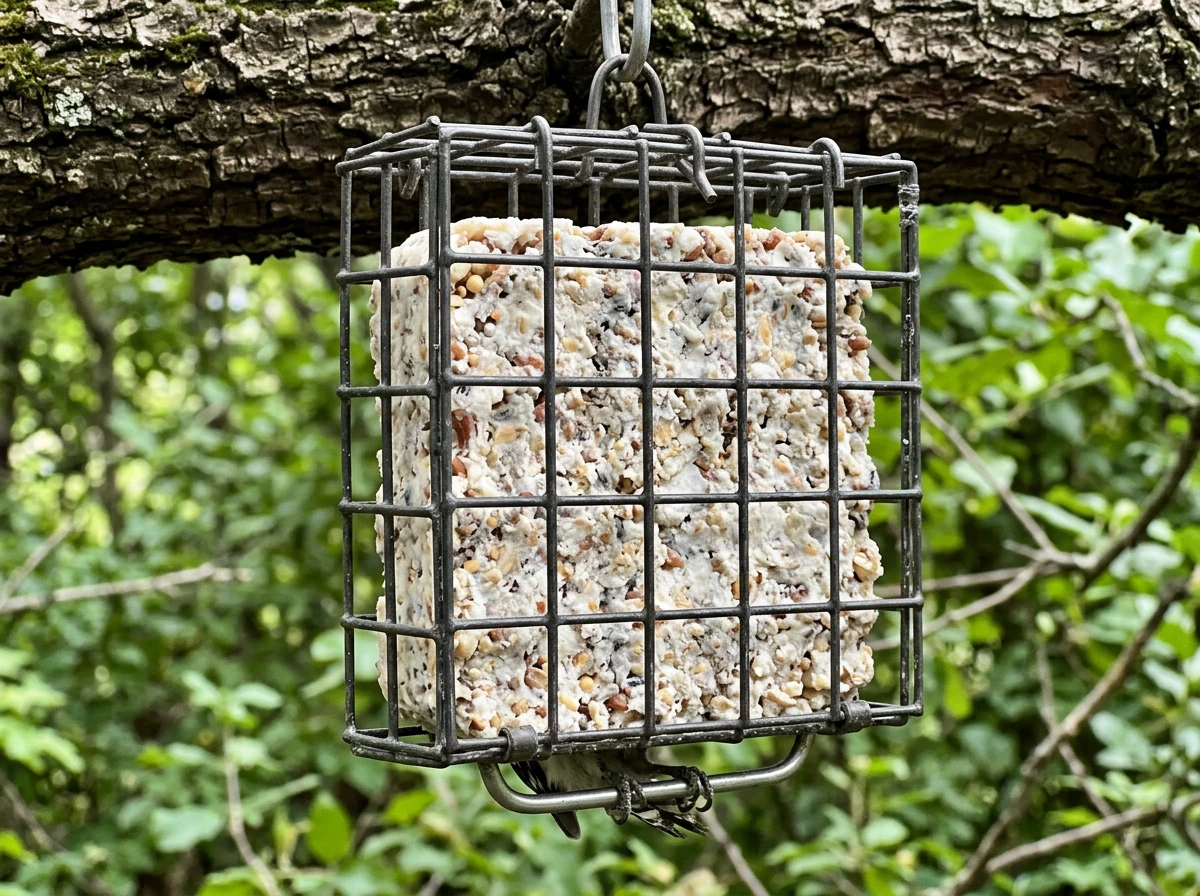
Suet feeders are wire or mesh cages that hold a solid block of rendered fat mixed with seeds or insects. Audubon says suet feeders attract woodpeckers, titmice, nuthatches, and chickadees year-round, and sometimes pull in wrens, creepers, and warblers. The Downy Woodpecker is probably the most frequent suet feeder visitor you'll see. Suet cages should be hung well off the ground, from a tree, a pole near other feeders, or from a wire stretched between trees. In warm weather, look for "no-melt" suet cakes specifically, because standard suet can turn rancid quickly in heat and become dangerous for birds.
Nectar feeders: hummingbirds and orioles
Audubon positions nectar feeders as the dedicated feeder type for hummingbirds, and they also work for orioles with larger port designs and perches. The standard nectar recipe Audubon recommends is a simple sugar-water solution (roughly 1 part white sugar to 4 parts water). Cleanliness is non-negotiable with nectar feeders: in warm weather, Audubon says to change nectar about twice per week and to clean up any spills immediately with hot water. Red dye in nectar is unnecessary and potentially harmful, so skip it.
Window feeders: close-up views with built-in safety rules
Window-mounted feeders suction-cup directly to glass and give you an unbeatable close-up view. They follow Audubon's collision-distance rule: place any feeder either within 3 feet of a window or more than 30 feet away. A window feeder placed within 3 feet is safe because birds can't build enough speed to injure themselves on the glass before they reach it. Feeders placed between 3 and 30 feet are the danger zone. Window feeders inherently solve the placement problem, though they work better for smaller birds like chickadees and finches than for larger species.
| Feeder Type | Best Birds | Best Seed/Food | Key Feature to Look For |
|---|---|---|---|
| Tube feeder | Chickadees, finches, nuthatches, cardinals | Black-oil sunflower, safflower, peanuts | Metal ports, easy disassembly for cleaning |
| Nyjer tube feeder | Goldfinches, siskins, redpolls | Nyjer (thistle) seed | Tiny ports, no mesh bags |
| Hopper feeder | Cardinals, blue jays, titmice, mixed species | Sunflower, safflower, cracked corn | Enclosed roof to keep seed dry |
| Platform/ground feeder | Doves, juncos, sparrows, towhees | Cracked corn, millet, sunflower | Open area placement, 10+ feet from cover |
| Suet cage | Woodpeckers, nuthatches, chickadees, titmice | Suet cakes (no-melt in summer) | Sturdy wire mesh, hang off ground |
| Nectar feeder | Hummingbirds, orioles | Sugar water (1:4 ratio) | Ant moat, easy-clean bottle or basin |
| Window feeder | Chickadees, finches, small species | Black-oil sunflower, mixed seed | Within 3 feet of glass, strong suction cups |
Matching your feeder setup to your actual environment
The right feeder in the wrong spot won't work. Environment matters as much as feeder type, and Audubon's guidance gives clear numbers for placement decisions.
Standard yards with room to work with
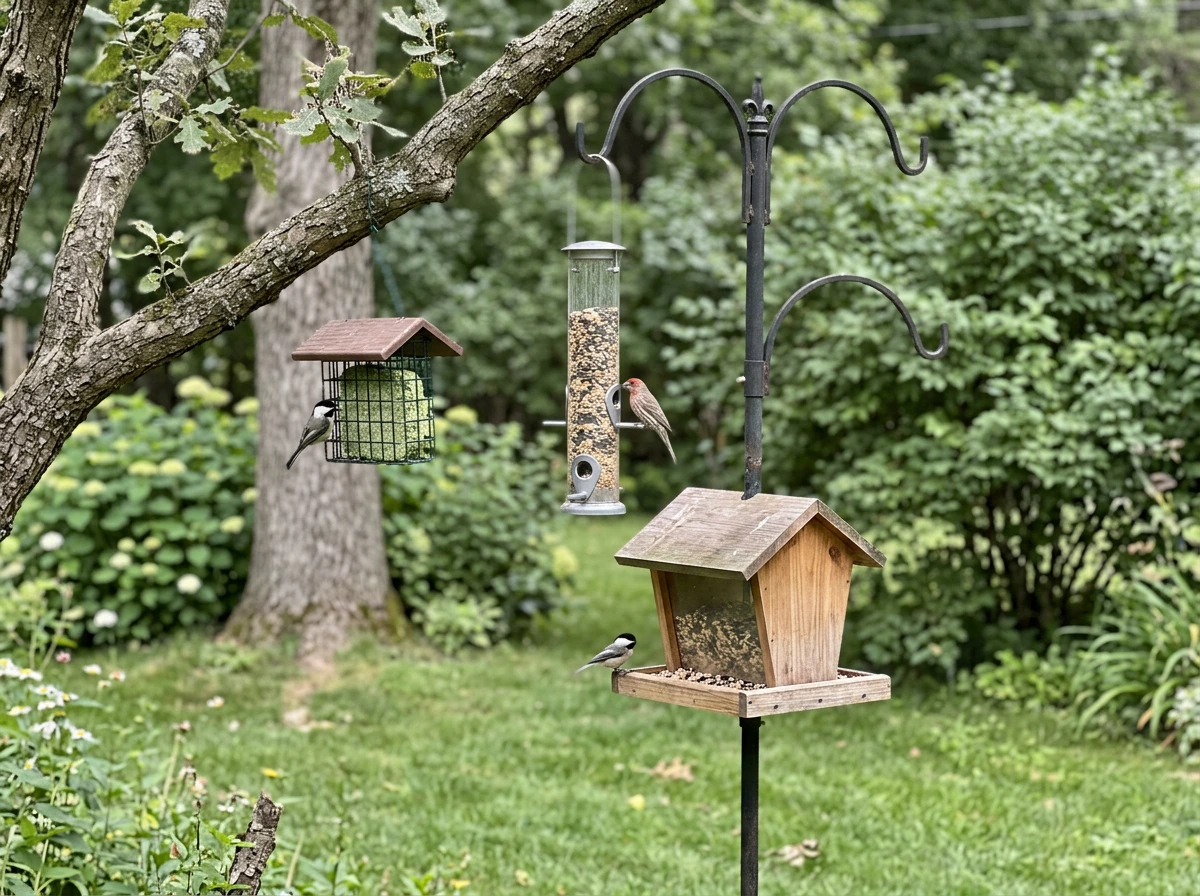
In a typical backyard, the most effective setup is a pole-mounted system that can hold multiple feeder types at once: a tube feeder for sunflower seed, a suet cage hanging off a side arm, and optionally a thistle tube for finches. Place the pole at least 8 to 10 feet from any tree, building, fence, or other structure that a squirrel could jump from. Add a baffle (a cone or tube-shaped metal squirrel guard) set about 4 to 5 feet up the pole. This is the closest thing to a squirrel-proof setup that Audubon describes without requiring a specialty feeder.
Balconies and small spaces
On a balcony or in a small urban yard where you can't achieve the 8 to 10 foot clearance from structures, a weight-activated feeder is your best alternative. On a balcony or in a small urban yard, a weight-activated feeder can also be a great way to keep a bird feeder safe from squirrels bird feeder can. These feeders close their seed ports when something heavy (like a squirrel) lands on the perch ring, while birds, which weigh far less, can still feed normally. Audubon specifically calls this out as the solution when pole spacing isn't possible. A window feeder mounted directly on glass is another strong option for apartment balconies with limited rail space.
Winter feeding setups
In winter, seed spoilage from moisture becomes a bigger problem and the birds that visit shift. Audubon's winter guidance emphasizes hopper feeders for their ability to keep seed dry, and suet feeders for high-calorie fat that birds need in cold weather. Keep feeders well-stocked in winter because birds that rely on them in cold snaps can be seriously stressed by an empty feeder during a freeze. Brush snow off platform feeders after storms and check that seed in hopper feeders hasn't clumped or frozen. "No-melt" suet isn't the concern in winter, but make sure standard suet doesn't freeze solid into a block birds can't actually access.
Height and window collision distances
Hang tube feeders at least 5 feet off the ground. For window placement, the numbers Audubon repeats consistently are: within 3 feet of the glass (safe) or more than 30 feet away (safe). The 3 to 30 foot zone is the danger zone where birds can build speed but can't distinguish the glass in time. If you're somewhere in that range, move the feeder closer to the window rather than farther from it. Audubon also recommends complementary steps like light-colored blinds, external netting, and closely-spaced window decals to reduce reflectivity and collision risk.
Feeder features that actually matter
Feeder marketing loves to list features. Here's what actually makes a difference based on Audubon's practical guidance and real-world use.
Weatherproofing and rain protection
Any feeder that leaves seed exposed to direct rain is going to cause problems fast. Wet seed clumps, grows mold, and can make birds sick. For tube feeders, look for a weather dome or rain guard that mounts above the feeder. For hopper feeders, the enclosed roof design is the primary weather protection, so look for one with a roof that extends generously past the seed tray on all sides. Suet cages are less affected by rain but should still be hung in a spot with some overhead protection if possible.
Ease of cleaning
This is probably the feature people undervalue most when buying a feeder. Audubon's cleaning protocol requires scrubbing with warm soapy water, soaking in a 1-part bleach to 9-parts-water solution for about 15 minutes, rinsing thoroughly, and letting the feeder fully dry before refilling. That process needs to happen at least every two weeks, and more often in wet weather or if you see sick birds. A feeder that doesn't come apart easily, or has small internal spaces you can't reach, will not get cleaned properly. Before buying, turn the feeder over in your hands and ask: can I get a brush into every corner? Can I take this apart without tools?
Squirrel and pest resistance
As covered in the placement section, a pole-mounted baffle at 4 to 5 feet up, with 8 to 10 feet of clearance from any jumping surface, is the primary defense. For the feeder itself, metal ports and metal construction on critical wear points resist squirrel damage much better than all-plastic feeders. If you're in a tight space, a weight-activated feeder is the right tool. Avoid cheap mesh bags for thistle seed entirely.
Seed type compatibility and waste control
Audubon's single most repeated seed advice is: don't use filler-heavy mixed blends. Seed mixes that include milo, red millet, or other filler grains create a pile of rejected seed under your feeder that turns into a sludgy, moldy mess and can make birds sick, one reason you should focus on <bird feeder best> practices for seed type and waste control. Use specific seeds in specific feeders: black-oil sunflower in your tube or hopper feeder, Nyjer in a dedicated thistle feeder, peanuts in a mesh peanut feeder, and cracked corn or white millet at ground level for doves and sparrows. bird feeders news
Smart and solar features: worth it or not?
Smart camera feeders have improved significantly and are genuinely fun if you want to identify visitors automatically. They're not something Audubon specifically endorses, but they don't conflict with any of the guidance either. The main trade-off is cleaning: camera feeders with integrated electronics are harder to submerge in a bleach solution, so check whether the camera unit detaches before you buy. Solar-powered features (like heated water dishes or seed warmers in winter) can be useful in cold climates, though most standard feeders don't require power.
Specific birds: what to buy and why
Hummingbirds
Use a nectar feeder with an ant moat built in or the ability to add one. Ants and bees are the biggest pest problems for hummingbird feeders, and Audubon is direct: an ant guard or water moat (which ants can't cross) is the first line of defense. Clean nectar feeders thoroughly and change the nectar at least twice a week in warm weather. Make your own nectar with 1 part white sugar to 4 parts water, no red dye. Position the feeder within 3 feet of a window or more than 30 feet away. Native nectar-rich plants around the feeder will increase hummingbird traffic significantly.
Orioles
Orioles will visit nectar feeders with larger ports and perches, but they're also attracted by orange halves and grape jelly offered in small dish-style feeders. If you're specifically targeting orioles, look for an oriole-specific nectar feeder with orange coloring and larger feeding ports. Time your setup for spring migration (orioles typically arrive in April and May across much of North America) and have the feeder out before they arrive.
Woodpeckers
Suet is the primary draw. Audubon names the Downy Woodpecker as probably the most frequent visitor to suet feeders, followed by Hairy Woodpeckers, Red-bellied Woodpeckers, and others depending on your region. A standard suet cage hung from a tree or pole arm near your main feeder station is all you need. In warm months, switch to no-melt suet cakes to prevent rancidity. Woodpeckers also visit tube feeders loaded with peanuts (in-shell or shelled) or sunflower seed, and some will use peanut feeders with large mesh openings they can cling to.
Cardinals
Cardinals prefer black-oil sunflower seed and safflower. They like having a perch wide enough to sit on comfortably, which makes hopper feeders with a broad tray ideal. They'll also visit tube feeders with larger perches. Cardinals tend to feed at dawn and dusk more than midday, so don't assume your feeder isn't working if you miss them at noon.
Finches (goldfinches, house finches, siskins)
Goldfinches and their finch relatives are the target audience for Nyjer tube feeders. They'll also eat black-oil sunflower and visit tube feeders. A dedicated thistle feeder will produce noticeable finch traffic within a week or two in most areas. American Goldfinches are year-round residents in much of the U.S. and will visit in winter when their plumage turns olive-yellow, so don't take down the thistle feeder just because it's cold.
Blue jays
Blue jays love peanuts, shelled or in-shell, and will also eat sunflower seed and cracked corn. They prefer hopper feeders or platform feeders where they can land and feed without cramped perches. Jays are assertive and will dominate smaller feeders, so positioning a separate peanut or hopper feeder away from your main finch/chickadee setup reduces conflict.
Doves and ground-feeding species
Mourning doves, juncos, white-throated sparrows, and towhees all feed naturally at or near the ground. Cracked corn and white millet scattered in an open area at least 10 feet from trees or shrubs will bring them in. An elevated platform feeder (a few feet off the ground on a pole) is a safer version of this, avoiding deer attraction while still serving ground-preferring birds.
Bluebirds
Bluebirds are a special case. Audubon is direct about this: fruit specialists like bluebirds rarely eat birdseed, so a standard seed feeder won't attract them reliably. Mealworms (live or dried) in a shallow dish feeder are the main option if you want to draw bluebirds to a feeder. Beyond that, Audubon's guidance shifts to habitat: bluebird nest boxes placed in open areas near low vegetation are the more effective long-term strategy for supporting bluebirds in your yard.
Common buying mistakes and how to troubleshoot after setup
Birds aren't coming to the feeder
Give it time, especially if you've just set up a new feeder or moved an existing one. Birds in the area need to discover it, which can take days or a few weeks. Make sure the seed is fresh (old seed loses its appeal and can be moldy), the feeder is clean, and it's placed in a spot with some nearby cover where birds can wait before approaching. Too much open exposure with no nearby shrub or tree within reasonable distance can make birds feel unsafe. A few feet of proximity to a shrub or small tree without compromising the squirrel-clearance rules is the balance to strike.
Squirrels won't stay off
Run through the checklist: Is your pole baffle set at 4 to 5 feet off the ground? Is the feeder at least 8 to 10 feet from any surface a squirrel could launch from? If you can't achieve that spacing, switch to a weight-activated feeder. If squirrels are still getting through despite a correctly installed baffle, look at whether the baffle itself is large enough in diameter (some smaller baffles can be gripped around the edges) and whether the pole is wobbling enough to let an acrobatic squirrel bypass it.
Seed is spoiling or clumping
Spoiled seed is usually a combination of moisture getting in and seed sitting too long. First, check whether your feeder has adequate rain protection. Second, reduce the amount you put in so it turns over faster rather than sitting for weeks. Third, check the seed itself: sunflower seed in a sealed bag from a reputable source stays fresh much longer than bulk seed from a bin that's been sitting open. In wet weather, Audubon recommends cleaning feeders more frequently than the standard every-two-weeks schedule.
Ants and bees on nectar feeders
For ants: use a water-filled ant moat above the feeder (ants can't cross standing water). Many hummingbird feeders include these; if yours doesn't, attachable ant moats are widely available and easy to add. For bees: choose feeders with ports that recess inward so bees can't reach the nectar with their shorter tongues while hummingbirds can still access it with their long ones. Mop up any nectar spills immediately with hot water, because spilled nectar is the main attractor. Yellow coloring on feeders also attracts bees, so avoid feeders with yellow port accents.
Sick or dead birds at the feeder
Take the feeder down immediately, discard all remaining seed, and do a full cleaning with the bleach solution (1 part bleach to 9 parts water, 15-minute soak, thorough rinse, fully dry before refilling). This isn't optional. Disease can spread rapidly through a feeder station, and Audubon is firm: if you see sick birds, clean and disinfect right away. Report sick birds to your local wildlife or Audubon chapter if you're seeing a pattern.
Rats and other unwanted mammals
Rats are attracted to seed spilled on the ground. The fixes: switch to no-waste seeds (hulled sunflower, shelled peanuts) that don't leave shells accumulating, use a seed tray catcher under tube feeders, and clean up debris regularly. Don't leave seed in platform feeders overnight. Reduce the amount you put out so it gets consumed before the end of each day. Ground-scattered cracked corn is a particular rat magnet, so if rats are a problem, bring that feeding method to a halt and switch to elevated feeders only.
DIY and alternative feeding when you don't want a traditional feeder
Not everyone wants to maintain a pole-and-feeder station, and Not everyone wants to maintain a pole-and-feeder station, and there are legitimate alternatives that align with Audubon's approach to supporting backyard birds. that align with Audubon's approach to supporting backyard birds.
Native plants as a feeding system
Audubon consistently frames native plants as a complement to feeders, not just an aesthetic choice. Native flowering plants provide nectar for hummingbirds (and attract the insects hummingbirds also eat). Native shrubs with berries support bluebirds, mockingbirds, and thrushes that won't visit seed feeders. Native trees produce the insects that feed nestlings of almost every species. If you're in a space where feeders are impractical, even a few native plant species can meaningfully support local birds year-round.
Simple DIY feeders
A pine cone coated in peanut butter and rolled in black-oil sunflower seeds hung from a branch is a legitimate suet alternative that many species will use. A shallow dish or jar lid filled with fresh water is technically a feeding station for birds that need to drink and bathe. A simple mesh bag of peanuts (in-shell) hung from a hook attracts blue jays and woodpeckers without requiring a specialty feeder. These DIY options work best as supplements to a main feeding station rather than replacements for it, but they're real options when budget or space is limited.
Nest boxes as habitat support
For species that feeders don't effectively attract, nest boxes fill the gap. Audubon has detailed guidance on bluebird nest boxes specifically, because bluebirds respond to nesting habitat more reliably than to feeders. Similarly, nuthatches and other cavity nesters benefit from nest box programs. If your goal is supporting a specific species rather than maximizing visitor count at a feeder, a well-placed nest box may be more effective than any feeder purchase.
Water features
A clean, shallow birdbath or a simple drip water feature attracts birds that may never touch a seed feeder: warblers, thrushes, and many other species that pass through during migration. Keep the water fresh (change it every day or two in warm weather), scrub the basin weekly, and place it in a spot with nearby vegetation for cover. A dripper or mister that creates water movement is even more effective because birds notice moving water from farther away.
The bottom line across all of this: Audubon's recommendations aren't complicated, they're just consistent. Match the feeder to the bird's foraging style, use the right seed, keep everything clean, place it at the right distance from windows and jumping surfaces, and protect it from pests with baffles or weight-activated mechanisms. Get those fundamentals right and you'll have a functioning, bird-safe feeding station regardless of which specific feeder model you choose. For more on finding the top-rated options across categories, the best suet feeders for woodpeckers, and what birds are most likely visiting feeders in your region, those topics are covered in detail elsewhere on this site.
FAQ
Can I mix seeds in one hopper or tube feeder to save money?
Audubon’s approach is to avoid filler-heavy mixes and instead match seed to feeder and bird. If you mix seeds, birds will reject parts of the blend and the leftovers become waste that can spoil. A better budget strategy is using separate feeders for sunflower and thistle, and using cracked corn or millet only in the dedicated ground or elevated tray setup.
How often should I refill feeders, and how do I prevent seed going stale?
Refill before the feeder is completely empty, because a freeze can stress birds that rely on steady access. At the same time, reduce what you put out so seed turns over quickly, especially after rainy spells. If you see clumping, damp odors, or a lot of rejected seed underneath, dump and clean rather than topping off.
What’s the safest way to place feeders if I have lots of squirrels but also want small birds like finches?
Use a pole setup with a baffle at 4 to 5 feet and keep the station 8 to 10 feet from jump-off surfaces. For finches, add a dedicated thistle tube feeder with tiny ports on a pole or from a branch area where squirrels cannot easily reach. If you cannot meet spacing, switch to a weight-activated feeder to close ports when heavy animals land.
My tube feeder has metal ports, but squirrels still spill seed. What should I check first?
First confirm the baffle is positioned correctly and that the pole does not wobble enough to let an animal bypass it. Next look for openings where seed can escape, worn or loose parts, and gaps between feeder sections. Finally, ensure the feeder is at least 5 feet off the ground, because lower placement increases the chance of successful grabs.
Do I need to worry about mold even if the weather is dry?
Yes, because mold can start when seed gets intermittently damp, even from wind-driven rain or condensation inside a partially covered hopper. If you notice spoiled odors, visible mold, or birds coughing or acting lethargic, stop using that feeder and clean immediately, then switch to the right rain protection (weather dome for tubes, enclosed roof for hoppers).
Can I leave a feeder out overnight during a heavy rain or snow?
You can leave it out, but prioritize feeders that are built to stay dry. For tube feeders, make sure there is a rain guard or weather dome, for hoppers use an enclosed roof that extends beyond the tray, and for platforms avoid direct exposure to wet seed. After major storms, brush snow off and inspect for clumps before refilling.
How do I clean nectar feeders properly without damaging the parts?
Audubon’s core rules are immediate cleanup of spills and frequent nectar changes in warm weather. For cleaning, use hot water thoroughly, and scrub any removable components so residue does not build up in ports. Make sure everything is fully rinsed and dry enough before refilling so diluted nectar and old film do not seed spoilage.
Do I need to add ant repellent or should I rely on a moat?
Start with a moat or ant guard because ants cannot cross standing water. If your feeder does not come with one, choose an add-on that fits tightly above the base. Avoid approaches that might contaminate nectar, and keep an eye out for ants that follow around the outside, which usually means the moat is not sealing properly.
What window placement is safest for collision prevention if I have one spot only?
If you can choose, place the feeder within 3 feet of the glass or more than 30 feet away. If you currently have it between 3 and 30 feet, move it closer to 3 feet rather than farther away. Also reduce glare using light-colored blinds or netting, because reflectivity can pull birds into the danger zone.
How do I handle ants and bees when they are both showing up at the same time?
Keep nectar clean and dry by changing it at least twice a week in warm weather and removing spills immediately. Use a feeder design that recesses ports so bees cannot reach nectar with their shorter tongues, and add an ant moat as your first line of defense. Avoid feeders with yellow port accents because those can increase bee activity.
What’s the best way to attract hummingbirds if I don’t see any in the first week?
Assume discovery takes time, and then optimize placement and surrounding habitat. Position the feeder near cover, within collision-safe window distance rules, and plant native nectar flowers nearby if possible. Also confirm nectar freshness, using a 1-to-4 sugar to water ratio and skipping red dye, because poor nectar quality can slow visitation.
If I’m seeing birds visiting at first but they stop, what are the common causes?
Most often it is stale food, dirty feeder parts, or a change in weather that affects seed moisture and accessibility. Check for damp clumps, look for mold, and review your cleaning cadence. Also consider increased competition or predation risk, such as squirrels dominating ports or a new nearby perching location for hawks.
Do platform feeders always increase deer problems?
Platform feeders can attract deer in some regions, and Audubon’s guidance treats spilled or accessible seed as the trigger. If deer are a concern, switch to elevated platform trays on a pole, keep the area cleaner, and avoid leaving seed directly on soil at night. If deer persist, pause ground-level feeding methods altogether.
I want bluebirds. What should I do if seed feeders never bring them?
That outcome is expected, because bluebirds rarely use typical seed feeders. Your best feeder option is not seed, it is mealworms in a shallow dish feeder. For reliable results long-term, prioritize bluebird nest boxes in open areas near low vegetation, and treat feeders as a supplement rather than the main strategy.
What do I do if I suspect sick birds at my feeder station?
Stop using the feeder immediately, discard remaining food, and disinfect using a bleach-to-water soak as recommended, then rinse thoroughly and fully dry before refilling. Check for patterns across days, and if illness seems widespread, report to local wildlife officials or your Audubon chapter so they can advise next steps and monitoring.