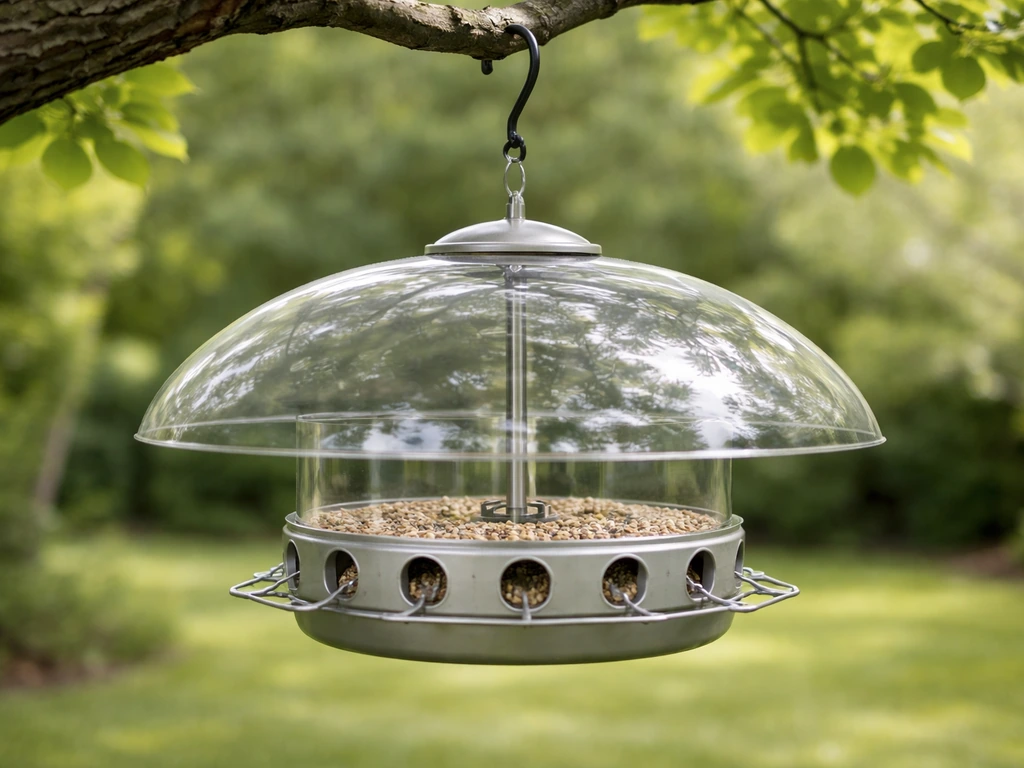
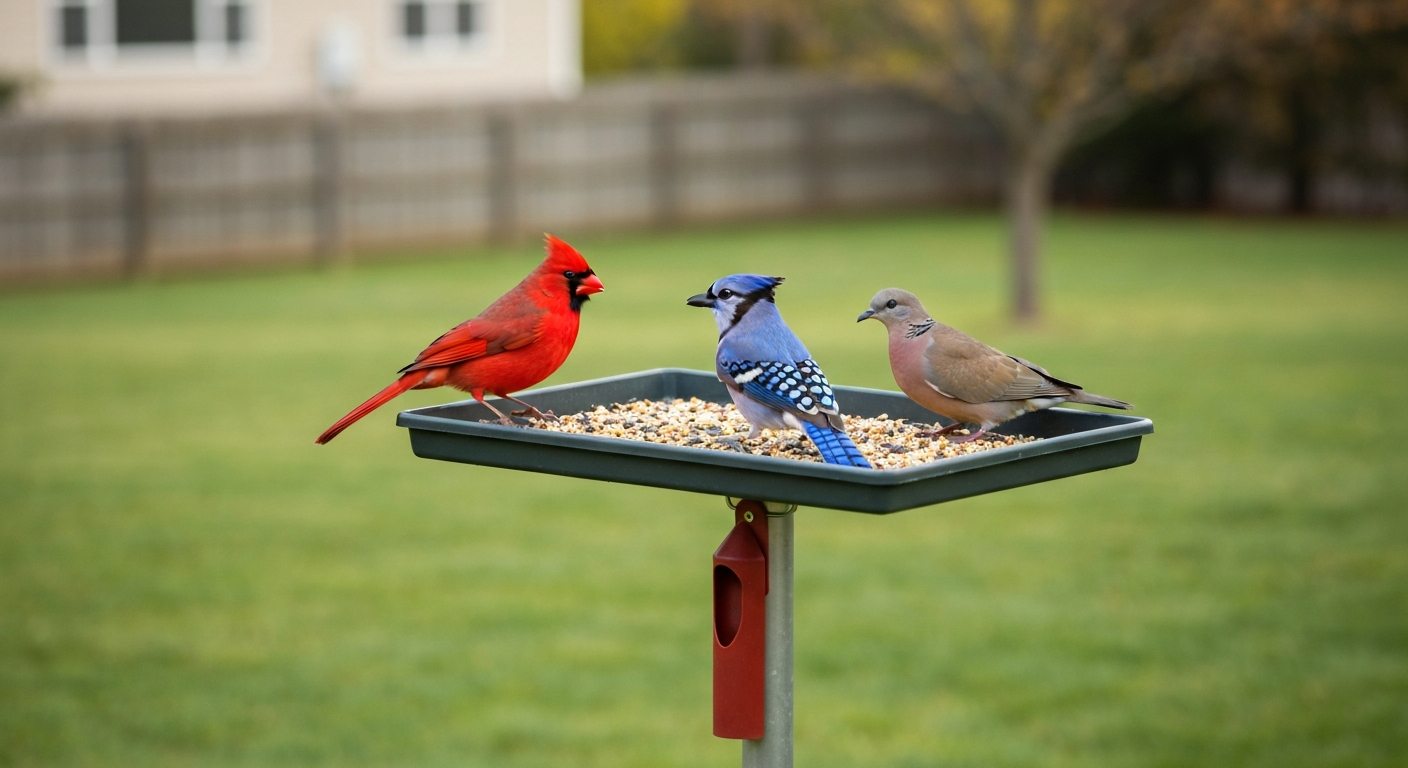
A flat top bird feeder is a platform-style tray feeder with a flat, open surface where seed, fruit, or other food is spread directly for birds to access. Most designs mount on a pole, post, or fence rail and sit exposed without a roof, though some versions include a shallow lip or partial overhang. They attract the broadest mix of backyard birds of any feeder type, including Northern Cardinals, Blue Jays, doves, and even woodpeckers, because the open surface and stable footing appeal to birds that prefer not to cling or squeeze through narrow ports. The trade-off is that the open design also invites squirrels, rats, and seed spoilage, which means your material choices, mounting setup, and cleaning routine matter more with a flat-top than with almost any other feeder style.
Flat Top Bird Feeder Guide: Picks, Mounting, Pest Proofing & DIY
What exactly counts as a flat-top feeder
The terms 'flat-top,' 'platform,' and 'tray feeder' are used interchangeably, and all three describe the same fundamental design: a raised, open surface birds land on to eat. The Cornell Lab's Project FeederWatch classifies platform feeders as the style that attracts the widest variety of seed-eating backyard birds, and the Audubon Society echoes that while calling out the downsides: accumulated droppings, spilled seed, and greater exposure to weather and pests. Audubon’s guide classifies feeder types (tray/platform, tube, hopper, suet, nectar, etc.) and notes platforms accumulate droppings and spilled seed while tube and hopper feeders reduce waste and limit access by larger species Bird Feeding Basics (Audubon Society guide to bird feeders). If you have only ever used tube or hopper feeders, switching to a flat-top will immediately change the mix of birds you see. Larger, shyer ground-feeders like doves and White-throated Sparrows will visit a low-mounted flat tray that they would never approach a hanging tube feeder.
In everyday backyard use, flat-top feeders show up in a few common forms: a simple cedar tray on a post, a powder-coated metal platform screwed to the top of a pole, or a hanging tray with a wide rim. The one constant is the flat, open feeding surface. Some buyers confuse them with hopper feeders that have a flat roof (a 'big top' style) or with post-top feeders that may have an angled or peaked cap. A true flat-top keeps the feeding surface level and uncovered, or only lightly shielded on one side.
How flat-top feeders differ from post-top, big-top, and fence-top designs
These four terms sound similar but describe meaningfully different products. A post-top feeder refers to how the feeder mounts, not what it looks like: it sits on top of a 4x4 or similar wooden post via a base flange, and the feeder body itself might be a hopper, tube, or platform style. A big-top feeder (like the Droll Yankees Big Top series) uses a large peaked or domed roof over a feeding area, which significantly improves weather protection but reduces the open-surface character that makes flat-tops so bird-friendly. A fence-top feeder clamps or mounts to a fence rail and is typically a very simple tray, similar in function to a flat-top but restricted in placement and usually smaller. The flat-top feeder is the purest platform format: the feeding surface is the product's defining feature, and mounting method (post, pole, fence, or hanging) is secondary.
| Feeder Style | Defining Feature | Roof/Cover | Typical Mount | Weather Protection | Best For |
|---|---|---|---|---|---|
| Flat-Top / Platform | Open, level feeding tray | None or minimal lip | Post, pole, fence, hanging | Low — relies on drainage holes | Widest bird variety, Cardinals, Jays, Doves |
| Post-Top | Mounting method (atop a 4x4 post) | Varies by feeder body style | 4x4 wooden post with top flange | Depends on feeder type mounted | Stable elevated feeding, garden aesthetics |
| Big-Top / Domed | Large peaked or dome roof over feeding area | Full peaked/dome roof | Pole, post, or hanging | High — roof sheds rain and snow | Weather-exposed yards, Cardinals, Jays |
| Fence-Top | Clips/mounts to fence rail | Rarely included | Fence rail clamp or bracket | Low — very open | Small yards, fence-line feeding, Sparrows, Doves |
The practical takeaway: if weather is your primary concern, a big-top or domed design will outperform a flat-top year-round. If mounting flexibility and attracting the widest species mix is the goal, the flat-top wins. Post-top is really a mounting category, not a feeder type, so you can have a flat-top feeder that is also post-top mounted. These distinctions matter when you're browsing retail listings, because the same product can be described multiple ways.
Droll Yankees Big Top and popular post-top models compared
The Droll Yankees Big Top is one of the most recognized names in the domed/big-top category, and it comes up often when buyers are researching flat-top feeders because the names sound related. They are not the same design. The Big Top uses a large dome that protects seed from rain while still allowing a wide variety of birds to feed underneath. It is a good feeder, but the dome changes bird behavior slightly since some species are less comfortable ducking under a cover. Below is a side-by-side look at the Big Top alongside typical flat-top platform feeders and the Squirrel Buster Plus, which is a popular pole-mount option with weight-activated pest control.
| Model / Style | Type | Capacity | Roof / Cover | Squirrel Deterrent | Mounting Options | Approx. Price Band | Best For |
|---|---|---|---|---|---|---|---|
| Droll Yankees Big Top | Domed hopper/platform hybrid | ~3 lbs seed | Large dome — full rain/snow cover | Dome can be set low to block squirrels | Pole, hanging | $40–$60 | Weather-exposed yards, Cardinals, Jays, Chickadees |
| Cedar Platform Feeder (generic) | Flat-top platform | 1–2 lbs seed (open tray) | None (open tray) | None built-in — add baffle separately | Post, pole, hanging, fence | $20–$45 | Wide species mix, ground-feeding birds, Doves, Cardinals |
| Metal Powder-Coated Platform Feeder | Flat-top platform | 1.5–3 lbs seed | None or shallow lip | None built-in — add pole baffle | Pole top-mount, post | $25–$55 | Durability-focused buyers, Cardinals, Jays, Doves |
| Brome Squirrel Buster Plus | Tube with adjustable weight-activated shroud | ~5.1 lbs seed | Vented top cap | Weight-activated shroud (adjustable) | Pole adaptor available, hanging | $50–$75 | Squirrel-heavy yards, Finches, Chickadees, Nuthatches |
| Perky-Pet Solar Smart Camera Feeder | Platform/tube hybrid with camera | ~3.5 lbs seed | Partial cover | Weight-activated Seed Shield™ | Pole, wall, stake | $90–$130 | Tech-focused birders, Cardinals, Jays, monitoring use |
The Squirrel Buster Plus and the Perky-Pet Solar Smart Camera feeder are included here because they represent the kinds of feature-rich alternatives buyers often compare against a simple flat-top. If you want to add a camera or solar charging to your setup, those features currently come packaged into tube or hybrid designs rather than true open-platform feeders. The Perky-Pet model pairs a 1080p motion-activated camera with a solar panel and weight-activated Seed Shield, requiring a 2.4 GHz Wi-Fi connection, and is one of the few mainstream feeders that integrates all three features in one unit.
Flat-top feeder specs at a glance
| Spec | Cedar / Wood | Powder-Coated Metal | UV Polycarbonate / Acrylic | Recycled Plastic (HDPE) |
|---|---|---|---|---|
| Typical Capacity | 1–2 lbs (open tray) | 1.5–3 lbs | 0.5–2 lbs | 1–3 lbs |
| Mounting Options | Post top, pole, hanging | Post top, pole top-mount | Hanging, pole, window | Post, pole, hanging |
| Weatherproofing | Moderate — needs seasonal sealing | Good — resists rust if powder coat intact | Good — UV-stabilized, check for yellowing | Very good — won't rot or rust |
| Drainage | Drilled holes recommended | Punched drainage holes (check spec) | Molded drain slots common | Molded drain slots common |
| Squirrel Resistance | None built-in | None built-in | None built-in | None built-in |
| Price Band | $20–$45 | $25–$55 | $15–$40 | $30–$65 |
| Target Birds | Cardinals, Jays, Doves, Sparrows | Cardinals, Jays, Doves, Woodpeckers | Finches, Sparrows, small perching birds | Cardinals, Jays, Doves, general mix |
| Lifespan (maintained) | 3–7 years with sealing | 5–10+ years | 3–6 years (UV degradation) | 10+ years |
When a flat-top feeder is the right choice
A flat-top feeder earns its place in a yard where you want the broadest possible species mix and have a spot where you can mount it away from jump points. Cardinals strongly prefer a wide, stable tray surface and black-oil sunflower seed, according to UF/IFAS Extension guidance on feeder selection, and they are more likely to visit a flat tray than a narrow tube feeder. Blue Jays are the same: big birds that want room to land and forage. Mourning Doves will almost always prefer a flat surface, often sharing it with Sparrows. Woodpeckers visit flat trays when suet or nut pieces are offered alongside seed. Orioles can be drawn in with orange halves or grape jelly placed on the tray surface. Bluebirds will visit if you offer mealworms on a low-mounted flat tray positioned in an open lawn area.
Yard layout matters a lot here. Flat-top feeders work best when mounted at least 10 feet from fences, rooflines, and tree branches to give you a fighting chance against squirrels, ideally on a smooth metal pole with a torpedo or cylinder baffle below the tray. A small, heavily wooded yard makes squirrel management much harder regardless of feeder type. If your yard has clear sight lines and open lawn, a pole-mounted flat-top at about 5 to 6 feet high gives ground-feeding birds the comfort of proximity to cover without being inaccessible. For balconies, deck rails, or fence lines, a simple flat tray clamp-mount works well for smaller visitors like Sparrows and Finches even if it misses the bigger species.
Seasonally, flat-top feeders shine in spring and fall migration when a wide variety of species passes through and you want to offer multiple food types simultaneously: sunflower, millet, safflower, and fruit can all sit on one tray at once. In winter, the open surface collects snow quickly, which means you will be clearing the tray after every snowfall to prevent seed from freezing into a solid mass. A feeder with drainage holes and a slightly raised mesh floor helps enormously in wet seasons because it lets rain and melt water drain through rather than pooling and soaking the seed.
The honest pros and cons
- Attracts the widest variety of backyard birds of any feeder type, including ground-feeding species that ignore other feeder styles
- Accommodates multiple food types simultaneously: mixed seed, sunflower, millet, fruit pieces, mealworms, and nut pieces
- Simple design means easy cleaning and refilling with no ports, tubes, or hoppers to disassemble
- Available across a wide price range, and a basic version is one of the easiest DIY feeders to build
- Works with most standard pole and post systems, and pairs easily with squirrel baffles
- Low, stable profile makes it comfortable for larger, shyer birds like Cardinals, Jays, and Doves
- Open design is the most vulnerable to seed spoilage from rain, snow, and bird droppings — Cornell Lab flags this as the primary downside of platform feeders
- Attracts squirrels, rats, and raccoons more readily than enclosed feeder styles because there is no physical barrier to the food
- Requires more frequent cleaning than tube or hopper feeders — at minimum monthly, and more often in damp or shady locations, to prevent Salmonella and mold risk
- Seed can freeze into the tray surface in winter, requiring manual clearing after snowfall or freezing rain
- No built-in pest deterrent; squirrel-proofing requires a separate baffle and correct pole placement
- Not ideal for Nyjer/thistle-feeding finches (American Goldfinches strongly prefer nyjer tube feeders) or hummingbirds (which need nectar feeders entirely)
Mounting and installation options
Most flat-top feeders ship with at least one mounting method and hardware for a second. The four most common configurations are pole top-mount, 4x4 post top-mount, fence or deck rail clamp, and hanging chain or cable. Manufacturers commonly document mounting options, hanging (hook), top‑mount (pole flange), post‑top (4x4 post mounts), deck/fence mounts, and window suction mounts, and list the specific hardware and hole/pole size requirements; see Perky‑Pet Resources & Manuals (installation and mounting support) for examples. Each has different implications for squirrel management, stability, and the types of birds you attract.
Pole top-mount (recommended for most yards)
- Choose a smooth metal pole rated for your feeder's weight — most flat-top trays are light, but add seed weight (1–3 lbs) to your calculation
- Install the pole at least 10 feet from any fence, roofline, deck railing, or tree branch that a squirrel could jump from
- Attach a torpedo or cylinder-style baffle to the pole at least 4 feet above the ground and below the tray
- Screw or slide the feeder's base flange onto the pole top according to manufacturer instructions — check the pole diameter matches the flange (common sizes are 1-inch and 1.5-inch OD)
- Level the tray before fully tightening to ensure drainage holes work correctly
- Test stability by pressing down on each corner of the tray — any wobble at the top-mount connection point should be corrected before filling with seed
4x4 wooden post top-mount
Post-top mounting gives a more substantial, garden-furniture feel and is popular for cedar platform feeders. Most manufacturers sell a top-mount flange plate that screws to the post top and accepts the feeder base. The limitation is that wooden posts are harder to fit with a smooth-surface squirrel baffle, a wrap-around sheet metal guard is one option, but placement still has to be correct. If squirrel control is a priority, a metal pole with a proper baffle is the better starting point.
Fence-top and deck rail installation
Clamp-mount fence-top feeders are the fastest to install but offer almost no squirrel deterrence since the fence itself acts as a squirrel highway. For urban balconies or yards where pole installation is not possible, this is a practical compromise. Use a clamp rated for your fence or railing material (vinyl rails need clamps designed for smooth surfaces), and keep the tray as far from climbing surfaces as the clamp arm allows. Expect squirrel visits unless the fence is completely isolated. If you specifically want a top-of-fence bird feeder, look for clamp-mount trays labeled fence-top or rail-mounted for easy installation.
Hanging installation
Some flat-top trays include a hanging chain or wire. A hanging flat tray swings in wind, which can spill seed and deter some of the larger, less confident birds like Cardinals that prefer a stable surface. If you hang a flat tray, use a short chain (12 inches or less) and attach a dome baffle above it on the same line. Hang from a smooth metal hook on a smooth metal rod, avoid hanging directly from a tree branch or wooden arm where squirrels can run down the line.
Materials, capacity, and weatherproofing
The material your flat-top feeder is made from affects how long it lasts, how easy it is to clean, how well it handles freezing and thawing, and how attractive it looks after a few seasons. In my experience testing multiple feeder styles outdoors through winter, material quality separates the feeders that look good after three years from the ones you're replacing every spring.
Cedar and other rot-resistant wood
Cedar is the go-to wood for platform feeders because it resists moisture, insects, and rot better than untreated pine or fir. A well-built cedar tray with drilled drainage holes and a linseed oil or exterior sealant finish can last 5 to 7 years before the wood starts to check and split. The downside is maintenance: seal it once a year (in spring before the wet season), sand away any rough spots that could snag feathers, and replace any screws that rust through. Avoid pressure-treated lumber, the preservatives are not safe near bird food.
Powder-coated metal
A powder-coated steel or aluminum tray is my personal preference for a long-term setup. Powder coating resists corrosion well as long as the coating stays intact, and metal trays are easy to scrub clean with a stiff brush and bleach solution. Check that the drainage holes are punched through the powder coat cleanly, poorly finished holes can rust from the inside out. If the coating chips in a spot, touch it up with a rust-inhibiting spray paint or the rust will spread under the finish within one wet season.
UV-stabilized polycarbonate and acrylic
Clear or tinted polycarbonate trays look good and let you see seed levels easily. Polycarbonate outperforms acrylic for outdoor durability: it resists impact better and holds up to UV exposure longer before yellowing. Both materials are lighter than metal, which is a plus for hanging trays, and both clean easily. The trade-off is that UV stabilization degrades over time regardless of quality, expect some yellowing and brittleness after 3 to 5 years in full sun. Store polycarbonate feeders indoors during extended winter periods if you want to maximize lifespan.
Recycled plastic (HDPE)
High-density polyethylene recycled plastic is the most weather-resistant material available in platform feeders. It does not rot, rust, or crack from freeze-thaw cycles, and it can genuinely last 10 or more years with nothing more than a regular bleach scrub. Colors fade a bit over time but the structure holds. It is heavier than polycarbonate and typically more expensive than wood, but if you want a genuinely low-maintenance feeder that survives a decade of outdoor exposure, HDPE is worth the extra upfront cost.
Materials comparison at a glance
| Material | Weatherproofing | Freeze-Thaw Resistance | Ease of Cleaning | Lifespan (maintained) | Maintenance Level | Typical Cost |
|---|---|---|---|---|---|---|
| Cedar / Rot-Resistant Wood | Moderate — needs annual sealing | Good if sealed | Moderate — porous surface | 3–7 years | High — annual sealing, screw checks | $20–$45 |
| Powder-Coated Metal | Good — resists corrosion while coating intact | Excellent | Easy — scrub-friendly | 5–10+ years | Low — check coating for chips annually | $25–$55 |
| UV Polycarbonate | Good — check UV rating | Good (flexible) | Very easy | 3–6 years (yellowing) | Low — store in winter if possible | $15–$40 |
| Acrylic | Moderate — yellows and cracks faster than PC | Fair — can crack in hard freeze | Very easy | 2–4 years | Low — replace more frequently | $10–$30 |
| Recycled HDPE Plastic | Excellent — no rot, rust, or cracking | Excellent | Very easy — non-porous | 10+ years | Very low — just clean regularly | $30–$65 |
Drainage and spoilage prevention
Drainage is non-negotiable in a flat-top feeder. A tray without drainage holes will pool water after any rain, soaking seed within hours and creating the perfect environment for mold and bacterial growth. At minimum, look for four or more drainage holes at least 6mm in diameter spread across the tray floor, or a mesh bottom that lets water fall through freely. Some designs use a slightly raised mesh insert over a solid base, which is excellent for keeping seed dry while still containing it. In very wet climates or shady locations, a partial roof or positioning the feeder in morning sun where it dries quickly makes a noticeable difference in seed life.
Squirrel-proofing and pest control
I want to be direct about this: there is no completely squirrel-proof flat-top feeder. The open platform design is fundamentally accessible. What you can do is make access difficult enough that squirrels move on to easier targets, and the most effective combination is correct pole placement plus a baffle. Cornell Lab is clear that no deterrent method works without proper siting, if a squirrel can jump to the feeder from anywhere within about 10 feet horizontally or 5 feet vertically, it will. That means the pole needs to be at least 10 feet from any structure, and the baffle needs to be positioned at least 4 feet off the ground to prevent jumping over it from below.
For rats and raccoons, additional measures are needed. Rats are attracted by spilled seed below the feeder as much as by the feeder itself, so a catch tray below the platform feeder, combined with daily or every-other-day clearing of seed from the ground, reduces attraction significantly. Raccoons are strong enough to pull down most feeders unless the mounting connection is very secure, use locking hardware on the pole-top connection and consider bringing the feeder indoors at night if raccoon pressure is high in your area.
- Use a smooth metal pole with no footholds — wooden posts and textured metal give squirrels a grip
- Mount a torpedo or cylinder baffle 4 to 5 feet up the pole, below the feeder tray
- Keep the feeder at least 10 feet horizontally and 5 feet vertically from any fence, tree, roofline, or deck
- Clear spilled seed from the ground daily to reduce rat attraction
- Consider weight-activated feeder inserts or a caged platform design if squirrel pressure is very high
- Avoid hanging the feeder from a tree branch — squirrels will simply climb the tree and drop down
Seasonal care and winter feeding
Flat-top feeders need more attention in winter than any other season. Snow accumulates on the open tray surface quickly and can freeze into a solid layer that buries seed entirely. After any snowfall, clear the tray with a soft brush before it compacts. In temperatures that hover around freezing, wet seed in a poorly draining tray can freeze solid overnight, a mesh-bottom tray or drainage holes help prevent this, but in hard freeze conditions even well-drained trays can ice up at the drainage points. Pouring a small amount of warm (not boiling) water over a frozen tray breaks it loose without stressing the material.
In winter, high-fat foods matter more than in summer because birds burn more calories staying warm. Black-oil sunflower, peanut pieces, and white millet are all good flat-tray offerings from October through March. Suet is often put in a dedicated cage feeder, but crumbled suet nuggets or peanut butter-based suet dough can be placed directly on a flat tray and is especially attractive to Woodpeckers and Nuthatches. In freezing conditions, avoid offering fruit or moist foods on the tray, they freeze and become unusable within hours.
Compatibility with cameras, solar, and smart features
As of mid-2026, purpose-built smart camera feeders with solar charging are not commonly available in true open-platform flat-top formats. Most camera-integrated feeders use a tube or enclosed hopper design because the seed reservoir needs to house the electronics and battery. The Perky-Pet Solar Smart Camera Squirrel-Resistant feeder is a good example: it pairs a 1080p motion-activated camera with solar charging and a weight-activated Seed Shield, but it is a partially enclosed design, not an open flat tray. If you want a flat-top and a camera, the practical solution is to mount a separate wildlife camera (a trail cam or a dedicated bird camera) aimed at the feeder tray from a nearby post or tree. Many birders do exactly this and get better image quality from a dedicated camera than from built-in feeder cameras.
Solar-powered options are similarly limited for flat-top trays specifically, because the tray does not have a body to house a solar panel. Some advanced pole systems (like Wild Birds Unlimited's APS lineup) let you add accessories such as lights or heated water features to the same pole, but solar-heated flat trays are not a mainstream product category at this point. If heated feeding (to prevent seed freezing) is a priority for your winter setup, look at heated platform feeders that run on a standard 12V cord rather than solar.
DIY flat-top feeder: a simple build plan
A basic flat-top tray feeder is one of the easier DIY bird feeder projects, and a handmade cedar tray can outperform many cheap commercial options. You need a piece of 1x6 or 1x8 cedar board (untreated), four short pieces of 1x2 cedar for the side rails, exterior-grade screws, and a drill for drainage holes.
- Cut a 12x16 inch rectangle from 1-inch cedar board for the tray base — larger if you want to attract Jays and Doves which appreciate more room
- Cut four side rails from 1x2 cedar to frame the tray edges: two at 12 inches and two at 16 inches (the rails keep seed from blowing off the edge)
- Drill six to eight 3/8-inch drainage holes evenly spaced across the tray base
- Screw the side rails to the tray base using exterior screws, keeping rail height at 1 inch — tall enough to contain seed but low enough for birds to see over
- Sand all edges smooth and apply one coat of exterior linseed oil or food-safe wood sealant
- Drill a centered hole in the base sized to match your pole's top-mount flange diameter, or add four eye bolts at the corners for hanging chain
- Allow the sealant to cure fully (24–48 hours) before adding seed
Total materials cost runs roughly $15 to $25 depending on what cedar costs in your area. The result is a genuinely functional feeder that cleans up easily and can be refinished each spring. The main limitation is that a DIY tray offers zero squirrel deterrence on its own, so pair it with a proper pole and baffle system for the best results.
Cleaning, maintenance, and disease prevention
The CDC and Project FeederWatch are unambiguous about feeder hygiene: platform feeders carry a higher disease transmission risk than enclosed designs because birds congregate on the open surface, and droppings contaminate the food directly. A CDC Emerging Infectious Diseases report linked a 2020–2021 human Salmonella outbreak to wild songbirds at contaminated feeders. The recommended cleaning protocol is a soap and water scrub followed by a 10 percent bleach rinse (one part bleach to nine parts water), then thorough drying before refilling. Do this at minimum once a month, and more often during damp weather or if you see sick birds at the feeder.
- Empty all remaining seed from the tray — discard moldy or wet seed in the trash, not the compost
- Scrub the tray surface with a stiff brush and hot soapy water, paying attention to corners and drainage holes
- Rinse with a 10 percent bleach solution and let it sit for 2 minutes
- Rinse thoroughly with clean water to remove bleach residue
- Allow the tray to dry completely in the sun before refilling — wet trays spoil fresh seed within hours
- If you see sick or dead birds near the feeder, take the feeder down for two weeks to break any transmission cycle and disinfect before putting it back up
Check mounting hardware every spring: screws in wooden trays rust and loosen over winter, and pole connection flanges can work loose from wind movement over the season. A loose tray that rocks in wind spills seed and deters confident birds. Also check drainage holes and clear any that have become plugged with seed husks or debris.
Buying recommendations by use case
There is no single best flat-top feeder for everyone. The right choice depends on your primary goals, your yard's pest situation, your climate, and how much time you want to spend on maintenance. Here is how I would approach it by scenario.
| Use Case / Priority | Best Material Choice | Mounting Recommendation | Extra Features to Look For | Approx. Budget |
|---|---|---|---|---|
| Attracting Cardinals, Jays, and Doves | Cedar or powder-coated metal, wide tray (14x16 in or larger) | Metal pole top-mount with torpedo baffle | Low side rails, mesh or perforated floor | $30–$55 |
| Low maintenance / long life | Recycled HDPE plastic | Metal pole with flange top-mount | Smooth non-porous surface, large drainage holes | $40–$65 |
| Heavy squirrel pressure | Any material — focus on mounting system | 10+ ft from jump points, smooth metal pole, cylinder baffle | Weight-activated insert if available, or wire cage surround | $25–$50 (plus baffle) |
| Winter feeding / snow country | Powder-coated metal or HDPE | Pole mount, elevated for clearing | Mesh bottom, drainage holes, consider a partial hood | $30–$60 |
| DIY / budget build | Cedar (DIY cut) | Post-top with flange or pole mount | Drainage holes, sealant finish | $15–$25 materials |
| Small yard / balcony / fence | Lightweight polycarbonate or metal | Fence clamp or deck rail mount | Short side rails, easy removal for cleaning | $15–$35 |
| Orioles and Bluebirds as target species | Any durable material, low-profile tray | Low pole mount (4–5 ft) in open lawn area | Sections for fruit, mealworms, and seed separately | $25–$50 |
If you are just starting out and want one feeder that does the most, I would pick a powder-coated metal flat-top tray in the 14x16 inch range, mounted on a smooth metal pole with a torpedo baffle at about 5 feet off the ground, loaded with black-oil sunflower seed. For details on choosing and installing the best bird feeder post for stability and squirrel control, see our guide to the best bird feeder post. That combination will draw Cardinals, Jays, Doves, and a rotation of Sparrows and Finches within a week or two in most North American backyards. Once you see which species visit most, you can add a nyjer tube feeder for Goldfinches or a suet cage for Woodpeckers alongside it to round out the feeding station.
Troubleshooting common flat-top feeder problems
| Problem | Likely Cause | Fix |
|---|---|---|
| Seed spoiling within 1–2 days | Poor drainage, feeder in full shade, or oversized fills | Add/clear drainage holes, move to morning sun, fill less at a time |
| Squirrels emptying the tray daily | Feeder within jump range, no baffle, or inadequate baffle height | Relocate pole 10+ ft from structures, add/raise torpedo baffle |
| Rats under the feeder | Spilled seed accumulating on ground | Add a catch tray, reduce fill amount, clear ground seed daily |
| Birds avoiding the feeder | New feeder scent, wrong seed type, or tray positioned near cat activity | Wait 1–2 weeks, check seed type for target species, move feeder |
| Wood tray cracking or splitting | Inadequate sealing, freeze-thaw stress | Sand, reseal annually with exterior oil or sealant |
| Tray wobbling or tipping | Loose flange connection or light tray in wind | Tighten all mounting hardware, add weight or use a heavier tray model |
| Ice blocking drainage holes in winter | Freeze overnight in wet tray | Clear ice with warm water, consider mesh-bottom tray replacement |
FAQ
What is a flat-top (platform) bird feeder?
A flat-top or platform feeder is a raised, flat feeding surface (tray) where seed, fruit, suet, or mealworms are spread for birds to feed from. It may have a shallow roof or no roof; designs vary from simple open trays to covered platforms with drainage holes. Platform feeders attract the widest variety of backyard species because they accommodate different feeding styles and food types, but their exposed food makes them more vulnerable to pests and weather.
How does a flat-top feeder differ from post-top, big-top, and fence-top models?
- Flat-top/platform: open tray surface for a wide range of foods and species. - Post-top: a feeder mounted on the top of a 4x4 post or similar, usually smaller and sometimes roofed; it's a mounting method rather than a tray style. - Big-top: typically a large, umbrella-like roof over a feeder (often used to shelter platform or hopper feeders) providing more weather protection. - Fence-top: designed to mount directly on a fence or deck rail (narrower tray and specific mounting hardware). Differences are mainly in mounting and shelter: flat-top describes the tray design; post-top, big-top and fence-top describe mounting/roofing solutions and are often combined with platform feeders.
Which backyard bird species are best attracted to a flat-top feeder?
Flat-top feeders work well for cardinals, doves, jays, grackles, ground-feeding sparrows, thrushes, some woodpeckers (when offering suet or peanuts), and for temporarily placing fruit for orioles. Finches prefer nyjer in tube feeders over open trays, and hummingbirds need specialized nectar feeders. Use platform feeders when targeting larger, ground- or tray-feeding species such as cardinals, jays, doves, and some woodpeckers.
What are the main pros and cons of flat-top feeders?
Pros: - Very versatile (seed types, fruit, mealworms). - Attracts broad species diversity. - Good viewing for backyard watchers and cameras. - Easy to fill and inspect. Cons: - Exposed seed leads to faster spoilage and mold in wet/damp conditions. - Higher risk of visits by non-target animals (squirrels, rats, raccoons). - More droppings and higher disease transmission risk if not cleaned regularly. - Needs drainage, roof/overhang, or frequent maintenance to remain sanitary.
How should I evaluate materials, capacity, and weatherproofing when shopping?
Materials: prioritize stainless steel, powder-coated metal, UV-stabilized polycarbonate, or rot-resistant woods (cedar). These resist corrosion, chewing, and UV damage better than inexpensive plastics. Capacity: choose based on species and refill frequency — 1–3 cups for small window/platform feeders, 3–8+ cups for yard platforms. Weatherproofing: look for roofs/overhangs, sloped covers, and trays with drainage holes. If you live in wet or snowy climates, favor covered platforms with good drainage and durable materials.
What mounting and compatibility options exist for flat-top feeders?
Common mounting options: - Pole-mounted/post-mounted: use a pole flange or top-mount adapter for 4x4 posts or steel pole systems (e.g., APS). - Fence- or deck-top: models with clamp or bracket hardware sized for rail widths. - Hanging: hooks or chain attachments for tree branches or shepherd’s hooks. - Window-mounted: small tray/window feeders with suction cups and clear housings. Check product specs for hole/pole diameter and included adapters to ensure compatibility.
Droll Yankees Big Top Bird Feeder Guide: Setup, Birds, Pests
Set up Droll Yankees Big Top bird feeder, attract target birds, prevent squirrels and pests, and keep it clean in any we