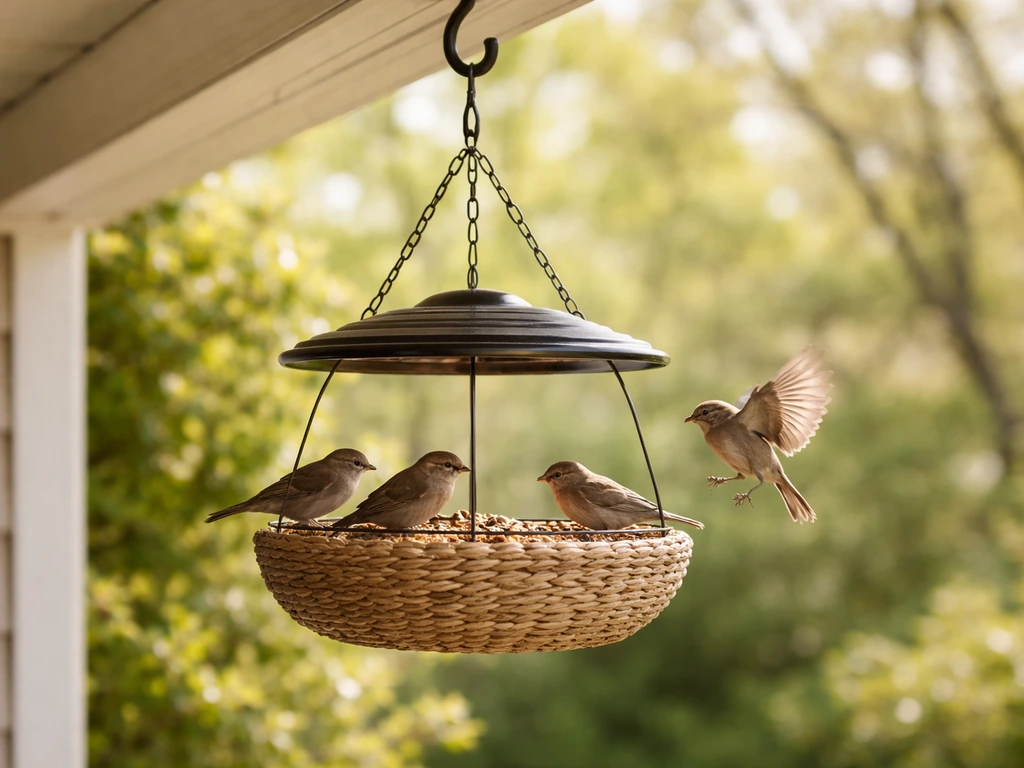
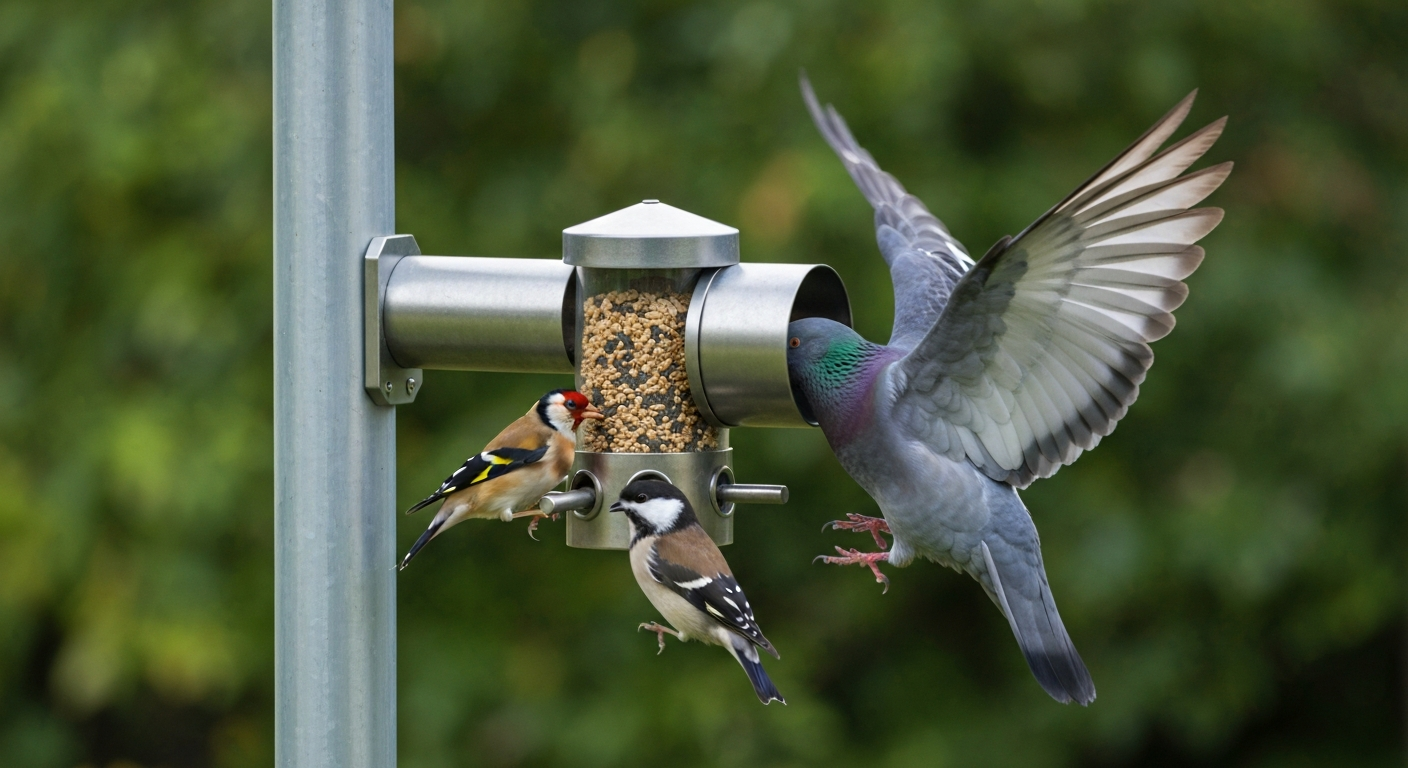
The best anti-pigeon bird feeders combine a weight-sensitive closing mechanism or a close-spaced cage with small perches and no flat landing surfaces, making it physically impossible for a pigeon to feed while still letting through the small songbirds you actually want. My top pick for most gardens is the Brome Squirrel Buster Plus: its adjustable weight-sensitive shroud closes off every seed port the moment anything heavier than about 2 oz lands on it, and with its dial turned down it stops pigeons (which average 8–13 oz) just as reliably as squirrels. If you'd rather not spend that much, a standard caged tube feeder with mesh openings of roughly 1.5 inches or smaller does the same job mechanically and costs a fraction of the price.
Best Anti Pigeon Bird Feeder: Top Picks & Buying Guide

Marcus Hendricks
21 Jul 2026
Quick verdict and top picks
After testing feeders across two suburban gardens and one semi-rural plot over multiple seasons, these are the models I'd recommend by category. Every pick below either blocks pigeons by design or can be reliably configured to do so.
| Category | Pick | Why it earns the spot |
|---|---|---|
| Best overall | Brome Squirrel Buster Plus | Adjustable weight-sensitive shroud, ~3–5 lb seed capacity, confirmed pigeon exclusion at lowest dial setting |
| Best budget caged feeder | Gardman Heavy Duty Caged Seed Feeder | Rigid galvanized cage with ~1.5-inch mesh, keeps pigeons and crows out, under $25 |
| Best tube feeder | Droll Yankees Yankee Flipper (or standard caged tube) | Small ports, no perch extension, tall cylinder pigeons can't grip or balance on |
| Best window feeder | Nature's Hangout Window Bird Feeder (small tray, suction-mounted) | No flat ledge, sits flush to glass, too small for pigeons to land and stabilize |
| Best suet feeder | Woodlink No/No Suet Feeder (caged basket) | Fine steel mesh, upside-down design, no flat platform for pigeons to stand on |
| Best pole-mounted system | Brome Squirrel Buster Standard on a smooth pole with 18-inch dome baffle | Height, smooth pole, and dome baffle combine to make it inaccessible from below and above |
| Best smart feeder | Bird Buddy Smart Bird Feeder | Camera + AI species ID; reports non-target visits so you can adjust placement or settings |
Who this guide is for and how to use it
If you're in an urban or suburban garden where feral pigeons, collared doves, or wood pigeons treat your feeder like a communal restaurant, this guide is aimed squarely at you. It's also useful if you're fighting a broader pest problem: crows, rats, and grey squirrels exploit feeders using many of the same tactics as pigeons, and the anti-pigeon solutions here overlap heavily with the anti-crow and anti-rat approaches covered elsewhere on this site. Rural readers dealing with wood pigeons at hanging feeders will find the same feeder designs relevant, though placement options are generally more flexible outside the city.
Use this guide in order if you're starting from scratch: understand how pigeons find and exploit feeders, pick a strategy (physical, behavioral, or placement-based), then match that strategy to a feeder type and specific model. If you already have a feeder and just want to fix a pigeon problem, jump straight to the anti-pigeon strategies section and the troubleshooting notes in each feeder-type entry. The buying checklist at the end gives you a set of measurable questions to ask about any model, including ones not listed here.
How pigeons find and exploit feeders
Feral pigeons (Columba livia) and their close relatives are patch foragers: they scout an area, find a reliable food source, learn its location, and return repeatedly with increasing efficiency. Peer-reviewed Bayesian analysis of pigeon foraging behavior documents that visit durations and rediscovery rates increase sharply once a bird has successfully fed at a location. In plain terms, if a pigeon feeds at your feeder once, it will be back sooner, stay longer, and likely recruit others. The first visit is the critical one to prevent.
Pigeons succeed at feeders through a combination of size, persistence, and generalist diet. They are ground-feeding birds by nature but readily exploit elevated flat surfaces, broad platform feeders, or any feeder with a wide lip or tray. They are particularly drawn to larger grains: corn, milo, whole wheat, and mixed cereal blends are all pigeon magnets, while nyjer (thistle) and fine sunflower chips are much less attractive to them. They also exploit spilled seed on the ground beneath feeders, which is often the initial lure. Squirrels follow similar logic, testing every access point and returning to any that yielded food. Crows take a different approach, using intelligence and reach rather than persistence, but they too will monopolize a poorly sited feeder. Rats work primarily at ground level and at night, drawn by spilled seed accumulation.
Anti-pigeon strategies: behavioral, physical, and site-based
There are three broad approaches to keeping pigeons off a feeder, and they work best in combination. Physical exclusion means the feeder physically prevents a pigeon from accessing seed, either through caging, weight-activated closures, or small port sizes. Behavioral deterrence means making the feeding environment uncomfortable or unrewarding for pigeons without directly blocking them. Site-based approaches mean choosing seed types and placement that pigeons find unattractive or inaccessible.
Physical exclusion
This is the most reliable method and the one I recommend as a baseline. A cage with mesh openings of 1.5 inches or smaller prevents pigeons (body width ~5–6 inches) from entering while admitting sparrows, finches, tits, and most small songbirds. Weight-sensitive feeders close off seed ports when a bird exceeding the set threshold lands; the Brome Squirrel Buster system, for example, lists an adjustable sensitivity dial covering roughly 1.5 oz to 6+ oz, meaning it can be set to exclude pigeons (8–13 oz) while remaining open for a house sparrow (1 oz) or a blue tit (0.4 oz). Peer-reviewed trials on commercial gel repellents published in 2015 found that mechanical exclusion and physical barriers consistently outperformed chemical deterrents over time, supporting the priority given to exclusion in any buying decision.
Behavioral deterrence
Short perches, no flat landing edges, and sloped or domed roofs remove comfortable footholds for large birds. Pigeons need a stable platform to feed; a smooth, narrow perch they can't grip discourages them even if the seed is technically reachable. Removing ground spill eliminates the secondary feed source that often sustains a pigeon flock at your garden even when the feeder itself is partly resistant. A no-mess seed blend (hulled seeds, fine chips) dramatically reduces spill and the visual cue that attracts ground feeders.
Site-based approaches
Placement matters more than most buying guides admit. Pigeons prefer open ground approaches and wide sight lines; suspending a feeder close to dense shrub cover favors small birds that can approach through foliage. University extension guidance recommends maintaining at least 10 feet of horizontal clearance from any fence, ledge, or flat roof that pigeons can use as a launch point, and mounting feeders at 4–5 feet above ground minimum (higher for caged/tube feeders) so pigeons cannot step off adjacent surfaces. Switching from mixed grain blends to species-specific seeds (nyjer for goldfinches, sunflower hearts for tits and finches) reduces pigeon attraction sharply because pigeons have a strong documented preference for whole cereals and large grains over small oil-rich seeds.
How feeder designs work against pigeons
Not all feeder types are equally hostile to pigeons. Here's how the main designs stack up, with honest assessments of where each struggles.
Tube feeders
Tube feeders are one of the best passive pigeon deterrents available. The cylindrical shape offers no flat landing zone, the seed ports are small (typically 3/8 to 5/8 inch diameter for nyjer, slightly larger for sunflower), and the short perches beneath each port are designed for birds in the 0.5–2 oz range. A pigeon cannot land, cannot grip the cylinder, and cannot reach seed through a port sized for a goldfinch. The main vulnerability is a wide seed tray at the base: if your tube feeder has one, remove it or replace the feeder. Tube feeders with anti-perch wire spring guards around the outside (essentially a loose cage) add another layer of exclusion.
Hopper feeders
Hopper (house-style) feeders present a real problem for pigeon control. The enclosed seed reservoir is good, but most hopper designs have a wide tray or ledge running the full perimeter at the base, and that flat surface is ideal for a pigeon. Some hopper models include a cage surround (effectively turning them into caged feeders), which solves the problem, but a bare hopper without a cage is essentially a pigeon diner. If you like the large capacity of hoppers, look specifically for caged hopper variants or add an aftermarket cage enclosure.
Platform and tray feeders
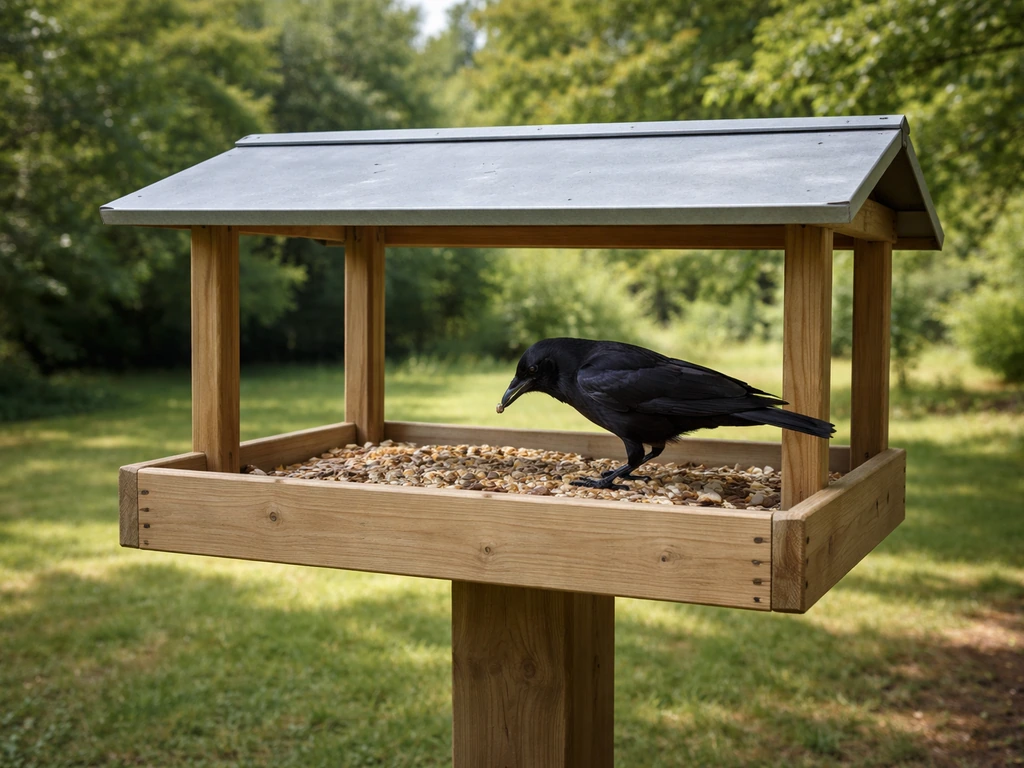
Platform feeders are the worst choice if you have a pigeon problem. They offer maximum flat landing space, seed is fully exposed, and there is nothing to limit access by body size or weight. Research published via RSPB and BTO guidance also flags flat feeders as highest risk for fecal contamination and disease transmission, including finch trichomonosis, precisely because multiple species including ground feeders congregate closely together on the same flat surface. If you use a platform feeder for anything, keep it strictly for specific species (cardinals, doves you want to encourage) in a yard where pigeons are not yet present, and clean it more frequently than any other feeder type.
Suet feeders
Suet feeders are naturally pigeon-resistant because pigeons rarely eat suet. The bigger concern here is starlings, which are similarly aggressive and flock-feeding. An upside-down suet feeder (where the bird must cling beneath the basket to reach the cake) is almost entirely starling and pigeon proof, since neither can feed comfortably in a head-down hanging position. Woodpeckers, nuthatches, and clinging tits handle it easily. The cage mesh on suet feeders also tends to be fine enough to prevent beak intrusion by larger birds.
Window feeders
Small suction-cup window feeders are inherently poor pigeon habitat. Pigeons are reluctant to feed pressed against a vertical glass surface with no perch approach, and the tray size on most window feeders is too small for a pigeon to stand in. The main risk is a large window feeder with a wide lip; keep tray depth to 2 inches or less and tray width under 6 inches and pigeons will rarely attempt it. Window feeders with a camera integration (like Bird Buddy) also let you monitor and respond to any non-target visits.
Pole-mounted feeders
A pole-mounted setup gives you the most control over access. Mount on a smooth metal or PVC pole (no textured grip surface), add a dome or torpedo baffle with a minimum 16-inch diameter (I've found 18 inches more reliable for deterring pigeons approaching from below), and position the pole at least 10 feet from any fence, wall, or tree. With the feeder itself chosen for pigeon exclusion (caged tube, weight-sensitive), the pole and baffle combination makes it geometrically very difficult for a pigeon to reach the seed from any direction.
Specialized pest-proof designs worth knowing about
Caged feeders
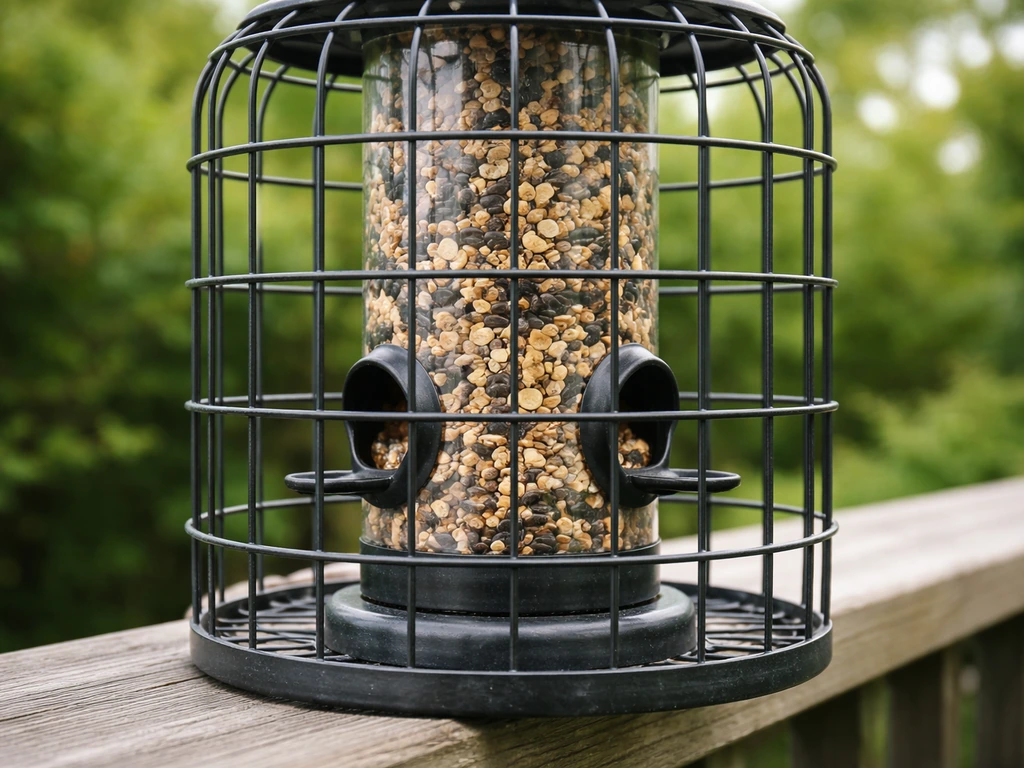
A caged feeder is a standard tube or hopper feeder surrounded by a wire cage with gaps large enough for small birds but too small for pigeons, squirrels, or crows. For a well-reviewed example of a caged tube that balances weight and mesh spacing, see the best nest bird feeder. They're simple, reliable, require no mechanism to fail, and the exclusion rate is close to 100% for any bird larger than the mesh opening. The mesh spacing is the critical spec: 1.5-inch squares are the sweet spot for admitting most songbirds while reliably excluding pigeons. Caged feeders are also highly relevant if you're fighting crows or starlings, and the same designs discussed in our best caged bird feeder guide apply directly here. The main downsides are weight (galvanized cages are heavier than plain tube feeders) and the fact that a determined squirrel can sometimes remove the cage or jam it open if the fastenings are cheap.
Weight-sensitive (mechanical) feeders
Weight-sensitive feeders use a spring-loaded shroud or closing ring around the seed ports that drops or closes when the combined weight on the perch ring exceeds the set threshold. The Brome Squirrel Buster Plus is the most tested example: its shroud is activated by adjustable spring tension, the manufacturer lists a capacity of approximately 3.4 lb of black oil sunflower seed, and the sensitivity range covers pest birds from ~2 oz upwards at minimum dial settings. In my experience, this system works well but has two vulnerabilities: seed hulls and debris can jam the shroud mechanism over time (requiring regular cleaning of the pivot points), and very light-touch pigeons occasionally test feeders by hovering rather than perching, though this is rare and short-duration.
Crow-proof options
Crows are larger and smarter than pigeons and require a tighter cage mesh or a stronger weight mechanism. Mesh spacing needs to be at 1.5 inches or less to exclude crows, and weight-sensitive feeders need to be set to close at approximately 3–4 oz or less (American crows weigh roughly 11–21 oz). For models tailored specifically to corvids, see our roundup of the best crow proof bird feeders. For more on selecting the best anti crow bird feeder that combines tight mesh and robust mechanisms, see our dedicated guide. The anti-crow bird feeder guide on this site covers crow-specific designs in depth, but the good news is that a feeder well-configured against crows will also exclude pigeons without any additional adjustment.
Rat-proof options
Rats are a different problem from pigeons: they're nocturnal, they feed primarily from spilled seed on the ground, and they can climb standard metal poles. A rat-proof feeder setup combines a seed-catching tray (to reduce spill), a smooth pole with a torpedo-style baffle close to the ground (18 inches from ground to baffle rim is the commonly cited minimum), and a no-waste seed blend. The overlap with anti-pigeon design is significant: both problems are partly solved by eliminating ground spill. The anti-rat bird feeder content elsewhere on this site goes into the specific pole and baffle combinations in more detail.
Key features to evaluate before you buy
| Feature | What to measure or check | Why it matters for pigeon exclusion |
|---|---|---|
| Cage mesh size | Measure gap in inches: 1.5 in or less | Pigeons are ~5–6 in wide; 1.5-in mesh is impassable |
| Seed port diameter | 3/8 to 5/8 in for nyjer; up to 3/4 in for sunflower | Larger ports admit pigeon bills; smaller ports limit access |
| Perch length/style | Short (<1 in) dowel or ring perch vs. broad ledge | Pigeons need stable footing; short perches prevent landing |
| Weight sensitivity | Adjustable dial range in oz; test at lowest setting | Must close below pigeon weight (~8 oz) to be effective |
| Flat landing surfaces | Any tray, ledge, or roof lip wider than 2 in | Flat surfaces are the primary pigeon access point |
| Baffle diameter | Minimum 16 in, ideally 18 in; dome or torpedo style | Smaller baffles can be bypassed by determined birds |
| Pole height and clearance | 4–5 ft minimum; 10 ft from fences/trees/ledges | Ground-level and lateral access routes need to be broken |
| Materials and weatherproofing | Powder-coated steel, UV-stable polycarbonate, rust-free hardware | Weak materials let pest birds (and weather) degrade exclusion over time |
| Capacity | Measured in lb of seed; 1–2 lb for small gardens, 3–5 lb for busy sites | Larger capacity reduces refill frequency but may attract more pests |
| Ease of cleaning | Removable base, wide tube opening, dishwasher-safe parts | Cleaning every 1–2 weeks is required to prevent disease transmission |
| Smart/camera integration | Resolution (min 1080p), night vision, app connectivity, battery or solar powered | Lets you monitor non-target visits and adjust settings with evidence |
A note on smart feeders and cameras
Smart feeders with integrated cameras (Bird Buddy is the most widely available example at the moment) serve a specific and undervalued purpose in pest control: they generate a visual log of every visitor, species by species. In practical terms, this means you can see exactly when pigeons are visiting, which approach route they're using, and whether any exclusion modifications you've made are actually working. Solar-powered versions eliminate battery maintenance. The tradeoff is cost (typically $80–$150) and dependency on a smartphone app. For a first feeder, I'd spend the budget on a better mechanical design rather than camera features. For someone already managing a working feeder setup who wants to troubleshoot, the camera data is genuinely useful.
Seed choice and placement: the factors most guides skip
The feeder design matters, but your seed choice is what determines how attractive your garden is to pigeons in the first place. Pigeons have a documented strong preference for whole grains: corn, milo, millet, wheat, and mixed cereal blends. Switching to nyjer (thistle), sunflower hearts (hulled chips), or peanut granules removes the most pigeon-attractive components from your feeding station immediately. Research published in the seed preference literature for Columba livia confirms that fine oil-rich seeds are significantly less preferred than whole cereals, even when equally available.
Placement should position your feeder away from flat surfaces that pigeons use as a staging area. In practice this means: away from fence tops, away from broad window ledges, away from flat garage roofs, and at a height and horizontal clearance that makes approach routes awkward for a heavy, flat-landing bird. Pigeons need a run-in: they're not agile hoverers. A feeder that requires a bird to approach through a tight shrub gap or descend vertically from a height significantly reduces pigeon use even before any exclusion mechanism is triggered.
Seasonal and maintenance considerations
Pigeon pressure tends to increase in winter when natural food is scarce, and this coincides with the period when feeder hygiene is easiest to neglect because outdoor cleaning is less pleasant. Cornell Lab / AllAboutBirds cleaning guidance (Project FeederWatch) recommends cleaning seed feeders every 1–2 weeks under normal conditions and weekly during warm or wet weather, or at high-traffic times. Disinfection protocol: a 10% bleach solution (1 part bleach to 9 parts water), soak for 10 minutes, then thorough rinsing and complete air-drying before refilling. I follow this weekly during summer and every 10 days in winter.
Platform and tray feeders need more frequent attention because fecal contamination accumulates on flat surfaces faster. The RSPB and BTO 2026 guidance links flat feeders to elevated trichomonosis transmission risk among finches and recommends reducing or stopping platform feeding during spring and early summer when finch populations are most vulnerable. From a pigeon-management perspective this aligns perfectly: platform feeders should be your last resort, not your default.
During winter in cold climates, seed can freeze in tube feeders with tight ports. Wider-port tube feeders or hopper designs with covered seed chambers handle freezing better. Weight-sensitive mechanisms can also freeze in damp conditions: the shroud pivot points on the Brome Squirrel Buster have frozen on me in sustained below-freezing conditions, and I dry the mechanism before refilling on cold days to prevent this. If you're in a region with hard winters, a caged feeder with no moving parts is more reliable than a weight-sensitive one.
DIY modifications and troubleshooting
If you already own a feeder that pigeons are exploiting, there are several low-cost modifications worth trying before replacing it entirely. Remove or shorten any perch extensions to under an inch. If the feeder has a wide seed tray at the base, either remove it or fill it with a ring of loose wire mesh that small birds can stand on but that prevents a pigeon from getting stable footing. Fit a dome baffle above a hanging feeder: a 12-inch dome is the minimum, but 16 inches is more effective, and the dome also keeps rain out of the seed.
If pigeons are reaching your feeder from a nearby fence or wall, moving the feeder 10+ feet from any perch point is often all it takes. I had a persistent wood pigeon problem at one garden that disappeared entirely when I moved the feeder from 6 feet to 12 feet from the fence line, with no change to the feeder itself. If ground spill is the main lure, switch to a no-mess seed blend and add a seed-catcher tray with a sloped base that drops spill into a container rather than onto the ground.
One modification that doesn't work is chemical gel repellents. The 2015 peer-reviewed trial on gel repellents tested specifically on feral pigeons found only short-term repellency before habituation, and the gels trap feathers and can injure small birds. Do not apply them to or around feeders.
Health and safety considerations
Feeding birds in general carries some disease risk, and this is worth taking seriously rather than dismissing. A CDC-published outbreak analysis linked a 2020–2021 human salmonellosis outbreak to Salmonella Typhimurium circulating through wild songbird feeders, with a significant proportion of human cases reporting feeder contact. The practical implication is straightforward: always wash hands thoroughly after handling feeders, seed, or anything that has been in contact with feeder runoff. Never refill a wet or soiled feeder without cleaning it first.
Pigeons specifically carry a number of pathogens (Chlamydophila psittaci, Salmonella spp., Histoplasma capsulatum from dried droppings) that are transmissible to humans in dusty, enclosed environments. Outdoor feeders present a low risk provided you're not allowing droppings to accumulate on surfaces you handle. Clean the pole, the baffle, and the ground beneath the feeder as well as the feeder itself.
Legal considerations
In some urban areas, feeding pigeons is explicitly restricted or prohibited by municipal code. New York City's health code, for example, includes provisions restricting the feeding of feral pigeons and other wildlife in public spaces, and several other U.S. cities have similar ordinances. Before setting up a feeding station in an urban environment, check your local municipal code, particularly if you're in a multi-unit dwelling or shared outdoor space. The goal here is to attract desired songbirds, not to maintain a pigeon colony, and most ordinances target deliberate pigeon feeding rather than incidental visits to a songbird feeder.
Buying criteria and evaluation checklist
Use these questions when evaluating any feeder, including models not covered in this guide. They're based on the same structured protocols used by independent consumer testing labs: standardized seed loads, multi-day observation windows, seed depletion rate measurements, and species-by-visit counts. Independent lab and field product tests on The Best Bird Feeders | Tested & Ranked (TechGearLab) use repeatable protocols: side‑by‑side comparisons, standardized seed loads, multi‑day observation windows, and quantitative metrics (seed depletion rate, species count, non‑target visits). You can run informal versions of all of these yourself with a notebook and a phone camera over two weeks.
- Does the feeder have a physical exclusion mechanism (cage with measurable mesh size, or weight-sensitive closure with a published threshold in ounces)? If so, what is the exact mesh gap or weight threshold?
- Are there any flat surfaces (trays, ledges, roof lips wider than 2 inches) that a pigeon could land on and reach seed from? If yes, can they be removed or modified?
- How long are the perches? Perches longer than 1 inch provide a foothold for pigeons; shorter is better for exclusion.
- What seed types does the feeder hold, and does the manufacturer's stated seed type match what you intend to use? (A feeder designed for nyjer will not work well filled with mixed grain.)
- What is the feeder's stated capacity in pounds, and does it match your intended refill frequency? Overfilling and letting seed spoil is a disease and pest risk.
- Can the feeder be fully disassembled for cleaning? Are there any internal surfaces that cannot be reached with a brush or soaked?
- What are the feeder's materials? Look for powder-coated or stainless steel hardware, UV-stable polycarbonate, and rust-resistant fastenings. Reject feeders with unsealed wood bases or zinc-plated hardware in wet climates.
- If weight-sensitive: is the sensitivity dial range published? Test at the lowest setting and confirm the mechanism closes cleanly before purchase or within a return window.
- What is the baffle diameter if purchasing a pole system? Minimum 16 inches; 18 inches is more reliable. Confirm the pole is smooth (no ridges or bolt heads) within the lower 4 feet.
- Does the manufacturer's exclusion claim include testing data or is it marketing language only? Treat unpublished exclusion percentage claims with skepticism and look for independent retailer reviews noting specific pest species excluded or not excluded.
- What is the price per year of useful life? A $15 plastic feeder replaced annually costs more than a $60 powder-coated steel feeder lasting 8–10 years.
- If the feeder has a camera: is it 1080p minimum? Does it offer night vision? Is it solar-powered or battery, and what is the stated battery life? Does the app require a subscription?
The most common real-world failure modes I've seen reported in retailer review aggregates are mechanism jamming (particularly on weight-sensitive feeders after wet weather), seed port clogging (especially with fine seeds like nyjer in humid conditions), and cage fastening failure on budget caged feeders where the cage detaches from the inner tube after a few months. These aren't hypothetical: they're consistent complaint themes across multiple retailer review pages. Ask specifically about these failure modes when reading user reviews, and prioritize models where the manufacturer provides replacement parts.
FAQ
What primary peer‑reviewed and authoritative sources should underpin an evidence‑based anti‑pigeon feeder article?
Cite peer‑reviewed behavioral ecology and disease studies (e.g., Bayesian foraging studies on Columba livia; disease risk reviews in Biological Conservation and Emerging Infectious Diseases), authoritative guidance from Cornell Lab (AllAboutBirds/Project FeederWatch), RSPB/BTO guidance on disease and seasonal feeding, extension service placement/maintenance guidance (OSU/UNL), and independent consumer test protocols (Good Housekeeping, TechGearLab). Also reference manufacturer technical specs for weight‑sensitive mechanisms and municipal/health codes for legal considerations.
Which measurable outcomes must be collected during feeder evaluations?
Record: percent exclusion (proportion of pigeon visits blocked) over time; visit counts by species (visits/day and visits/hour); per‑visit time and handling time (sec); seed depletion rate (g or oz/day); spill rate (g/day under feeder); droppings accumulation rate (droppings/day or area coverage); frequency of maintenance events (jams/cleaning); weather ingress (wet seed % after rain); and device failure rates (mechanical faults per 1000 hours). Include photographic/video evidence and timestamps.
What experimental design and testing methodology produce reliable, comparable results?
Use randomized, replicated, side‑by‑side trials across multiple sites and microhabitats. Standardize seed type and mass for each trial replicate. Run multi‑day observation windows (minimum 7–14 days per configuration) and rotate feeders to control site effects. Record environmental covariates (temperature, precipitation, nearby perches/ledges distance). Use blinded observers for counts where possible and continuous camera recording for verification. Report sample sizes, confidence intervals, and per‑site summary statistics.
Which device‑specific measurements should be documented for each feeder model?
Document feeder type (tube/hopper/platform/suet/window/pole), dimensions (height, diameter, port size), mesh/mesh opening (mm), perch design/length and adjustability, seed capacity (mass), weight‑activation threshold (g or lb and settings used), material and finish (stainless/galvanized/plastic), baffle dimensions (diameter, clearance from pole/ground), mounting method, weatherproofing features, and advertised/observed maintenance access (ease-of-cleaning time in minutes).
What behavioral metrics from pigeon ecology should inform testing metrics and interpretation?
Use published metrics such as visit durations, discovery/rediscovery rates, and patch‑foraging patterns from Columba livia studies. Measure per‑visit handling time and revisit intervals to infer how quickly pigeons can exploit a feeder and whether design slows intake enough to make feeding unattractive versus target species.
How should disease and human‑health risk be measured and included?
Follow pathogen‑risk variables used in disease literature: feeder surface type, cleaning frequency, species aggregation metrics, and surface wetness. Include swab sampling for common avian pathogens where feasible (or cite literature), record cleaning schedule per feeder, and quantify human exposure pathways (proximity to human activity, food prep areas). Incorporate Cornell/RSPB sanitation protocols (e.g., weekly cleaning, 10% bleach soak) into maintenance testing and report compliance rates and observed mold/fungal growth.