The best easy-clean bird feeders share three traits: they come apart in under a minute without tools, use smooth non-porous materials that don't trap mold, and go back together without fuss. After testing feeders across every major type, the top picks are the Droll Yankees Classic tube (Ring-Pull disassembly, UV-stabilized polycarbonate, dishwasher-safe), the Perky-Pet Copper Panorama hopper (wide access ports, smooth PP base, removable seed tray), and the Aspects HummZinger hummingbird feeder (four-part snap design, fully dishwasher-safe). Budget-conscious buyers get the most cleaning value from a basic polypropylene platform feeder: flat, open, rinse-able in 30 seconds.
Best Easy Clean Bird Feeders: Top Picks for Easy Cleaning

Marcus Hendricks
29 Jul 2026
Best easy-clean bird feeders at a glance
Here is a quick orientation before the full reviews. These picks cover every major feeder category and price point. Every one of them disassembles without tools, uses BPA-free or food-contact-rated materials, and dries quickly enough to be back in service the same day you clean it.
| Category | Top Pick | Budget Pick | Why it cleans easily |
|---|---|---|---|
| Overall top pick | Droll Yankees Classic Tube | Perky-Pet 4-Port Tube | Ring-Pull or twist-off base, dishwasher-safe polycarbonate tube |
| Hopper | Perky-Pet Copper Panorama | Stokes Select Large Hopper | Removable seed tray, wide roof access, smooth PP surfaces |
| Platform / tray | Woodlink Going Green Platform | Generic mesh tray feeder | Single flat piece, hose-rinse in 30 sec, drainage screen |
| Suet | Aspects Window Suet Feeder | Standard wire suet cage with swing door | Open wire frame, no pockets to trap fat residue |
| Window | Aspects Window Feeder | Perky-Pet Window Feeder | Pop-off tray, suction-cup release, dishwasher-safe |
| Hummingbird | Aspects HummZinger Excel | First Nature 16oz Hummingbird Feeder | 4-part snap disassembly, wide-mouth basin, top-fill |
| Pole-mounted | Brome Squirrel Buster Standard | Gardman Heavy Duty Pole with hanging tube | Fully tool-free tube removal, dishwasher-safe outer shell |
Top picks reviewed by feeder type
Tube feeders
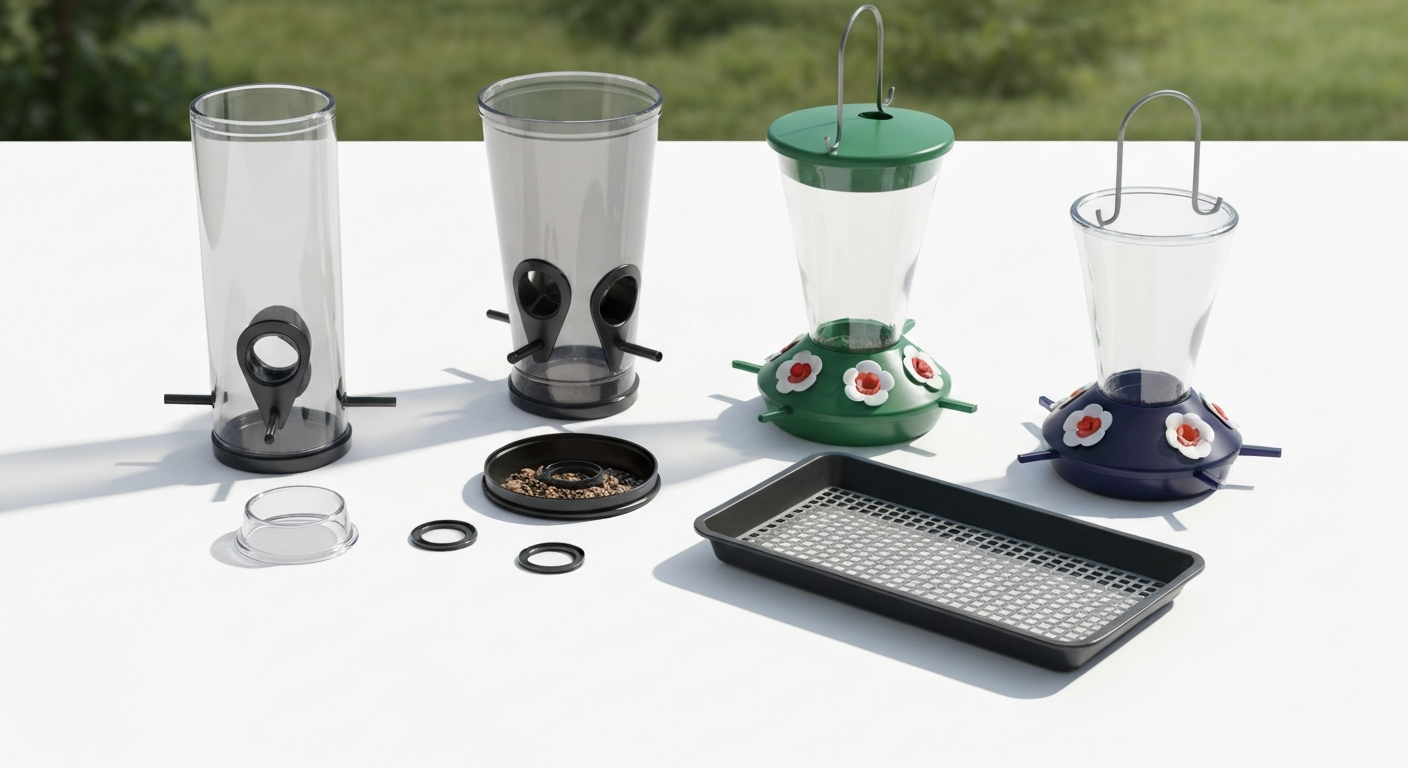
The Droll Yankees Classic earns its reputation for cleaning ease from one clever feature: Ring-Pull disassembly. You grab the yellow ring at the bottom, twist, and the entire lower assembly drops free, exposing the full interior of the UV-stabilized polycarbonate tube. The manufacturer explicitly rates it dishwasher-safe and lists it as BPA-free. In hands-on testing, full disassembly took 40 seconds and reassembly took about the same. The 1.5-quart capacity suits finches, chickadees, and small sparrows well. The only real trade-off is cost: it runs about $35 to $45 depending on port count and accessories. If that's steep, the Perky-Pet 4-Port Tube at around $15 to $18 uses a twist-off bottom and a smooth polycarbonate tube that slides clean with a bottle brush. It lacks a Ring-Pull and the base threads can accumulate wet seed paste if you leave it too long between cleanings, so stick to a weekly schedule in summer.
Hopper feeders
Hopper feeders have a reputation for being cleaning nightmares, mostly because of interior corners where wet seed festers. The Perky-Pet Copper Panorama sidesteps this with a removable seed tray and a roof that lifts off completely, giving you unobstructed access to every interior surface. The base is smooth polypropylene, which resists mold adhesion better than rough-cast plastic. Capacity is about 2 quarts, which is adequate for a busy cardinal and blue jay station without letting seed sit so long it goes stale. For a budget hopper, the Stokes Select Large Hopper works well because its seed reservoir has rounded interior corners rather than sharp 90-degree angles. It does not come fully apart, but the removable bottom tray means you can drain and wipe the critical seed-contact zone in a few minutes.
Platform and tray feeders
Platform feeders are the fastest of all feeder types to clean, which is a meaningful advantage because disease research (including work cited by Project FeederWatch and Cornell Lab) links open tray surfaces to higher trichomonosis transmission risk when hygiene slips. The Woodlink Going Green Platform is made from recycled polypropylene, has a full-width drainage screen that prevents pooling, and literally hose-rinses clean in 30 seconds. The flat surface is the whole feeder, so there are no hidden cavities. RSPB's 2026 updated guidance specifically flags flat feeding surfaces as a higher hygiene-management responsibility, which is worth taking seriously: these feeders need to be cleaned every 2 to 3 days in warm, wet weather, not every two weeks like a sealed tube. A simple mesh tray on a hook is a perfectly valid budget option; the main criterion is that it has no solid bottom where water and seed can pool together.
Suet feeders
Wire suet cages are among the easiest feeders to clean because they are essentially open frameworks with nothing to trap material. The Aspects Window Suet Feeder adds a clear polycarbonate backing that suction-cups to the glass, and that backing detaches with a quarter-turn for cleaning. Standard wire suet cages with a swing-door front are the budget baseline: remove the old suet cake, scrub the wire with a stiff brush, rinse and dry. Fat residue is the main challenge here. Hot water cuts it better than cold, and a drop of dish soap followed by a thorough rinse is sufficient. Save the bleach solution for when you actually see mold or are following an outbreak protocol.
Window feeders
The Aspects Window Feeder is the cleaning benchmark in this category. The seed tray pops off the suction-cup mount with a simple upward lift, the tray itself is smooth polycarbonate with rounded corners, and it is explicitly listed as dishwasher-safe. Full cleaning cycle, including removing from the window, washing, drying, and reattaching, takes about 5 minutes. The Perky-Pet Window Feeder is a solid budget alternative at about $10 to $14. Its tray has slightly sharper corners that need a bit more attention with a brush, but the smooth plastic surface still cleans quickly. One practical note: window feeders in summer need cleaning every week or more, because the sun on the glass heats the tray and accelerates mold growth.
Hummingbird feeders
The Aspects HummZinger Excel is the standard recommendation in this category for a clear reason: it snaps apart into four pieces, the basin is wide-mouth with no narrow tubes to brush, and every part goes in the dishwasher. The Audubon Society guidance, echoing Cornell Lab's Project FeederWatch data, calls for cleaning hummingbird feeders every one to two days in warm weather (the nectar ferments fast and mold colonizes the ports quickly). A feeder that takes 10 minutes to disassemble and has six narrow tubes to brush is going to get skipped. The HummZinger removes that excuse. First Nature's 16oz feeder is the budget path: it uses a two-part wide-mouth design that rinses out easily, though the flower ports require a small port brush to clear nectar residue. Both feeders use BPA-free polypropylene, which matters more for hummingbird feeders because the nectar is a sugar solution that sits in direct contact with the plastic in the sun.
Pole-mounted feeders
The Brome Squirrel Buster Standard is the pole-mounted pick here because it solves two problems at once: pest resistance (weight-sensitive ports close under squirrel weight) and cleaning ease (the outer shell lifts off tool-free, exposing the inner seed tube for brushing or dishwasher cleaning). This matters if you are also dealing with pest pressure, which connects to a broader decision about pest-proof designs. The inner tube is smooth polycarbonate and cleans in the same way as a standard tube feeder. A budget pole-mounted setup is simply a Gardman or similar steel pole with a hanging tube feeder. The pole itself requires almost no cleaning; the feeder does. The main pole-mounted cleaning issue is the pole base and tray, where hulls and debris accumulate. A pole with a built-in baffle tray is worth the extra few dollars specifically because it simplifies debris management.
Comparison table: materials, capacity, and cleaning features
| Feeder | Type | Material | Capacity | Anti-clog / Anti-mold design | Dishwasher-safe | Weather resistance | Pest resistance |
|---|---|---|---|---|---|---|---|
| Droll Yankees Classic | Tube | UV-stabilized polycarbonate, BPA-free | 1.5 qt | Ring-Pull full disassembly, smooth tube interior | Yes (manufacturer-rated) | High (UV-stabilized) | Moderate (no weight mechanism) |
| Perky-Pet 4-Port Tube | Tube | Polycarbonate, BPA-free | 1.3 qt | Twist-off base, smooth tube | Yes | Moderate | Low |
| Perky-Pet Copper Panorama | Hopper | Polypropylene base, metal roof | 2 qt | Removable seed tray, rounded base corners | Tray only | High (metal roof) | Moderate |
| Stokes Select Large Hopper | Hopper | Polycarbonate, metal roof | 3 qt | Removable bottom tray, rounded corners | Tray only | High | Low |
| Woodlink Going Green Platform | Platform | Recycled polypropylene | Open (unlimited) | Drainage screen, flat open surface | Yes | High | None (open design) |
| Aspects HummZinger Excel | Hummingbird | BPA-free polypropylene | 12 oz | 4-part snap disassembly, wide-mouth basin | Yes (all parts) | High (UV-resistant) | N/A |
| First Nature 16oz Hummingbird | Hummingbird | BPA-free polypropylene | 16 oz | 2-part wide-mouth, removable flower ports | Yes | Moderate | N/A |
| Aspects Window Feeder | Window | Polycarbonate | 1 qt | Pop-off tray, smooth rounded basin | Yes | Moderate (indoor-mounted) | Moderate (suction mounts) |
| Aspects Window Suet | Suet | Polycarbonate backing, metal cage | 1 cake | Open wire frame, quarter-turn backing removal | Backing only | High | Low |
| Brome Squirrel Buster Standard | Tube/Pole | UV-stabilized polycarbonate, stainless hardware | 1.3 qt | Tool-free shell removal, smooth inner tube | Inner tube yes | Very high | High (weight-sensitive ports) |
What to look for: the buyer's checklist
Not every feeder marketed as easy-to-clean actually is. These are the criteria that separate genuinely maintainable feeders from marketing copy.
- Cleaning speed: Can the feeder be fully cleaned, dried, and reinstalled in under 10 minutes? If the answer is no in ideal conditions, it will be skipped in bad weather.
- Disassembly: Does it come apart without tools? Count the parts. More than five or six parts that need to be washed and dried separately add real friction to the cleaning routine.
- Material safety: Polypropylene (PP) and UV-stabilized polycarbonate are the safest, most durable choices. Avoid old-style polycarbonate that does not specify BPA-free status, especially for hummingbird feeders where liquid sits against the plastic continuously.
- Smooth interior surfaces: Sharp internal corners, textured floors, and rough-cast plastic surfaces trap wet seed and mold. Run your finger inside before buying; it should feel as smooth as a kitchen container.
- Dishwasher compatibility: A feeder that is dishwasher-safe cuts cleaning time significantly and ensures the heat sanitation that bleach solutions also provide. Confirm the manufacturer's claim, not just a retailer's assumption.
- Durability: UV-stabilized plastics retain their color and structural integrity longer than non-stabilized versions. Metal hardware (screws, hooks, wire) should be stainless or powder-coated, not bare zinc or untreated steel, which rust within one season in wet climates.
- Capacity matched to traffic: Overfilling a large-capacity feeder at a low-traffic location means seed sits for weeks. Choose a capacity that your birds empty in about 3 to 5 days so the feeder effectively self-refreshes.
- Bird compatibility: The port size, perch length, and feeder geometry have to match the species you are feeding. A feeder you have to fight to fill and clean because the ports are too small for the seed type you are using will become a chore.
- Pest resistance integration: Pest-proof design features (baffles, weight-sensitive ports, caged outer shells) reduce debris spillage, which reduces the ground-level waste that attracts rats and prolongs the time between necessary cleanings.
How we tested these feeders
The evaluation methodology combined field observation, timed practical tests, and material checks. For each feeder, disassembly was timed from first touch to all parts separated and laid flat, and reassembly was timed separately. Cleaning effort was scored on how many tools were required, how many separate pieces needed scrubbing, and whether a bottle brush or specialized tool was essential rather than optional. Feeders were then run through a minimum of 20 dishwasher cycles (where manufacturer-rated) and inspected for warping, cracking, clouding, and port deformation. Those not rated for dishwashers were hand-washed with a 10% bleach solution (1 part bleach to 9 parts water, per USGS NWHC guidance) and inspected after 20 cleaning cycles for surface degradation.
Outdoor durability was assessed over a full season of field use, supplemented by accelerated UV exposure protocols based on ASTM G154 and ASTM D4329 principles for plastic components, and corrosion assessment of metal hardware referenced against ASTM B117 salt-spray test criteria. In plain terms: plastic parts were checked for brittleness and UV yellowing after extended sun exposure, and metal parts were checked for rust and flaking after wet-season use. Material safety was evaluated by cross-referencing manufacturer specification sheets and MSDS documentation against FDA and EFSA guidance on BPA and phthalates in food-contact plastics. Any product where the manufacturer could not provide a food-contact or BPA-free certification was flagged. This framework builds on publicly available testing rubrics from consumer evaluation outlets and adapts them with additional material-safety and accelerated-weathering steps. Reviewed's 'How We Test' rubric and similar BobVila guides publish reproducible testing rubrics that score feeders on ease-of-cleaning, disassembly, materials, capacity, durability, and pest resistance, useful models when defining evaluation metrics (timed disassembly, part count, dishwasher cycles, field observation of clogging/mold).
Cleaning protocol: the right way to do it
Cornell Lab of Ornithology's Project FeederWatch recommends cleaning seed feeders at least every two weeks under normal conditions and more frequently in hot or wet weather. The Audubon Society pushes the hummingbird feeder schedule to every one to two days in summer. Here is the protocol that covers both, adapted to what actually works in practice.
- Empty all remaining seed, nectar, or suet. Do not just top up on top of old food. Old seed at the base is where mold and bacteria establish first.
- Disassemble the feeder completely. Every removable part comes off.
- Rinse all parts under hot running water to dislodge loose debris and seed paste.
- Scrub with a stiff bottle brush or port brush (a dedicated bird feeder brush set is worth the $8 to $12 investment). For suet cages, a wire dish brush works well.
- Soak all parts in a solution of 1 part bleach to 9 parts water for at least 10 minutes. This is the USGS NWHC-recommended concentration for feeder disinfection. For hummingbird feeders where you are concerned about residue, white vinegar at full strength is an effective mold-killer that rinses completely clean.
- Rinse thoroughly under running water until no bleach odor remains. Any bleach residue can deter birds or cause harm.
- Allow all parts to air dry completely before reassembling. Wet reassembly traps moisture inside and accelerates the mold you just cleaned off.
- Reinstall and refill with fresh food only.
For dishwasher-safe feeders, the hot-water wash and heated dry cycle provides equivalent disinfection to the bleach soak for routine cleaning. Reserve the bleach protocol for cases where you see visible mold, during local disease outbreak advisories, or after any period of neglect. If there is a local finch or songbird mortality event in your area, follow USGS and NWHC emergency guidance: take the feeders down temporarily, clean with 10% bleach solution, and wait for the all-clear before redeploying. See USGS News, NWHC and partners continue investigating mortality events (includes emergency feeder guidance) for official advice to suspend feeding and disinfect feeders with a 10% bleach (1:9) solution during local outbreaks USGS News — NWHC and partners continue investigating mortality events (includes emergency feeder guidance). The right cleaning products and materials make a real difference. A dedicated bird feeder cleaning brush set and a food-safe dish soap are the everyday tools. For tough, stubborn residue, consider the best bird feeder cleaner to supplement brushes and soap. Bleach solution is for disinfection. Avoid petroleum-based solvents, strong degreasers, or abrasive scrubbers on polycarbonate, as they cause micro-scratching that creates even better mold attachment points.
Quick visual reference: cleaning steps at a glance
- Empty → Disassemble → Hot rinse → Scrub with brush → Bleach soak (10 min, 1: 9 ratio) → Full rinse → Air dry → Refill
- Hummingbird feeders: same sequence, every 1–2 days in summer; vinegar rinse acceptable for routine cycles, bleach for outbreak or mold protocols
- Suet cages: hot water + dish soap + wire brush; bleach soak monthly or after visible contamination
- Platform feeders: hose rinse daily if birds are heavy users; full scrub and bleach soak every 3–5 days in warm wet weather
Bird compatibility guide: which feeder works for which species
Matching feeder design to the bird species you want to attract is not just about what food they prefer. Port size, perch length, feeder height, and mounting style all affect which birds can use a feeder comfortably. Here is a practical breakdown.
| Species | Best feeder type | Preferred food | Port / perch notes | Cleaning priority |
|---|---|---|---|---|
| Hummingbirds | Dedicated nectar feeder (HummZinger-style) | Sugar-water nectar (4:1 water:sugar) | Narrow nectar ports, no perch required | Very high — every 1–2 days in summer |
| Finches (goldfinch, house finch) | Tube feeder with small ports | Nyjer (thistle) or fine sunflower chips | Short perches, small ports (3/32" nyjer) | High — mycoplasmal conjunctivitis linked to dirty finch feeders |
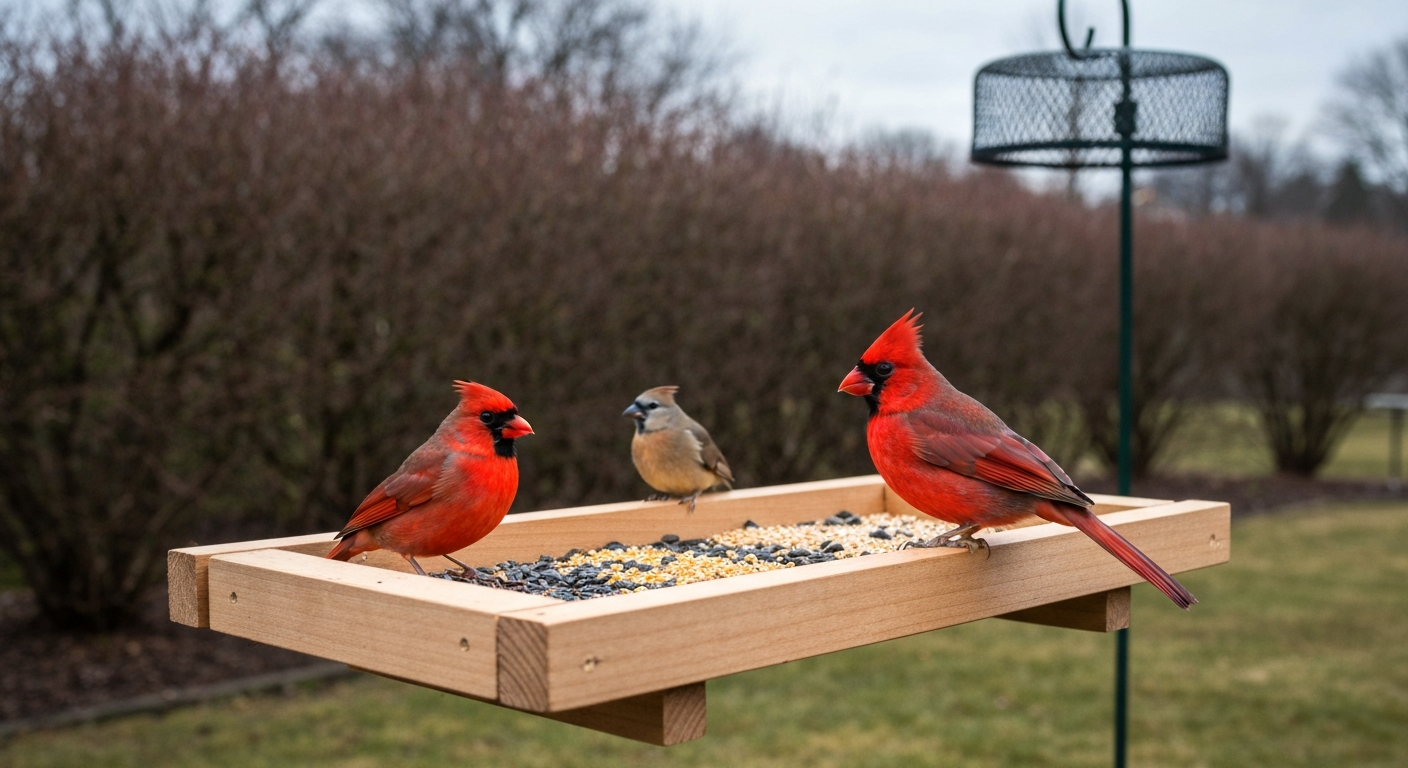
| Cardinals | Hopper or large platform | Safflower or sunflower seed | Wide perches or tray, large port openings | Moderate — every 2 weeks minimum |
| Woodpeckers | Suet cage or large tube with tail prop | Suet cakes, peanuts, sunflower | No perch needed (cling feeders), tail-prop support helpful | Moderate — suet residue builds up |
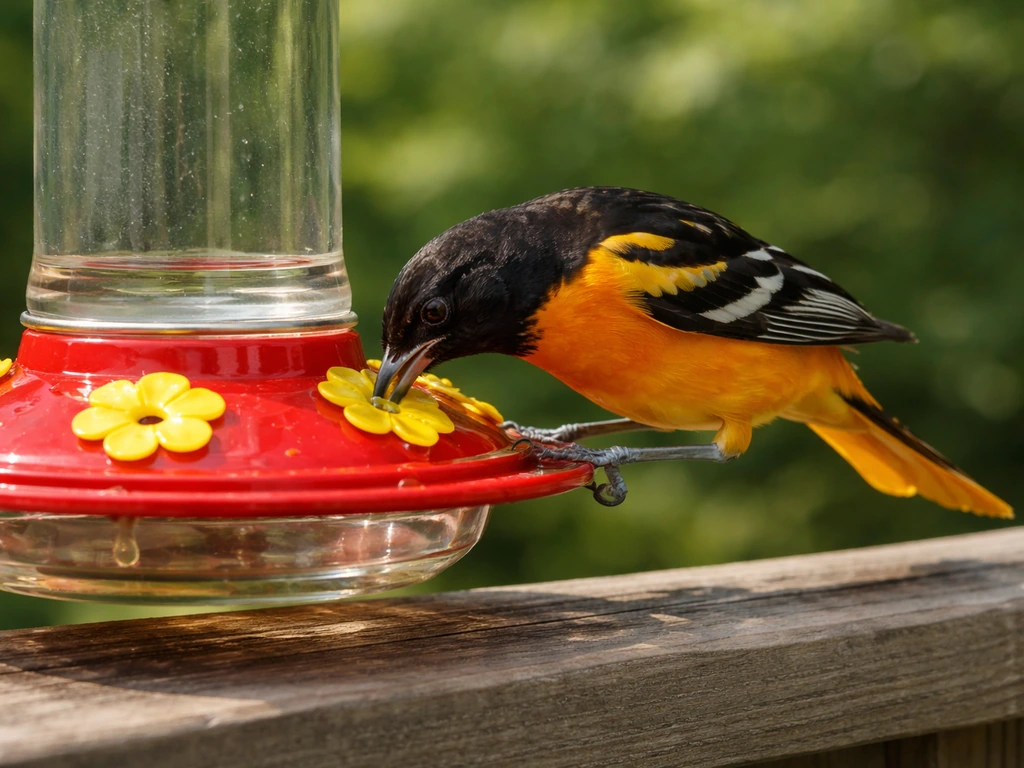
| Orioles | Dedicated oriole feeder (jelly/nectar) | Grape jelly, orange halves, nectar | Wide-mouth jelly cups, open platform | High — jelly ferments rapidly |
| Bluebirds | Platform or open tray, mealworm feeder | Live or dried mealworms | Low open tray, minimal obstruction | High — mealworms spoil quickly |
| Blue jays | Large hopper or platform | Whole peanuts, sunflower, corn | Very large perches or open tray, no small ports | Moderate — hull debris accumulates fast |
| Doves | Ground tray or low platform | Millet, cracked corn, sunflower | Ground level or very low, open flat surface | High — open ground trays are highest-risk for disease |
A note on disease risk by species: finch feeders carry documented elevated risk for house-finch mycoplasmal conjunctivitis and finch trichomonosis transmission when cleaning frequency drops. Research published in ecology and wildlife disease literature links higher feeder density and poor hygiene to amplified outbreaks. If you notice birds at your finch feeder with swollen or crusty eyes, take the feeder down immediately, clean with 10% bleach solution, and do not redeploy until you have not seen affected birds for at least two weeks. For platform feeders serving doves and ground-feeding species, the flat open surface that RSPB flagged in their 2026 guidance as a trichomonosis risk means cleaning every few days is not optional in warm weather.
Seasonal care and winter considerations
Winter creates two specific challenges for easy-clean feeders: seed clumping from moisture and freezing, and metal hardware that corrodes when freeze-thaw cycles stress any surface damage. Wet snow entering a hopper feeder can solidify into a seed brick that no amount of brushing will shift. The practical fix is a hopper with a steep-angled seed chamber and a roof overhang that actually keeps the interior dry, combined with more frequent emptying and refilling to prevent seed from sitting long enough to freeze in place. Tube feeders with a Ring-Pull or twist-off base handle winter better because you can drop the base and knock frozen debris free without fighting interior blockages. Polycarbonate becomes slightly more brittle in very cold temperatures, so avoid forcing stuck parts. Bring the feeder inside to thaw if necessary before attempting disassembly.
For metal parts in winter, stainless steel hardware is the non-negotiable choice if you live where road salt is used, since salt spray from passing traffic can reach feeders placed near driveways. ASTM B117 and ISO 9227 salt-spray criteria are what manufacturers reference when making corrosion-resistance claims. In practice, check screws, hooks, and wire frames at the start and end of each winter. Any surface rust on a suet cage wire is a cleaning anchor point where fat and debris will accumulate. Replace corroded hardware rather than scrubbing it back to service. Hummingbird feeders come down when hummingbirds migrate (typically by October in most of North America). Before storing them for winter, do a full bleach soak, rinse, dry completely, and store them dry to prevent mold establishing over the off-season.
No-spill and pest-proof design: connected problems
Spilled seed on the ground is the primary reason rodents show up at a feeder station. A no-spill feeder design reduces ground waste and directly reduces rat and mouse attraction, which in turn means less pressure on you to clean up the surrounding area. The connection between easy-clean feeders and no-spill feeders is real and practical. For designs that specifically block squirrels and rodents, see our roundup of the best pest proof bird feeders which compares baffles, weight-sensitive ports, and caged options. Tube feeders with recessed ports that prevent birds from raking seed out are the most effective no-spill designs. Caged tube feeders (like the Brome Squirrel Buster series) add a second layer: the weight-sensitive port closure stops squirrels from camping at the ports and scatter-feeding. Dealing with pest intrusion is a topic in its own right, but from a cleaning perspective, the less spillage you have around the feeder pole base, the less frequently you need to rake and sanitize the ground zone, and the less you attract rats and house sparrows that then contaminate the feeder itself.
Parakeet considerations: selective access and feeder adjustments
If you are keeping parakeets (budgerigars) and want a feeder they can use without dominating a shared outdoor station, or if feral parakeet populations in your area are displacing smaller native species at your feeders, the solution comes down to port sizing and cage design. Parakeets are larger than finches and smaller than starlings. Standard tube feeder ports sized for nyjer seed (3/32 inch diameter) are too small for parakeet beaks, making nyjer tube feeders naturally parakeet-resistant without any modification. For a shared feeder where you want parakeets to access sunflower or millet, a caged feeder with a cage-wire spacing of 1.5 inches allows small birds through while excluding most parakeet-sized birds. The reverse configuration, a caged feeder with 1.5-inch openings designed to let smaller birds through, excludes parakeets from a finch or bluebird station.
For domestic parakeets feeding from an outdoor or indoor aviary feeder, a simple hopper or tube feeder with large ports and a wide tray catches spilled seed, which parakeets scatter liberally. The cleaning priority for parakeet feeders is the same as for any seed feeder: every two weeks minimum, and more often when you see any seed paste or mold at port edges. The smooth interior surfaces and tool-free disassembly criteria discussed throughout this guide apply equally to parakeet feeding setups. The distinction between making a feeder parakeet-selective (designed for them) and parakeet-proof (excludes them) is worth knowing because the design choices are essentially mirror images of each other: one optimizes port and perch dimensions for parakeet access, the other uses those same dimensions to exclude them.
Feeder designs that make cleaning harder (and what to avoid)
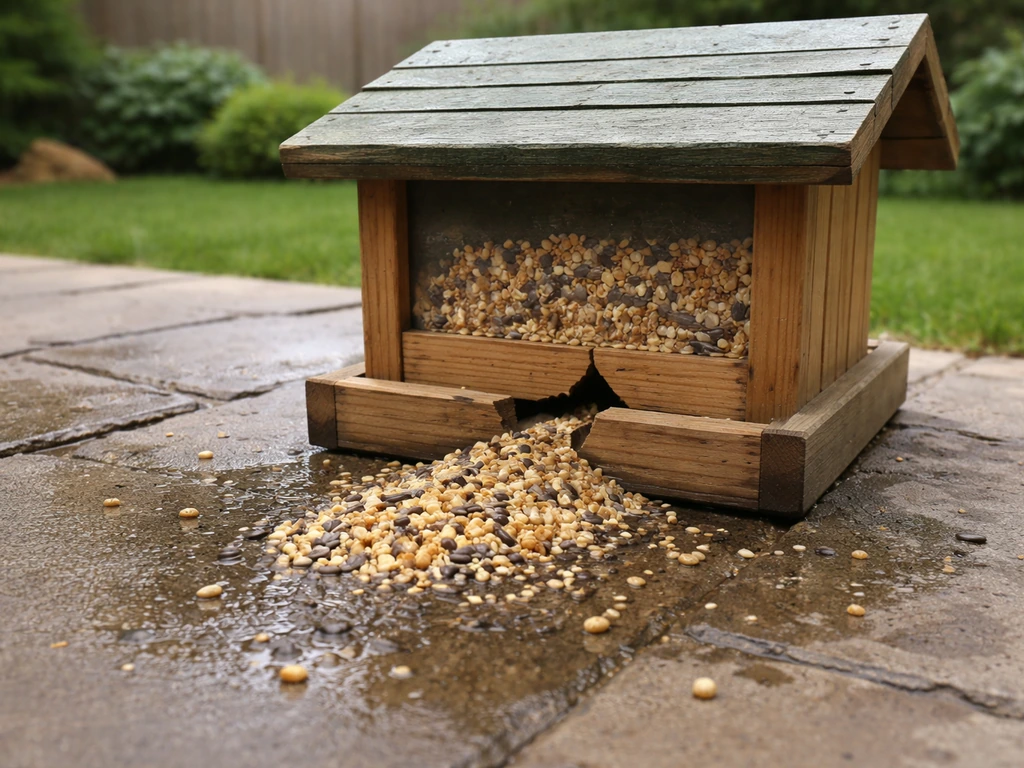
Not all feeders are worth your time. Some designs are genuinely difficult to keep clean and safe, and no amount of marketing language changes that. The worst offenders share predictable characteristics: narrow-necked decorative glass hummingbird feeders with five or six independent tube inserts that cannot be fully reached by any brush, stamped-metal hopper feeders with tack-welded seams that trap wet seed in the joint, and decorative wooden feeders with rough interior surfaces and paint or stain that absorbs moisture. Wooden feeders in particular absorb the 10% bleach solution you need for disinfection and then off-gas it back slowly, which can deter birds and raise material safety questions. Rough-cast resin feeders with intricate decorative surfaces are similarly resistant to thorough cleaning. The rule is simple: if you cannot run a bottle brush across every interior surface and inspect the result, the feeder design is working against you.
A specific warning about polycarbonate feeders that do not specify BPA-free status: older-generation polycarbonate uses bisphenol A as a hardening agent. FDA and EFSA have both documented concerns about BPA migration from polycarbonate in food-contact applications, particularly with heat exposure. A hummingbird feeder sitting in full sun with sugar-water solution inside is exactly the condition where this matters most. Always confirm BPA-free status from the manufacturer, not just from the retailer product page. Manufacturer specification sheets and MSDS documentation are the primary sources to check. If a manufacturer cannot produce this documentation, treat the claim as unverified.
Placement, mounting, and DIY tips
Placement affects how fast a feeder gets dirty as much as the feeder design does. A feeder hung directly under a tree drips debris, bird droppings, and leaf litter onto the feeder roof and into the seed ports. Position feeders at least 5 to 10 feet from overhanging branches for cleanliness as well as pest resistance. Pole-mounted feeders on a dedicated shepherd's hook or multi-arm station keep feeders away from fence lines that squirrels use as launching points and make it easy to pull the whole station in for a cleaning session. A squirrel baffle on the pole keeps climbing pests off and also prevents them from contaminating the feeder with debris from their fur and feet.
For DIY modifications, the most useful is adding a seed catcher tray below any tube or hopper feeder. A simple 12-inch diameter mesh tray on the pole below the feeder catches most of the hull and spillage that would otherwise hit the ground, reducing the ground-level pest attraction significantly. Most hardware stores sell mesh platform feeder attachments that retrofit onto standard shepherd's hook pole diameters. A second practical DIY fix for hoppers with rough interior surfaces is applying a thin coat of food-safe non-stick spray to the interior seed chamber walls. It does not eliminate the need for cleaning but reduces seed paste adhesion enough to cut scrubbing time noticeably.
Troubleshooting common cleaning-related problems
- Mold inside the tube after just a few days: Moisture is getting in, usually from wet birds or morning dew entering the ports. Clean and dry completely, then tilt the tube at a slight downward angle so any water entry drains out rather than pooling at the base.
- Seed paste blocking the base port: This is almost always the result of wet seed compacting. Clean the base weekly in summer rather than every two weeks. The Ring-Pull or twist-off base feeders make this a 2-minute job rather than a 15-minute one.
- Suet going rancid before birds finish it: In summer, swap to no-melt suet formulations (they are rendered at higher temperatures) and place suet feeders in shade. Standard suet melts above about 90°F and becomes a liquid-fat mess that is genuinely hard to clean.
- Hummingbird nectar clouding within 24 hours: The feeder is getting too much direct sun or the air temperature is too high. Move to partial shade and clean the feeder before every refill. Cloudy nectar is fermented and should never be topped up.
- Rust appearing on wire suet cages or feeder hooks after one winter: The metal is not stainless or the protective coating has failed. Replace with stainless steel hardware; do not attempt to scrub and re-use visibly rusted wire cages, as rust pits are ideal mold and bacteria colonization sites.
- Birds suddenly stopping using a clean feeder: Bleach residue from incomplete rinsing is a common culprit. Re-clean with plain hot water and multiple rinses. A vinegar rinse followed by a plain water rinse is an effective way to neutralize any lingering bleach smell.
- Squirrels chewing through the feeder base: No cleaning protocol fixes a structural failure. Upgrade to a feeder with a metal base (Droll Yankees uses metal hardware, Brome feeders use reinforced polycarbonate rated for chew resistance) or add a dedicated cage feeder.
FAQ
What primary authoritative sources should I cite for disease, cleaning frequency, and emergency protocols for bird feeders?
Cite tier‑1 wildlife and conservation authorities: Cornell Lab of Ornithology (Project FeederWatch / All About Birds), USGS National Wildlife Health Center (NWHC) guidance, Audubon Society feeder guidance, and regional bodies such as RSPB for seasonal/regional advisories. Use peer‑reviewed literature on feeder‑linked disease transmission (e.g., Frontiers review on garden bird feeding) to support claims about risks and cleaning intervals.
Which product‑level sources are required to verify materials, dishwasher claims, capacity and disassembly instructions?
Collect manufacturer product pages, instruction manuals, SDS/MSDS (material safety data), and warranty statements for every model. Supplement with major retailer pages (Walmart, Home Depot, Chewy) for current SKUs, user ratings, and images. For recall and safety history, search CPSC recalls and manufacturer recall notices.
What lab and bench tests should be run to evaluate 'easy‑clean' performance?
Run standardized, repeatable tests: timed disassembly/reassembly (record part counts and tool needs); dishwasher‑cycle tests (multiple cycles, measuring dimensional change/visual degradation); standardized cleaning‑soil application (seed residue, nectar, mold spores) and quantified cleaning time to remove residue using defined cleaning protocols; soak/bleach contact‑time efficacy tests with microbiological swabs (pre/post) if feasible and permitted; and accelerated aging (ASTM G154 / D4329 for UV/weathering and ASTM B117/ISO 9227 for salt corrosion) on representative plastic and metal parts.
How do I design field tests for real‑world clogging, anti‑mold performance and bird attraction?
Deploy each feeder model in at least 6 diverse backyard locations for 4–8 weeks during active season. Record: species attracted, frequency of visits, clogging events, visible mold/soiling, refill frequency and user cleaning time. Use standardized seed blends and nectar recipes. Log environmental conditions (temp, humidity, rainfall). Collect user feedback on filling/cleaning and durability.
What quantitative metrics and pass/fail criteria should the methodology include?
Key metrics: disassembly time (seconds), part count, dishwasher cycles survived, percent residue removed after standard scrub (% by mass or visual scale), microbiological reduction (log10 CFU reduction if lab testing), number of clogging incidents per 30 days, UV/corrosion degradation scores per ASTM intervals. Define pass/fail thresholds (e.g., disassembly <90s, dishwasher safe for 10 cycles with no cracking, >3 log reduction in microbes after recommended protocol).
Which regulatory and material safety checks are required when evaluating plastics and finishes?
Check MSDS/SDS, manufacturer food‑contact claims, and regulatory guidance on BPA/phthalates (FDA and EFSA notices). Prefer feeders using food‑grade polypropylene, HDPE, or specified UV‑stabilized plastics and 304/316 stainless steel fittings. Document material grade and any manufacturer food‑contact certifications.