
A cardinal bird feeder is built around one defining feature: room to land and stay. Unlike the slim tube feeders you see marketed for finches, a cardinal feeder has a wide, flat perching surface, generous seed ports or an open tray, and enough structural footprint that a bird the size of a Northern Cardinal (roughly 8 to 9 inches long, about 1.5 oz) can grip, balance, and eat without contorting. The most common styles you'll encounter are hopper feeders with extended trays, open platform feeders, and standard tube feeders retrofitted with a cardinal ring, a circular perch bar that wraps the base of the tube and widens the feeding station. Colors are usually earthy or neutral (green, brown, black, or natural wood), though red accents appear on some models. If a feeder looks substantial, broad, stable, and seed-forward, there's a good chance it was designed with cardinals in mind.
What Does a Cardinal Bird Feeder Look Like: Design & Tips
Who this guide is for and what you'll get out of it
This guide is written for backyard birders who are either shopping for their first cardinal feeder, trying to figure out why their current setup isn't bringing cardinals in, or wanting to tell a cardinal-specific feeder apart from the finch and oriole feeders already in the yard. I've spent several seasons testing feeders in a suburban backyard in the Mid-Atlantic, and I've made most of the obvious mistakes: tube feeders too narrow for cardinals to perch comfortably, feeders hung too close to windows, platform trays that pooled water after every rain. What follows covers visual identification of cardinal feeders, design logic, feeder types, features worth paying for, seed pairing, placement steps, winter prep, pest and durability problems, and a practical buyer's checklist tied to real use cases.
What a cardinal bird feeder actually looks like, quick visual ID
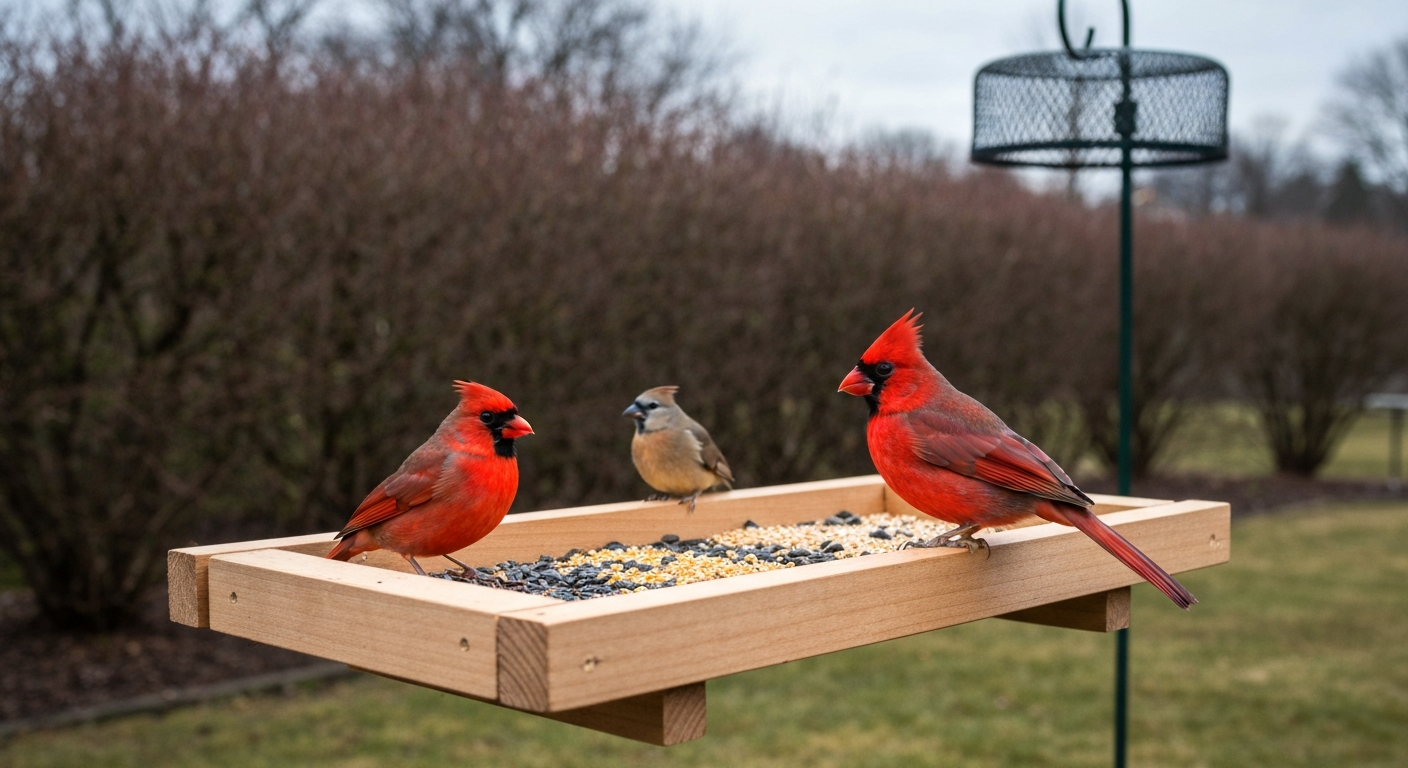
The fastest way to spot a feeder built for cardinals is to look at the perching area. If the perch or tray is at least 1.5 inches wide and sits directly below or around an open seed port, you're looking at a cardinal-capable design. Cardinal feeders tend to be wider and lower-profile than finch feeders. A platform feeder is essentially a flat, open tray, usually 12 to 18 inches across, sometimes with a shallow lip of 1 to 2 inches to keep seed from blowing off. A hopper feeder looks like a small barn or house, four angled walls funneling seed toward a trough at the bottom, with a wide landing ledge running the full length of each side. A tube feeder fitted with a cardinal ring has the standard vertical cylinder (typically 2 to 3 inches in diameter) but gains a circular metal or plastic perch bar, roughly 10 to 14 inches in diameter, attached near the seed ports at the bottom of the tube.
In terms of materials, you'll most commonly see clear or translucent polycarbonate panels on hoppers (so you can see the seed level), poly lumber frames in green or cedar tones on platform feeders, and powder-coated steel or UV-stabilized plastic on tube designs. Red is not a required color for a cardinal feeder, and the research on color preference is more nuanced than most product marketing lets on, studies show that color biases in foraging birds are highly context-dependent, so a green or black feeder stocked with the right seed will draw cardinals just as reliably as a red one. Peer‑reviewed research (Seeing red? Colour biases of foraging birds are context dependent, PMC) finds colour biases in foraging birds are context‑dependent, so red is not universally more attractive to seed‑foraging species Peer‑reviewed research (Seeing red? Colour biases of foraging birds are context dependent — PMC) finds colour biases in foraging birds are context‑dependent, so red is not universally more attractive to seed‑foraging species..
Key design elements: shape, perch, color, and size
Northern Cardinals have a specific feeding posture that shapes every good cardinal feeder design. They are large birds with a wingspan of 10 to 12 inches and a heavy, conical bill adapted for cracking thick seed shells. They prefer to face forward while eating rather than clinging sideways the way a chickadee or nuthatch does. That means they need a perch or platform they can stand on squarely, not wrap their toes around. A perch width of at least 1.5 inches is the practical minimum; many purpose-built cardinal feeders use perches of 2 inches or more. Cardinals are also sexually dimorphic, the male's brilliant red plumage and prominent crest are easy to spot, while the female is a warm buffy brown with reddish tinges on the crest, wings, and tail, so confirming a feeder is working is as simple as watching for that crest silhouette at any time of year.
Size matters more than most buyers expect. A tray or platform with less than 12 inches of usable surface starts to feel cramped for a pair of cardinals feeding together, and cardinals are not especially tolerant of other birds crowding their space. Larger platforms (14 to 18 inches) let multiple birds feed without constant displacement. Hopper feeders should have a feeding ledge at least 3 inches deep so seed doesn't immediately pour off when a cardinal lands. Seed port openings on tube feeders need to be large enough for black-oil sunflower seeds (roughly 0.4 inches diameter per seed), ports under 0.5 inches tend to jam or force cardinals to pick seeds out one at a time, which they will eventually give up on.
Which feeder types work best for cardinals
Platform (tray) feeders
Platform feeders are the single most reliable option for cardinals. They offer maximum visibility for the birds (cardinals are cautious and like to see what's around them), a broad standing surface, and compatibility with every seed cardinals prefer. The main tradeoff is exposure, open trays collect rain and debris, so you need a design with mesh or slatted bottoms for drainage, or you'll be dumping out soggy, moldy seed after every storm. JCs Wildlife and similar vendors make poly lumber hanging trays around 12 by 17 inches with mesh bottoms; that footprint and drainage design is close to ideal. Expect to clean a platform feeder more often than a hopper, roughly every 5 to 7 days in wet weather.
Hopper feeders
A well-built hopper feeder is probably the most visually recognizable style in any backyard. The classic house or barn shape keeps seed protected from rain, extends fill intervals to days or even a week depending on bird traffic, and gives cardinals good perching ledges on both sides. The critical spec to check is ledge depth: ledges under 3 inches don't give a cardinal enough footing and seed falls off before they finish eating. Hoppers typically hold 3 to 6 pounds of seed. Cedar and poly lumber construction last significantly longer than painted pine, which swells and cracks within a season or two.
Tube feeders with cardinal rings
A standard tube feeder is too narrow for cardinals to use comfortably. The workaround is a cardinal ring, which the Brome Squirrel Buster Plus includes as a documented accessory: a circular perch roughly 10 to 14 inches in diameter that attaches to the base of the tube and gives cardinals a stable platform to stand on while accessing the lower ports. Without the ring, cardinals will occasionally try and mostly give up. If you already own a tube feeder, check whether the manufacturer sells a ring attachment before buying a second feeder entirely.
Pole-mounted feeders
Pole mounting is more about squirrel management than feeder style. Almost any platform or hopper feeder can be pole-mounted, and doing so on a smooth metal pole with a baffle (positioned 4 to 5 feet above ground) effectively blocks most squirrel access. Cardinals are not deterred by pole mounting, they're confident fliers and will use any well-placed station. The pole gives you more control over feeder height, which ideally sits between 5 and 6 feet off the ground for cardinals.
Features that are actually worth paying for
Not every premium feature on a cardinal feeder earns its price, so here's how I think about each one based on real use.
- Seed port size: Look for openings of at least 0.5 inches to handle black-oil sunflower without jamming. Safflower seeds are slightly smaller and flow through most standard ports without issue.
- Perch width and material: Metal and poly perches outlast wooden dowels by years. Aim for 1.5 inches minimum; 2 inches is better for extended perching comfort.
- Capacity: For a busy yard with multiple cardinals, a feeder holding at least 3 pounds of seed is practical. The Brome Squirrel Buster Plus holds about 5.1 pounds and that's about the upper end of what's useful — more seed means longer fill intervals but also more seed exposed to spoilage if turnover is slow.
- Squirrel resistance: Weight-activated shroud systems (like the Brome design) that close ports under the weight of a squirrel are the most reliable mechanism I've tested. Cage-style feeders work but the cage openings need to be large enough for cardinals to get their heads in — roughly 1.5 inches square minimum.
- Weather resistance: Powder-coated steel and UV-stabilized polycarbonate hold up significantly better than painted wood or plain plastic after two or three winters. Look for drainage holes in trays and covered hoppers that actually shed water rather than pooling it at the seed line.
- Ease of cleaning: Feeders with removable trays or twist-off bases make the 10-day cleaning cycle much less of a chore. If it takes more than five minutes to disassemble, it won't get cleaned as often as it should.
Feeder types at a glance: comparison table
| Feeder Type | Best Seed for Cardinals | Perch Style | Weather Protection | Squirrel Resistance | Typical Capacity | Cardinal Suitability |
|---|---|---|---|---|---|---|
| Platform / Tray | Black-oil sunflower, safflower, millet mix | Full open surface (12–18 in) | Low (open tray; needs mesh drainage) | Low unless pole-mounted with baffle | 1–3 lb | Excellent |
| Hopper | Black-oil sunflower, safflower | Wide ledge (3 in+ depth) | Good (covered seed hopper) | Moderate with dome or baffle | 3–6 lb | Excellent |
| Tube + Cardinal Ring | Black-oil sunflower, safflower | Ring perch (10–14 in diameter) | Good (enclosed tube) | High with weight-activated shroud | 3–5 lb | Good (ring required) |
| Tube (no ring) | Nyjer, small millet | Narrow dowel (under 1 in) | Good | Varies | 1–3 lb | Poor |
| Suet Cage | Suet (secondary supplement) | Clinging grid | Moderate | Moderate | 1–2 suet cakes | Occasional, not primary |
| Window Feeder | Black-oil sunflower (small fill) | Tray surface | Low | Low | Under 1 lb | Fair (tight space) |
Seed recommendations and feeder-seed pairing
Black-oil sunflower seed is the single best seed for cardinals and the one I stock year-round. The shells are thinner than striped sunflower, making them easier for the cardinal's conical bill to crack, and the seed has a high oil and fat content that's especially valuable in winter when cardinals need extra calories for thermoregulation. Safflower is the second essential: cardinals love it, most squirrels and starlings don't, which makes it a smart choice for problem yards. Safflower has a slightly bitter coating that deters many pest species while remaining attractive to cardinals, house finches, and chickadees.
White proso millet is useful in a platform feeder as a ground-feeding supplement, since cardinals will occasionally drop down to a low tray. Avoid nyjer (thistle) as a primary cardinal seed, it's designed for small-billed finches and cardinals largely ignore it. Shelled sunflower (sunflower hearts or chips) is a premium option that reduces shell debris under the feeder and speeds up feeding, but it spoils faster than in-shell seed in humid conditions. In a platform feeder with slow turnover, I'd stick to in-shell sunflower to minimize waste.
Placement guide: step-by-step setup and winter prep
- Choose a location 8 to 10 feet from dense shrubs or a brush pile. Cardinals feel safer feeding within quick escape distance of cover, but the feeder itself should not be directly against a shrub where cats or other predators can use it as a hiding spot.
- Mount the feeder at 5 to 6 feet off the ground. This height puts it at a natural sightline for cardinals and above casual cat-jump range. Platform feeders can sit slightly lower (4 feet) if ground-feeding is your goal.
- Keep feeders either very close to windows (within 3 feet) or well away (more than 10 feet). The 3-to-10-foot zone is the danger zone for window strikes — birds flushed from a feeder at that distance have enough speed to be seriously hurt if they hit glass. Decals or tape strips on the outside of nearby windows help in any case.
- For pole mounting: use a smooth metal pole, set the baffle at 4 to 5 feet above ground, and keep all branches and structures more than 8 feet horizontally from the pole. Squirrels can leap roughly 8 feet horizontally from a launch point.
- For winter prep: switch to or add safflower and in-shell black-oil sunflower before the first frost — the higher fat content matters when temperatures drop. If you're using a platform feeder, check for drainage blockage before winter; frozen wet seed is a major spoilage issue. Consider adding a weather guard dome over tube or hopper feeders to shed snow and ice from the port area.
- Clean the feeder before any winter hiatus and again when you restart feeding in late winter or early spring. Cornell Lab and Project FeederWatch recommend routine cleaning every one to two weeks with hot soapy water, and a dilute bleach soak (one part bleach to nine parts water) if any sick birds have been observed at the feeder.
Seasonal adjustments: winter feeding and weatherproofing
Cardinals are year-round residents across most of their range and don't migrate, which makes winter feeding both more impactful and more maintenance-intensive than summer feeding. Project FeederWatch data consistently shows that cardinal visitation peaks from November through February in the northeastern and central US, when natural seed sources are depleted. That means winter is exactly when your feeder setup needs to work reliably. A platform feeder that drains well in summer will ice over in winter; adding a roof or switching to a covered hopper for the coldest months prevents the seed-brick problem where an entire load of seed freezes into a solid mass. Keep fills smaller and more frequent (every 2 to 3 days rather than weekly) so seed doesn't sit long enough to freeze solid in one block.
On the material side, poly lumber and powder-coated steel handle freeze-thaw cycles far better than painted or stained wood, which tends to crack at joinery points after a few winters. Polycarbonate panels on hoppers can yellow and become brittle after three to five years of UV exposure, so if you're investing in a hopper feeder, look for panels described as UV-stabilized. Metal baffles and poles actually benefit from cold weather since thermal expansion and contraction is less extreme in metal than in wood. If you're using a cage-style squirrel-resistant feeder, check that the cage welds haven't rusted open enough to let squirrels reach the seed, this is one of the most common failure modes I've seen after two or three winters.
Cardinal vs. finch vs. oriole feeders: how to tell them apart
Once you understand what each species needs, the visual differences between target-specific feeders become obvious. Finch feeders (built for goldfinches and house finches) are typically narrow vertical tubes with tiny ports, sometimes designed to dispense nyjer upside-down, with short thin perches or no perches at all, the opposite of what a cardinal needs. If a feeder looks like it would barely accommodate a sparrow, it's probably a finch feeder. Oriole feeders are a completely different category: they're built around nectar reservoirs or orange-skewering spikes, sometimes with small jelly cups, and they use bright orange coloring as a visual attractor. For visuals and specifics on nectar reservoirs, orange skewers, and jelly cups, see the oriole feeder guide on what does an oriole bird feeder look like. An oriole feeder has no seed ports and no perch wide enough for a cardinal's feeding posture. If you're comparing feeders across species, say, deciding whether to add a finch station alongside a cardinal platform, it helps to know that the two setups don't overlap much in either design or seed type, so you can run both in the same yard without significant cross-use.
The broad-platform, seed-forward silhouette of a cardinal feeder is really its clearest distinguishing feature compared to both finch and oriole designs. If you're exploring what those other feeders look like in more detail, the finch and oriole feeder design guides on this site walk through each style the same way this guide covers cardinals.
DIY and retrofit ideas for attracting cardinals
Building a platform feeder from scratch is genuinely one of the more approachable DIY projects in birding. A basic open tray feeder needs only a few pieces: a 14 by 18 inch base of 1/2-inch exterior plywood or cedar, a mesh or hardware cloth bottom insert for drainage (1/4-inch mesh works well), 1 by 2 inch cedar side rails to create the lip, and either a hanging cable or mounting block for a post. Family Handyman and similar resources publish cut lists and step-by-step builds that translate directly to functional feeders. The main practical notes: seal all wood-to-wood joints with exterior wood glue before screwing, leave at least four 1-inch drainage holes if you're not using mesh, and apply a food-safe exterior finish (raw cedar or untreated pine with a tung oil finish works well). Avoid pressure-treated lumber in any feeder where seed contacts the wood directly.
For retrofits, the most cost-effective upgrade to an existing tube feeder is adding a cardinal ring. Many manufacturers sell these as aftermarket accessories for $8 to $15. If your hopper feeder has shallow ledges (under 3 inches), you can screw a cedar strip along the full length of each ledge to extend the landing surface by an inch or two, it takes about 20 minutes and meaningfully improves cardinal use. A tray feeder underneath a hanging tube feeder is another option: the tray catches spilled seed, creates a secondary feeding station at a lower height, and is wide enough for cardinals even if the tube above is not.
Common problems and how to fix them
Squirrels and predators
The most consistent squirrel-proofing method I've used is the pole-and-baffle combination. A smooth metal pole with a torpedo or dome baffle positioned 4 to 5 feet off the ground stops most squirrels cold if all launch points are more than 8 feet away. Cage-style feeders work as a secondary measure but require checking that the opening size is large enough for cardinals (1.5 inches square minimum), some cages designed for smaller songbirds exclude cardinals along with squirrels. Weight-activated feeders like the Brome Squirrel Buster design are effective and well-documented; the cardinal ring accessory maintains cardinal access while the weight-sensitive shroud closes ports under squirrel weight. The one real-world caveat: very large gray squirrels sometimes straddle the shroud rather than triggering it, so a pole baffle remains the most reliable first line of defense.
Seed spoilage and mold
Wet seed in an undraining tray will mold within two to three days in summer and freeze-clump in winter. The fix is structural (mesh or drilled drainage) plus behavioral: fill less at a time during wet weather, and check the feeder after any significant rain. Bulk seed stored improperly is also a spoilage vector, extension guidance recommends airtight metal or hard plastic containers in a cool, dry location, and discarding any seed that smells off or shows visible clumping or powder (signs of mold or pantry insect activity). Aflatoxin contamination in improperly stored corn or peanut products is a documented risk for birds, so if you're including a peanut or corn-based supplement, buy from reputable suppliers and rotate stock regularly.
Weather and material durability
Painted wood is the most common durability failure I see. Paint peels at joints within a season, the wood underneath absorbs water and swells, and the feeder starts warping and splitting. If you're buying a wooden feeder, cedar without paint is a more durable baseline than painted pine. For plastic feeders, UV degradation is the primary issue: polycarbonate that isn't UV-stabilized yellows and cracks within two to three years in direct sunlight. Powder-coated steel lasts longest against corrosion but check welds at stress points (where perches attach to frames) after each winter, as these tend to be where rust starts.
Buyer's checklist by use case
| Use Case | Priority Features | Best Feeder Type | Seed to Stock |
|---|---|---|---|
| Small yard or balcony | Compact footprint, easy fill/clean, window or railing mount | Small hopper or platform tray (12 in) | Black-oil sunflower, safflower |
| Winter feeding only | Covered hopper or dome, weather-resistant materials, high-fat seed compatibility | Covered hopper, poly lumber platform with roof | In-shell black-oil sunflower, safflower |
| Squirrel or predator problems | Weight-activated shroud or cage, pole-and-baffle setup | Tube + cardinal ring with weight shroud, or pole-mounted platform with baffle | Safflower (also deters many pest birds) |
| Camera or pole mounting | Stable mount point, pole-compatible base, clear sightlines | Hopper or platform on dedicated 1-inch metal pole | Black-oil sunflower for consistent activity |
| Attracting cardinals specifically | Wide perch (1.5 in+), large ports, open or semi-open tray | Platform feeder or wide-ledge hopper | Black-oil sunflower as primary, safflower as secondary |
| Multiple species including cardinals | Multiple port sizes, wide tray plus tube attachment, easy reconfiguration | Hopper with extended ledge + tray feeder nearby | Sunflower + safflower + millet blend |
Ready-made cardinal feeders vs. DIY builds: pros and cons
Ready-made feeders win on convenience and often on squirrel-proofing engineering, the weight-activated mechanism in a feeder like the Brome Squirrel Buster Plus would be difficult and expensive to replicate in a home build. They also come with manufacturer dimensions tested against real bird behavior and, in some cases, documented warranties. The downsides are cost (a quality cardinal-ready hopper or tube-plus-ring setup runs $40 to $80), and the fact that many budget feeders marketed for cardinals cut corners on perch width, drainage, or material quality.
DIY builds win on platform feeder design specifically. A hand-built cedar platform feeder with mesh drainage, properly sized, costs $15 to $25 in materials and will outlast many store-bought equivalents if assembled well. You can also tune the exact tray dimensions to your space. The limitation is that you won't get a weight-sensitive squirrel-proof mechanism without significant additional hardware investment, so DIY platforms generally pair best with a pole-and-baffle setup for squirrel control.
| Factor | Ready-Made Feeder | DIY Build |
|---|---|---|
| Cost | $40–$80 for quality cardinal feeder | $15–$25 in materials (platform) |
| Squirrel resistance | High (weight-activated shroud available) | Low to moderate (relies on pole/baffle) |
| Customization | Limited to manufacturer dimensions | Full control over tray size and perch design |
| Durability | Varies — poly lumber and powder steel outlast budget plastic | High if cedar or exterior-grade materials used |
| Ease of assembly | Immediate use | Requires tools and basic woodworking skills |
| Cleaning convenience | Depends on design — check disassembly ease before buying | Build in easy-access panels from the start |
Photos and diagrams worth including
For anyone putting together a visual guide or product review around this topic, the most useful images are those that show the design features that distinguish a cardinal feeder rather than just the bird itself. Cornell Lab and Audubon maintain high-resolution, properly licensed cardinal photos through their institutional image libraries, and iNaturalist has community-contributed feeder images available under Creative Commons terms, always verify the specific license before publishing.
- Annotated overhead shot of a platform feeder showing tray dimensions, lip height, and drainage mesh (label: 'why platform depth and drainage matter for cardinals')
- Side-by-side of a tube feeder without and with a cardinal ring, showing the perch diameter difference (label: 'how a cardinal ring changes usability')
- Close-up of a hopper feeder ledge showing a cardinal in forward-facing feeding posture, illustrating why ledge depth matters
- Diagram of pole-and-baffle setup with measurements: pole height, baffle placement, clearance distance from nearest branch or structure
- Male and female Northern Cardinal at the same feeder — useful for visual comparison of the sexual dimorphism that makes cardinals easy to confirm at distance
- Seed comparison photo: black-oil sunflower vs. striped sunflower vs. safflower vs. nyjer — scale reference to show why port size matters for each seed type
- Before/after of a deteriorated painted wood feeder vs. a cedar or poly lumber equivalent at the same age
What to read next
If you've got cardinals sorted and want to expand your setup to other species, the design logic shifts pretty significantly. Finch feeders and oriole feeders are built around entirely different bird behaviors and feeding postures, the finch feeder guide on this site covers the narrow-tube, small-perch designs that goldfinches and house finches prefer, while the oriole feeder guides go deep on nectar dispensers, jelly cups, and the orange-color attractors that bring Baltimore orioles in. For specifics on choosing and setting up the best bird feeder for Baltimore orioles, see the dedicated guide covering nectar feeders, orange-skewering spikes, and jelly-cup stations. For recommendations on the best oriole bird feeders, see our dedicated oriole feeder guide for top picks and setup tips. If you're still working out which general feeder style makes the most sense before committing to a species-specific design, the broader overview of what a bird feeder looks like across all types is a useful starting point. For a visual primer on general feeder shapes and features, see the guide on what does a bird feeder look like. Cardinal feeders are one of the more forgiving categories to start with: get the perch width and seed right, and the birds usually show up.
FAQ
What primary species identification questions must be answered to describe what a cardinal bird feeder looks like and why cardinals use it?
Confirm Northern Cardinal field marks (male/female plumage differences, crest, thick conical bill, size) and typical feeding posture. Sources: authoritative species accounts and field guides (Cornell Lab All About Birds, Audubon) and high‑resolution reference photos for annotated visuals.
Which behavioral and ecological questions explain feeder shape, perch and color choices?
Investigate how cardinals feed (ground/tray use, preference for broad perches, front‑facing posture), social feeding behavior, and any color biases. Sources: species behavior guides (Cornell, Audubon), and peer‑reviewed studies on avian color foraging to avoid overstating color effects.
What feeder types and design features should be researched and compared?
List and define feeder types (platform/tray, hopper/box, pole‑/post‑mounted, tube variants with wide ports or cardinal rings), and features: perch width/shape, port size, seed ports vs open trays, capacity, weather guards, squirrel/predator defenses, drainage. Sources: All About Birds feeder ecology, product manuals/spec sheets, and specialist feeder reviews.
What measurable feeder dimensions and specs are required to give practical ‘what it looks like’ cues?
Collect concrete measurements: tray diameter/depth, perch width and shape (recommended ≈1.5 in+), tube diameter, port opening sizes, capacity (cups/pounds), overall height/weight. Sources: manufacturer manuals and retail spec pages (Brome, JCs Wildlife, Target product listings).
Which seed and nutrition questions must be answered for attracting cardinals?
Establish preferred seeds (black‑oil sunflower, safflower), recommended mixes, and winter energy needs. Cite seed preference summaries and rationale (oil content) from Audubon, Project FeederWatch and state wildlife pages.
What placement, mounting and camera‑use questions are important for readers?
Determine optimal feeder height, distance from cover, pole vs hanging mounting, camera‑mounting considerations (stability, sightlines), and predator/household access. Sources: Cornell All About Birds placement guides, Project FeederWatch instructions, extension or wildlife agency notes.