A slow release bird feeder controls how quickly seed reaches birds, whether through gravity-fed ports, adjustable openings, weight-triggered closures, or mechanical dispensers. Instead of piling seed into an open tray that empties in an hour and scatters hull waste everywhere, a slow release design meters seed out in small amounts so birds work for each bite. The result is less ground spillage, fewer rats and squirrels drawn in by easy pickings, longer intervals between your refills, and in some setups, a way to favor smaller species over aggressive ones. If you are burning through seed fast, fighting pest pressure, or just tired of constant refilling, a slow release feeder is worth a serious look.
Slow Release Bird Feeder: Choose, Install, Maintain, DIY
Marcus Hendricks
5 Aug 2026
Who this guide is for and what you will learn
This guide is written for backyard birders who are already feeding birds regularly but want to feed smarter. If you are a newcomer trying to attract your first cardinals or finches, you will find enough foundational context here to get started. If you are a seasoned watcher troubleshooting squirrel raids, seed mold, or winter clogs, you will find specific mechanisms, product criteria, and DIY options to evaluate. By the end you will know what a slow release feeder actually is (and what it is not), how the main slow-feed mechanisms work, which commercial designs perform best for different use cases, how to build a basic recycled-can feeder, which backyard species do well with slow-dispensed seed, and how to install, maintain, and pest-proof your setup across seasons.
What a slow release bird feeder actually is
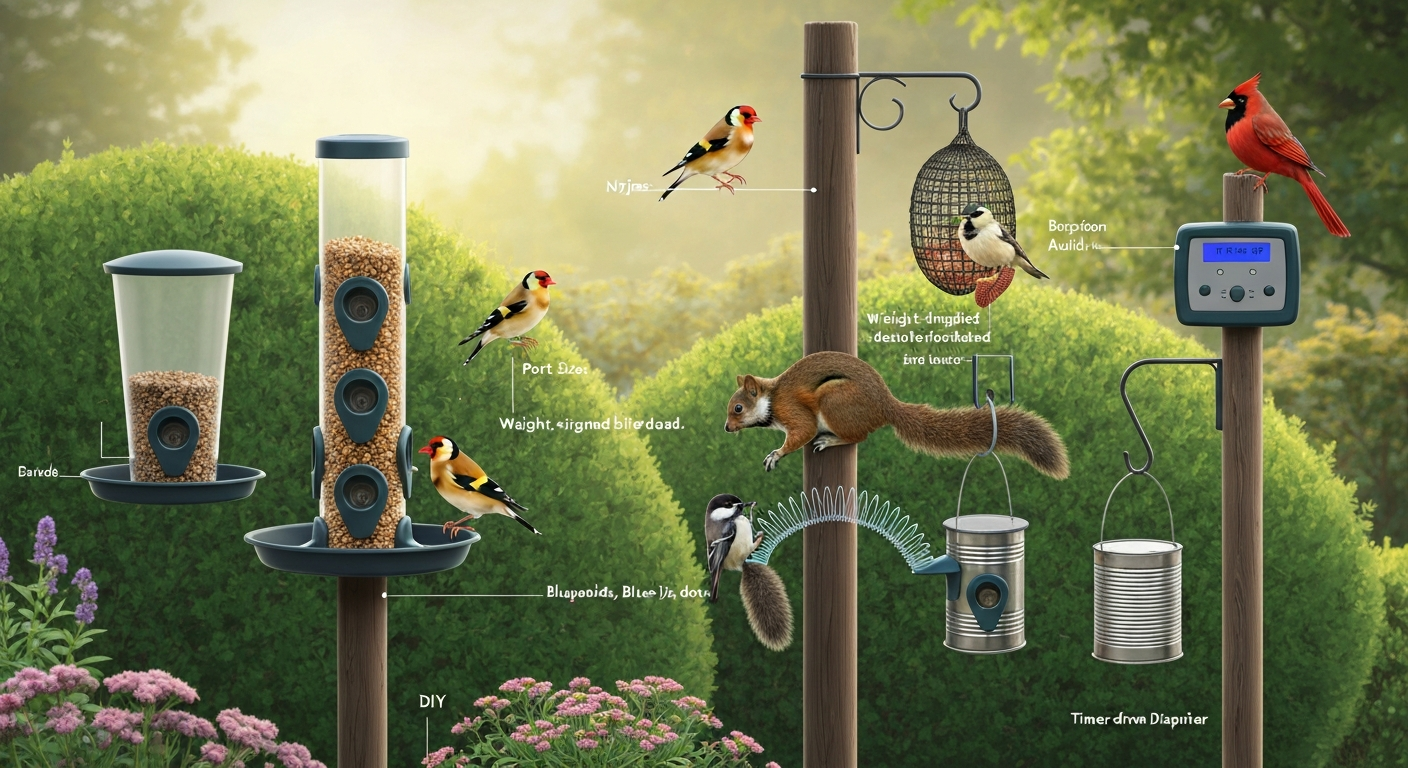
The term does not describe a single product category with a standard definition. It is a functional description: any feeder that limits how much seed is available at one time or controls the rate at which seed flows to birds. For a practical guide to choosing and using a slow bird feeder, see our detailed slow bird feeder guide. A Cornell Lab hopper feeder is technically a slow release design because seed sits in a reservoir and gravity delivers it to access ports only as birds pull it out. A tube feeder with small ports does the same thing on a smaller scale. At the more engineered end of the spectrum, patented designs use elastomeric (rubber-like) feed ports that require birds to press or pull to open, reducing spillage from wind or jostling. Motorized or timer-driven dispensers, which open a hatch on a schedule, represent the most deliberate form of metered delivery.
You use a slow release feeder when your goals include reducing waste, cutting down on ground seed that attracts rats and mice, stretching a bag of seed across more days, or limiting access to dominant species like house sparrows or starlings. It is not the right tool when you want to attract a maximum variety of birds quickly, as the restricted access can discourage timid or less persistent species from stopping by. Context matters: a slow feeder near a busy urban garden serves different goals than one in a quiet rural yard where you simply want to extend refill intervals.
The real benefits of slow-release feeding
Less waste, less mess
Platform and open-tray feeders invite birds to fling seed looking for their preferred pieces, a behavior well-documented in granivorous birds and measurably significant in terms of the seed volume that ends up on the ground uneaten. Restricted ports reduce that flinging behavior because birds cannot get a beak or foot under a pile of seed. Hulled sunflower chips through a tube feeder with narrow ports leave almost no shell debris compared to the same volume of in-shell seed on a platform. That matters practically: ground seed is the number one reason University of Nebraska Extension and similar wildlife agencies cite for attracting mice, voles, opossums, and skunks to suburban yards.
Extended intervals between refills
A slow release design does not necessarily hold more seed than a standard feeder, but it disperses it more slowly, so the same 3-pound capacity lasts longer before the tray or port empties. In practice, a gravity hopper with a narrow port delivers seed only when a bird actively feeds, whereas an open tray can be emptied in minutes by a flock of starlings. If you travel, work long hours, or simply want a low-maintenance setup, the extended interval between refills is one of the most immediately practical advantages.
Pest deterrence
Slow-dispensing ports do not eliminate squirrel pressure, but they reduce the reward. A squirrel that cannot scoop seed freely and has to work for each kernel is less likely to monopolize a feeder for long. Paired with a baffle or a slinky on the feeder pole (a genuinely effective low-cost deterrent), slow-feed mechanisms compound the deterrence effect. Weight-triggered closures go further: the feeder physically shuts under a squirrel's weight but stays open for a chickadee or finch.
Species regulation
Narrow ports sized for nyjer seed physically exclude larger-billed birds. Small perches on tube feeders favor clinging species like finches and chickadees over ground-feeding species like doves or house sparrows. Adjustable port sizes let you tune access seasonally, offering wider ports in winter when energy demands are highest and you want to attract a broad range of species, and tightening them in summer when pest pressure from non-target species is greater.
How slow-feed mechanisms work
Gravity feeders
This is the most common mechanism and the one most people already own without thinking of it as a slow release system. Seed sits in a reservoir (hopper or tube) above a delivery point. Gravity moves seed downward as the lower supply is consumed, but only as fast as birds eat it. The design passively limits availability without any moving parts. Port width is the main variable: a 1/4-inch port on a nyjer tube delivers far less seed per second than a 3/4-inch port on a sunflower tube. Engineering literature on bulk solids describes discharge rate as directly proportional to outlet area and inversely related to seed size, which is why matching port size to seed type is critical for consistent slow delivery without bridging or clogging. Finite element modeling of biomass hopper flow (Frontiers), experimental discharge-rate measurement methods describes standard discharge-rate measurements (weigh total discharged mass divided by discharge time, often with time-stamped video and a balance) and cites Jenike shear cell and ASTM D6128 flowability tests applicable to seed discharge rates (g/min or g/day) Finite element modeling of biomass hopper flow (Frontiers) — experimental discharge-rate measurement methods.
Adjustable ports
Some commercial tube and hopper feeders include a rotating sleeve, sliding plate, or locking collar that lets you change the port opening diameter. This is useful when switching between seed types (nyjer versus sunflower chips, for example) or when you want to temporarily restrict access during a period of heavy pest pressure. Adjustable-port feeders cost more but add meaningful flexibility over a fixed-port design.
Elastomeric feed ports
Patent applications document a more deliberate slow-release approach: a rubber or elastomeric port that stays closed by default and opens only when a bird presses its beak against it. The design claim is that this cuts spillage from wind disturbance and discourages pests that lack the beak dexterity to activate the port. In practice, this mechanism works best with birds already habituated to tube feeders. Expect a learning curve of one to two weeks before new visitors work the port reliably.
Weight-triggered closures
Several well-known commercial designs (Squirrel Buster series being the most recognized) use the feeder's own shroud, suspended around the ports, to physically block access when a heavier animal lands. The mechanism is a spring or counterweight calibrated to typical small-bird weights (roughly 10 to 50 grams). When a squirrel (typically 400 to 700 grams) or a large nuisance bird lands, its weight drives the shroud down over the ports. Small birds trigger no closure. This is a true weight-responsive slow-release system: it does not reduce rate when a target bird feeds, but it effectively stops feeding entirely for non-target animals.
Slinky and baffle accessories
These are not strictly part of the feeder itself but function as access-control devices in the overall system. A metal Slinky coiled around the feeder pole is a cheap and genuinely effective squirrel deterrent: squirrels grip the coil but the spring slides them down before they can climb. Pole baffles (dome or cylinder) work similarly by creating a smooth, overhang surface squirrels cannot get past. Neither mechanism slows seed delivery, but both reduce the frequency and duration of pest visits, giving target birds more of the available seed window.
Timer and motorized dispensers
At the most deliberate end of the spectrum, patented timer-driven feeders use a motor to rotate a seed drum or open a hatch on a programmed schedule, delivering a measured portion of seed at set intervals regardless of whether birds are present. These designs eliminate the passive gravity element entirely: seed is released only when the mechanism fires. This is useful in wildlife-management contexts or for habituating shy species to a feeding station, but they are less common in consumer backyard setups and carry higher price points and battery-maintenance requirements.
Commercial slow-release feeder designs worth knowing
Hopper feeders
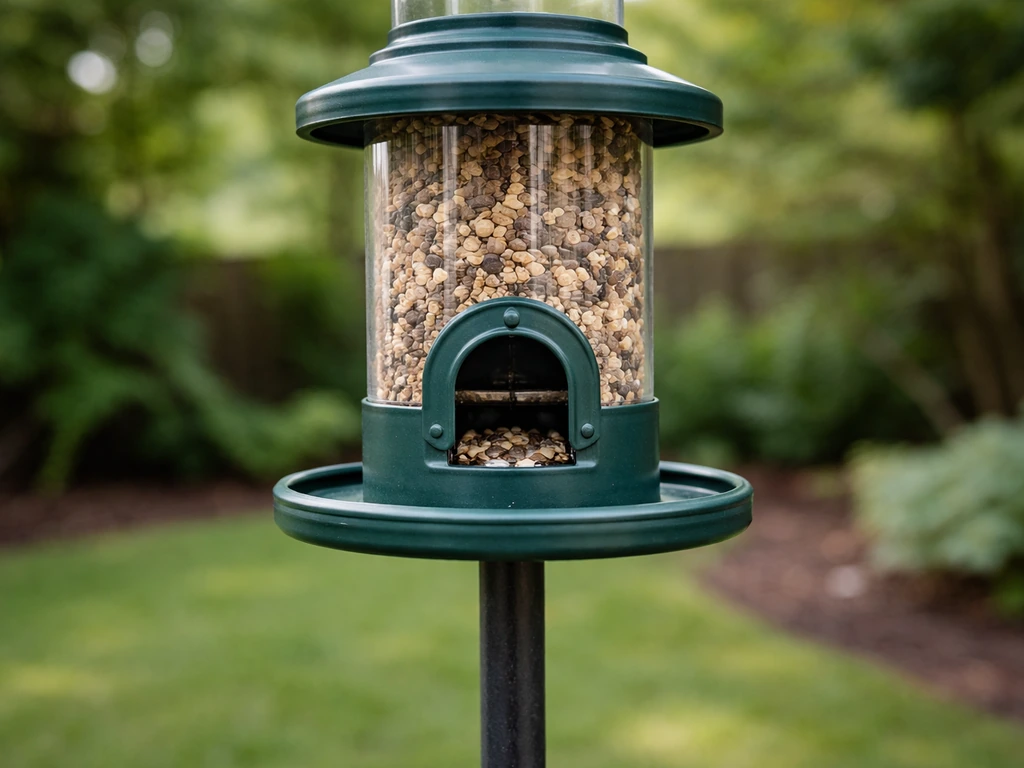
A hopper feeder stores seed in a central chamber and gravity-feeds it to a tray or perch bar below. The seed reservoir is the slow-release element: birds access only what has fallen to the tray level, not the full supply at once. Hopper feeders handle large seed volumes (commonly 3 to 8 pounds) and are compatible with black-oil sunflower, safflower, and mixed seed. The tradeoff is that the open tray still allows some raking behavior. Better hopper designs include seed-saver trays with small drain holes and a narrow tray width that discourages scooping. Wood-construction hoppers look attractive but require more maintenance than polycarbonate or metal versions, especially in wet climates where wood swells and traps moisture that promotes mold.
Tube feeders
A tube feeder with small, fixed ports is one of the most genuinely slow-dispensing designs available for a residential yard. Each port delivers seed only when a bird actively feeds from it, and the narrow opening limits how much seed can exit per feeding event. Metal-reinforced ports resist squirrel chewing, which plastic-only ports do not. For nyjer seed, mesh-tube feeders (sock-style or rigid mesh) allow finches to cling anywhere and pull single seeds through the mesh, which is an efficient slow-release method with minimal spillage. Tube feeders require regular cleaning because moisture and seed debris can accumulate at the bottom; look for models with removable base caps or drainage ports.
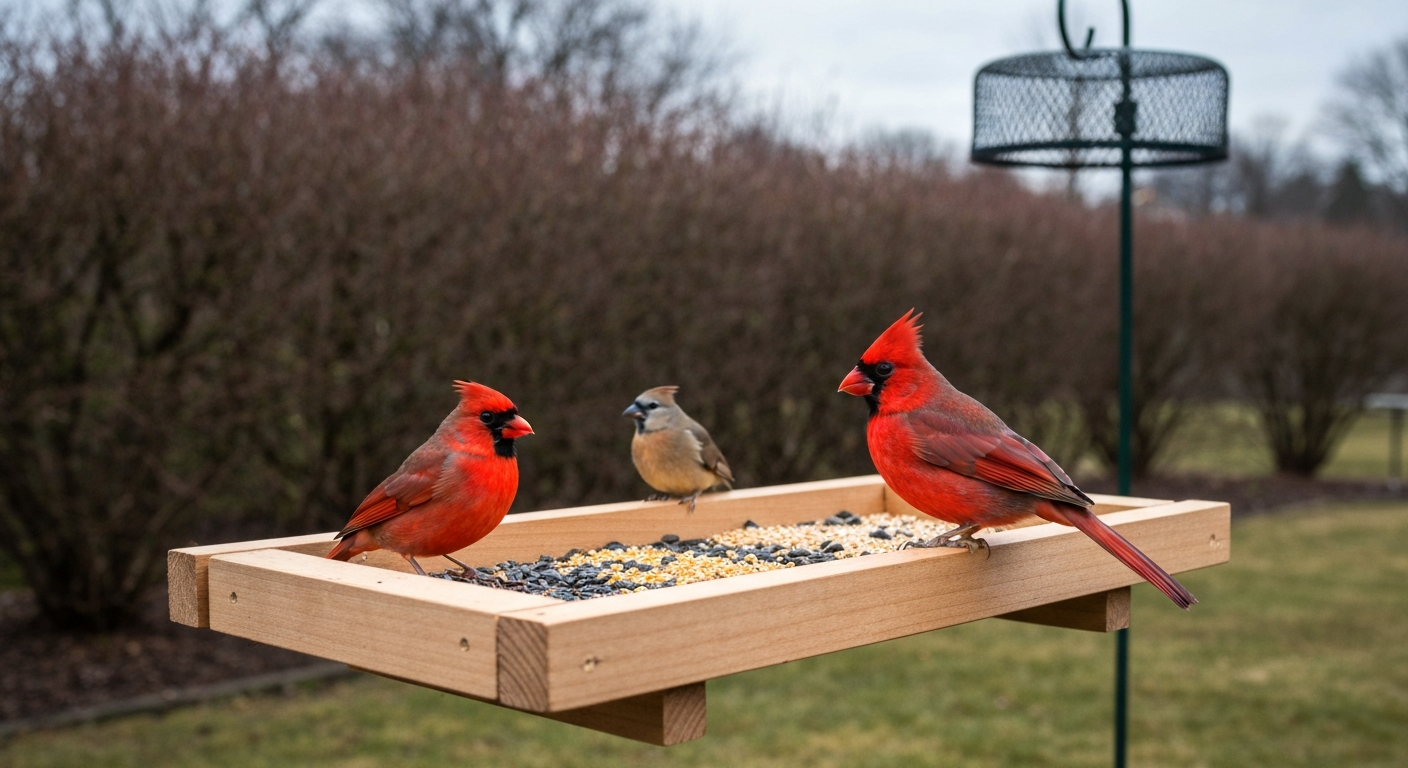
Platform feeders with restricted trays
Standard platform feeders are the opposite of slow release, but platform designs with screened bottoms, shallow seed wells, or seed-restricting inserts can limit volume and improve drainage. These work better as supplemental feeders for ground-feeding species (doves, juncos, native sparrows) rather than as primary slow-release setups. A platform feeder with a mesh or grid insert allows birds to pick through seed while small amounts fall through the grid to a catch tray, reducing the pile that attracts pests.
| Feeder type | Slow-release mechanism | Typical capacity | Weatherproofing | Squirrel/pest resistance | Best for |
|---|---|---|---|---|---|
| Gravity hopper | Reservoir gravity feed to tray | 3–8 lb | Moderate (roof overhang) | Low–moderate (open tray) | Cardinals, jays, chickadees, mixed species |
| Tube (fixed small ports) | Port-width limits per-event seed delivery | 1–3 lb | High (sealed cylinder) | Moderate (metal-reinforced ports) | Finches, chickadees, nuthatches |
| Nyjer mesh tube | Mesh limits single-seed pull | 0.5–1.5 lb | Moderate (fabric sock lower) | Low (accessible to squirrels) | Goldfinches, siskins, redpolls |
| Weight-triggered shroud | Shroud closes ports above weight threshold | 1–3 lb | Moderate–high | High (weight-responsive closure) | Small songbirds; excludes squirrels |
| Timer/motorized dispenser | Timed hatch releases measured portions | 1–5 lb | Variable (battery housing must seal) | High (no passive access) | Shy or regulated-access species |
| Platform with seed insert | Shallow well limits seed pile depth | 0.5–2 lb | Low (open design) | Low | Ground feeders: doves, juncos, sparrows |
Safety and durability checklist for commercial feeders
- Metal-reinforced ports resist squirrel chewing; all-plastic ports typically last one season before damage
- UV-stabilized polycarbonate or powder-coated steel resists cracking and fading in direct sun
- Drainage holes or mesh floors prevent standing water that accelerates mold and salmonella risk
- Removable seed tubes or trays make the weekly cleaning recommended by feeder hygiene advisories practical rather than theoretical
- Weight-closure spring tension should be adjustable if possible; factory settings exclude most squirrels but can also block larger target birds like blue jays
- Avoid feeders with sharp internal ridges or weld burrs that can trap seed and moisture
DIY slow-release feeders from recycled cans
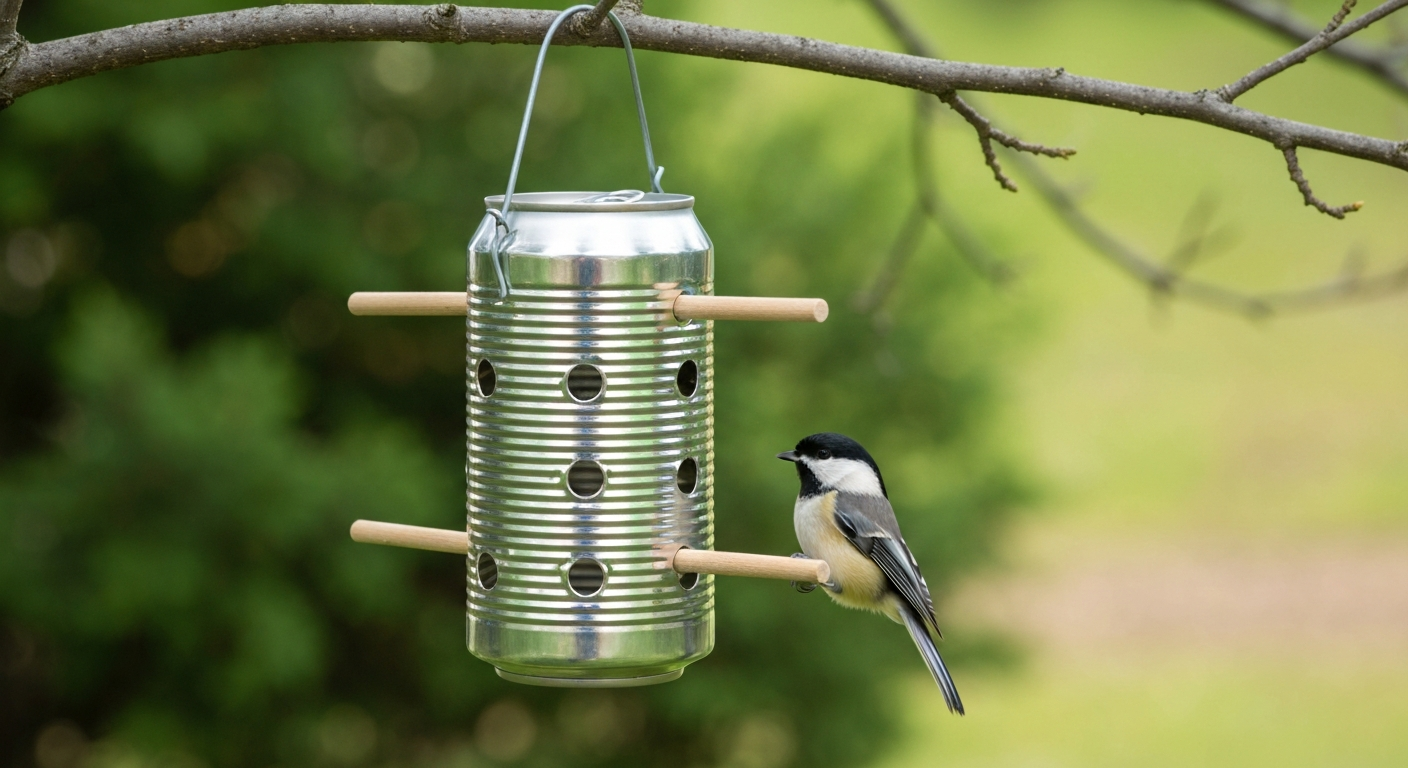
Recycled-can feeders (aluminum beverage cans, beer cans, soda cans, oil cans, and soup cans) are a popular DIY category. For a simple, low-cost example, a soda can bird feeder demonstrates the basic principles, controlled exit holes, a perch, and safe edges, making it a good starter DIY project. See the instructions below for how to build a simple soup can bird feeder from a recycled can. See this guide's DIY instructions for step-by-step tips on making an aluminum can bird feeder from recycled beverage and soup cans. They cost almost nothing in materials, make use of waste packaging, and can be sized and perforated to function as small gravity-feed dispensers. A simple recycled can bird feeder can be made by puncturing controlled-size exit holes and adding a small perch. I have built several versions over the years. They work, with caveats that are worth understanding before you start drilling holes in your recycling bin. See a simple beer can bird feeder DIY plan for step-by-step instructions.
Basic design options
The simplest recycled-can feeder hangs a cleaned can with one or two small holes punched near the bottom edge so seed trickles out as birds peck at it. A beverage can (standard 12 oz or 500 ml) works for small seed like nyjer or millet. A larger soup or coffee can (14 to 28 oz) handles sunflower seed. An oil can or larger format tin can offer more capacity and a sturdier wall. See a dedicated oil can bird feeder guide for detailed build plans and safety tips. The common design thread is: puncture controlled-size exit holes near the base, add a perch (a short wooden dowel threaded through small holes on either side of the can just below the exit hole), hang the can horizontally or at a slight downward angle from a wire or hook through the sealed end, and fill from the open end before sealing it with a plastic lid or cut cap.
Step-by-step build for a basic can feeder
- Clean the can thoroughly with hot water and dish soap; remove all food residue and let it dry completely for 24 hours
- Mark two exit holes near the sealed base of the can, about 3/8 inch diameter for sunflower or 1/4 inch for nyjer; use a nail punch or drill with a sharp bit
- Mark two perch holes directly below the exit holes, 1/8 inch diameter; thread a 4-inch wooden dowel (3/16 or 1/4 inch diameter) through both sides so it extends about 1 inch on each side
- Smooth all cut and punched edges with fine sandpaper or a small metal file to eliminate sharp burrs — this step is non-negotiable for bird safety
- Punch or drill a small hanger hole through the center of the closed base (the opposite end from the fill opening); thread a wire loop or S-hook through it
- Fill the can through the open end with dry, fresh seed; do not pack it tightly
- Close the open end with a tight-fitting plastic lid (original or cut from another container) or fold a small square of aluminum foil securely over the rim
- Hang at a slight downward angle toward the exit holes so gravity moves seed toward the ports; adjust angle to control trickle rate
Safety considerations for can-based feeders
The wall thickness of a standard beverage can runs around 0.10 mm in the midwall section, which is extremely thin. Cut edges are razor-sharp and stay that way. Any opening you create in a can needs to be filed or sanded smooth on both the inside and outside face before the feeder goes up. I use a round needle file for the inside edge of punched holes and 220-grit wet-dry sandpaper for the exterior. Do not skip this. Bird foot and tongue injuries from sharp metal edges are real and preventable.
Interior can linings are the other concern. Most food and beverage cans have an internal polymer or epoxy coating, and the FDA has documented that these linings historically used BPA-based epoxy resins. While direct food contact risk from these coatings at ambient temperature is considered low for humans, birds are small and spend time in close contact with the feeder interior. My recommendation: use cans only as exterior housings and avoid designs where seed sits directly in prolonged contact with the internal coating. A small folded tube of food-grade wax paper as an inner liner, or simply choosing cans with documented BPA-free coatings (now common on newer cans), is a reasonable precaution. Oil cans and paint cans should not be used unless you are certain of their prior contents and have confirmed the interior is clean and uncoated with residual chemicals.
Durability and coating recommendations
Bare aluminum and tin cans corrode on the exterior in wet conditions, especially at cut edges where the metal is exposed. A light coat of exterior-grade clear enamel spray paint on the outside extends feeder life considerably and is safe once fully cured (allow at least 48 hours after painting before filling). Avoid painting the interior or over exit holes. Beer, soda, and aluminum can feeders printed with colorful graphics look appealing but the printed ink is not waterproof; expect the graphics to fade within one season in direct sun. A coat of exterior clear-coat over the printed surface before deployment helps.
In terms of longevity, expect a thin beverage-can feeder to last one to two seasons before rust or deformation makes it unsafe. Heavier-gauge soup cans and oil cans last two to three seasons with a protective coat. None of these match the multi-year durability of a powder-coated steel or polycarbonate commercial feeder, but the near-zero material cost means replacement is not a financial burden. The environmental case for using recycled cans is straightforward: repurposing a can before it enters the recycling stream is a net positive over manufacturing a new plastic feeder, provided the build is done safely.
Using a Slinky as a DIY slow-access control
A metal Slinky threaded over a bird feeder pole, with the top loop attached to the pole just below the feeder and the coil hanging loosely around the pole to the ground, is a low-cost and genuinely effective squirrel deterrent. A squirrel grabs the coil, the spring stretches under its weight, and it slides back down before reaching the feeder. The National Wildlife Federation and numerous backyard birding forums document this as one of the most reliable DIY pest-control measures, costing under five dollars. Use a metal Slinky, not plastic; plastic versions crack quickly outdoors and the coil gaps allow squirrels to find footholds. Thread the top loop over the pole before installing the feeder, then secure it with a zip tie or hook so it cannot slide all the way down. The Slinky does not slow seed delivery inside the feeder itself but combines effectively with any slow-release port design to reduce pest time at the feeder.
Which birds do well with slow-dispensed seed
Not every backyard species is equally suited to slow-release feeding. Tube and port feeders favor birds that can cling or perch at a fixed point and work a small opening persistently. Ground-feeding and flock-feeding species tend to do better with platform access or at least a reasonable tray. Here is how the main backyard species break down.
| Species | Preferred feeder type | Seed preference | Slow-feed compatibility | Notes |
|---|---|---|---|---|
| American goldfinch | Nyjer mesh tube or sock | Nyjer, hulled sunflower chips | High | Clings readily; persistent at small ports |
| House finch / Purple finch | Tube with small ports | Black-oil sunflower, nyjer | High | Adapts quickly to port feeders |
| Black-capped / Carolina chickadee | Tube or weight-triggered | Black-oil sunflower, sunflower chips | High | Agile clingers; handles any port size |
| White-breasted nuthatch | Tube or hopper with perch | Black-oil sunflower, peanuts | High | Feeds upside-down; works ports efficiently |
| Downy / Hairy woodpecker | Suet cage or peanut tube | Suet, peanuts, sunflower | Moderate | Suet cages are naturally slow-dispensing |
| Northern cardinal | Hopper with tray or large-port tube | Black-oil sunflower, safflower | Moderate | Prefers wider perch; struggles with tiny ports |
| Blue jay | Hopper or large platform | Whole peanuts, sunflower, corn | Low–moderate | Weight may trigger spring-loaded closures; prefers open access |
| Mourning dove | Ground or platform feeder | Millet, milo, cracked corn | Low | Picks from ground; not suited to tube/port feeders |
| Dark-eyed junco | Low platform or ground scatter | White millet, finely cracked seed | Low | Ground feeder; benefits from seed that falls from slow-release ports above |
| Song sparrow / native sparrows | Low platform or ground below slow feeder | Millet, small seed | Low–moderate | Often scavenge spillage from slow-tube feeders above |
| Orioles | Nectar or fruit feeder (not grain) | Nectar, oranges, grape jelly | N/A for grain feeders | Separate feeder type; not relevant to seed slow-release |
| Hummingbirds | Nectar tube feeder | Sugar water | N/A | Flow rate controlled by port size in nectar feeder; separate category |
The behavioral pattern worth noting is that the species best suited to slow-release tube and port feeders (finches, chickadees, nuthatches) are exactly the birds most backyard watchers want to attract. The species that struggle with restricted ports (doves, juncos, native sparrows) are also the ground feeders who benefit indirectly from slow-release designs above, because seed that trickles slowly from a tube falls to the ground in small amounts rather than being dumped in bulk. Running a slow tube feeder above a bare ground patch or a low tray effectively creates a two-level feeding station: targeted port feeding above, incidental ground feeding below, with dramatically less waste than an open platform produces.
Buying criteria and what to look for
When I evaluate a slow-release feeder for a recommendation, I work through a short checklist of features that actually matter in real-world use rather than the marketing claims on the box. Capacity in pounds (not just 'large' or 'small'), material quality, port adjustability, and ease of cleaning are the factors that separate a feeder that lasts five years from one that ends up in a landfill after one season.
- Capacity: measured in pounds or ounces, not vague descriptors; 2–3 lb is practical for most backyards, 5+ lb suits high-traffic stations or extended trips
- Material: UV-stabilized polycarbonate or powder-coated steel outlast untreated plastic or uncoated aluminum; check for metal-reinforced ports if squirrels are a known issue
- Port adjustability: a rotating sleeve or sliding collar gives flexibility across seed types and seasons; fixed ports are fine if you feed one seed type consistently
- Weatherproofing: roof overhang depth (at least 2 inches), drainage holes in trays, sealed seams; critical in wet climates and for winter ice prevention
- Pest resistance: weight-triggered closure calibration (adjustable spring tension is preferable), compatibility with pole baffles and Slinky deterrents
- Cleaning access: removable base, wide tube openings, dishwasher-safe parts; feeders that cannot be fully cleaned are a disease risk and should be avoided
- Camera compatibility: if you want to add a smart camera later, check mounting options; some feeder systems are designed with camera mounts integrated into the pole or roof
- Seed-type compatibility: confirm port size matches the seed you intend to use; nyjer requires ports under 3/8 inch, sunflower needs at least 1/2 inch
Installation, placement, and seasonal care
Where to place your feeder
Place slow-release tube and hopper feeders at least 10 feet from the nearest fence or tree branch to reduce the squirrel launch angle. The old advice is to position feeders either within 3 feet of a window (so a collision is a bump rather than a lethal strike) or more than 30 feet away (so birds have time to avoid glass at full speed). A pole-mounted feeder at 5 to 6 feet height with a baffle at 4 feet is the standard setup. Avoid placing feeders directly over garden beds unless you want ground-fall seed to become an unplanned planting. Shade matters in summer: a feeder in full afternoon sun in July will heat seed to temperatures that accelerate rancidity, particularly in suet.
Winter care
Cold weather is when slow-release feeders earn their keep. Birds need more calories in winter and visit feeders more frequently. The slow-dispensing benefit shifts: it is less about reducing gluttony and more about ensuring seed is available consistently without the feeder emptying in one morning rush. In freezing temperatures, gravity hoppers and tube feeders can clog if seed absorbs moisture and compacts. Use dry, fresh seed and check ports after rain or freeze events. Metal ports handle freeze-thaw cycles better than plastic, which can crack. A short roof overhang reduces direct precipitation contact with ports. If you use a suet feeder in winter, the cage design is inherently a slow-release mechanism since birds must peck through the wire grid to access fat; this is one of the most naturally metered feeding setups available.
Cleaning and hygiene
Feeder hygiene advisories from wildlife organizations consistently recommend cleaning feeders every one to two weeks during active feeding seasons, and more frequently during wet weather or when you notice clumped or discolored seed. A dilute bleach solution (one part bleach to nine parts water) or a 10% white vinegar solution, followed by thorough rinsing and complete drying before refilling, addresses mold and salmonella risk. For slow-release feeders specifically, the risk area is the seed reservoir: if seed sits in a gravity hopper for more than two weeks in humid conditions, the bottom layer can compact and mold. Rotate seed by emptying the feeder fully before each refill rather than topping up on old seed.
Pest control troubleshooting
- Squirrels bypassing a pole baffle: check that the baffle is at least 4 feet off the ground and at least 18 inches in diameter; lower or smaller baffles can be jumped
- Rats under the feeder: switch to hulled seed (no shells to accumulate), add a seed-catcher tray with drainage, and stop feeding on the ground level temporarily
- House sparrows monopolizing ports: temporarily narrow port size or switch to nyjer, which house sparrows rarely bother with
- Clogged ports in humid weather: use a thin wire or pipe cleaner to clear; switch to a seed with less hull dust (chips or hulled seed create fewer fines that compact)
- Mold in reservoir: full disassembly clean with bleach solution; add a small packet of food-safe desiccant to reservoir if humidity is persistent
- Starling takeover: switch to an in-shell peanut tube with small ports or a weight-triggered feeder calibrated to exclude larger birds
Slow-release vs. standard feeder: a direct comparison
If you are deciding whether to switch from an open platform or standard hopper to a slow-release design, or whether to build a recycled-can version, the honest comparison below captures what you gain and give up. There is no universally superior option; it depends on your priorities, your bird population, and how much time you want to spend maintaining the setup.
| Factor | Open platform / standard hopper | Slow-release tube or port feeder | DIY recycled-can feeder |
|---|---|---|---|
| Seed waste | High (raking behavior, bulk access) | Low (port limits per-event delivery) | Low–moderate (depends on hole size) |
| Pest attraction | High (ground seed accumulates) | Low–moderate (less spillage) | Low if built correctly |
| Species variety attracted | High (broad access) | Moderate (favors clinging species) | Moderate |
| Refill interval | Short (high consumption rate) | Long (metered delivery) | Short–moderate (small capacity) |
| Cost | Low–moderate | Moderate–high | Near zero |
| Durability | Moderate (wood hoppers lower) | High (metal/polycarbonate tube) | Low–moderate (1–3 seasons) |
| Ease of cleaning | Easy (open tray) | Moderate (removable tube base) | Moderate (small opening) |
| Winter performance | Poor (open to ice/snow) | Good (sealed ports) | Poor (thin metal, no insulation) |
| Squirrel resistance | Low | High (with weight-triggered design) | Low |
| Best for | Variety, ground feeders, casual setup | Finches, targeted feeding, pest reduction | Budget builds, DIY projects, quick setups |
My honest recommendation: start with a quality slow-release tube feeder with metal-reinforced ports for your main seed station, add a pole baffle or Slinky for squirrel control, and keep a shallow tray on the ground beneath it for ground-feeding species that benefit from the trickle-down effect. If you want to experiment with DIY builds, a recycled soup can or oil can feeder is a satisfying project and a good second feeder for a specific seed type like nyjer or millet, but it is not a replacement for a well-built commercial tube feeder as your primary setup.
FAQ
What primary research tasks are needed to define and explain "slow release bird feeder" accurately?
1) Literature review of authoritative avian sources (Cornell Lab, Audubon, National Wildlife Federation) to define feeder classes, gravity/controlled-dispense mechanisms, and species–seed matches. 2) Patent and product-catalog review to inventory commercial slow-release mechanisms (elastomeric ports, adjustable ports, timed/motorized dispensers) and technical claims. 3) Engineering/bulk‑solids literature review to adapt standard discharge-rate measurement methods (timed mass loss, funnel/outlet tests) for seed. 4) Extension and wildlife-health guidance review for pest/cleaning/seasonal-care best practices. 5) Regulatory check (FDA) on reuse of food/beverage cans and lining materials for DIY-safety guidance. Primary sources: Cornell All About Birds, Audubon, university extensions (e.g., Nebraska), peer‑reviewed ecology papers, relevant patents (Google Patents), product catalogs/manufacturer specs, and FDA materials.
Which data sources should I cite and consult for each major article section?
Definition & benefits: Cornell All About Birds, Audubon. Commercial designs/mechanisms: patents (US/EP patents on elastomeric ports, timed feeders), manufacturer catalogs (Prince Corporation), product manuals. DIY recycled-can guidance: FDA on can linings, packaging/can‑thickness references, recycling guidance. Species fit: Cornell species/seed pages, Audubon species guides. Pest control & placement: University extension publications (e.g., Nebraska Extension), NWF. Testing & engineering methods: bulk solids textbooks, Frontiers/engineering papers. Hygiene/seasonal care: BirdNet/extension feeder fact sheets. Cite peer‑reviewed studies for ecological context (e.g., PeerJ parrots food-wasting paper).
What measurable bench tests are required to evaluate slow‑release performance?
1) Discharge-rate test: fill feeder with a standardized seed mix; record mass lost over fixed intervals (g/min, g/day) using a precision balance and time‑stamped video. 2) Spillage/waste test: quantify seed found on tray/ground under controlled bird-visit simulation or mechanical agitation (g/day). 3) Flow consistency test: run repeated discharge cycles and measure coefficient of variation in g/min. 4) Disturbance/test resilience: simulate wind/jostle and measure unexpected discharge/spill. 5) Bridge/bridge-susceptibility: measure time-to-blockage and percent flow reduction under humid conditions. 6) Capacity vs. refill interval: measure days of supply for target species at measured consumption rates. Use standardized seed types (black-oil sunflower, mixed, nyjer) and report humidity/temperature conditions.
How should user‑experience and field tests be designed and scored?
answer":"Design: deploy each feeder in matched backyard setups (same site or randomized blocks), run multi-week trials covering peak activity times, and log bird visits, species, seed take per visit, refill frequency, and observed pest interactions. Scoring criteria: (1) seed waste reduction (% less ground seed vs baseline), (2) refill interval extension (days between refills), (3) pest incidents per week (squirrels/rodents), (4) species access success (observed intended species feeding attempts vs blocked), (5) durability/maintenance (corrosion, clogged ports), and (6) user ergonomics (refilling ease, cleaning time). Collect photos/video and user notes. Report mean ± SD for quantitative metrics and include sample size and site conditions.
What mechanical tests validate anti‑pest/rat‑proof claims?
answer":"Lab and field tests: (1) Static load and pull tests on perches and ports (measure force to open or deform, N), (2) Squirrel/rat challenge tests (controlled exposure in outdoor enclosures for set hours and record success/failure), (3) Pole/baffle performance: simulate climbing attempts, (4) Weather exposure for ease-of-access changes (freeze/thaw cycles). Metrics: time-to-breach, breach rate (% trials), force required, and observable wear. Always disclose ethical and legal compliance for live-animal tests; otherwise rely on published extension protocols or manufacturer challenge data.
Which tests are required to evaluate recycled‑can DIY feeders for safety and durability?
answer":"1) Coating/chemical safety: identify interior linings; advise against using cans with unknown or epoxy/BPA linings for prolonged seed contact. 2) Edge safety: sharp-edge torque/tension tests and visual inspection after cutting; require edge filing or hem-binding. 3) Structural integrity: puncture/tensile tests relative to typical handling forces and weather cycles; measure deformation under load. 4) Corrosion/weathering: outdoor salt/spray or UV exposure tests and mass/appearance change over months. 5) Fastener shear tests: check rivets/screws holding parts. Report thickness (µm/mm) and expected lifespan under typical backyard exposure.