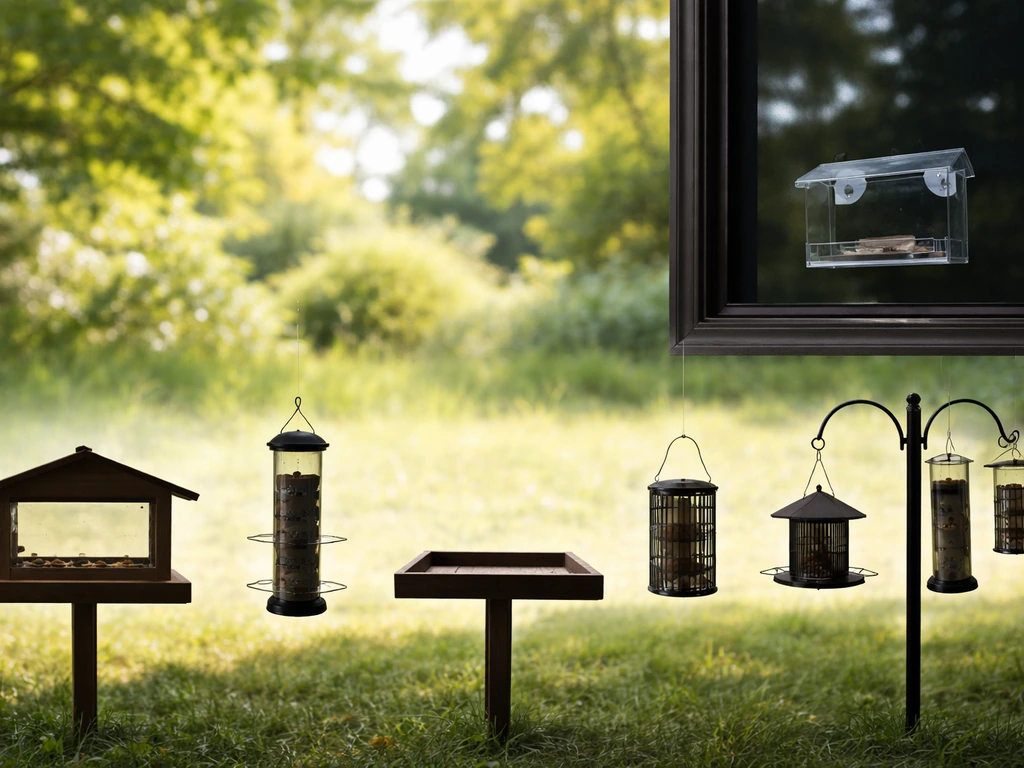
Bird feeders come in six main styles, and each one has a distinct silhouette you can spot immediately: the house-shaped hopper, the narrow cylinder of a tube feeder, the open flat tray of a platform feeder, the wire-mesh rectangle of a suet cage, the suction-cup box stuck to a window, and the tall pole-mounted setup that combines any feeder style with a freestanding post. Once you know what shape to look for, you can identify any feeder in a photo or a store shelf in about five seconds, and more importantly, you can tell whether it's going to work for the birds you actually want to attract.
What Does a Bird Feeder Look Like? Types and Visual Cues
Marcus Hendricks
7 Jun 2026
The six main feeder styles at a glance
Most of what you see sold as a bird feeder falls cleanly into one of these six categories. The differences aren't just cosmetic. The shape determines what food it holds, which birds can access it, and how well it survives rain, squirrels, and general outdoor abuse.
| Feeder Type | Basic Shape | Typical Material | Primary Food |
|---|---|---|---|
| Hopper | House/barn with roof and walls over a seed tray | Wood, metal, or plastic | Mixed seed, sunflower |
| Tube | Narrow hollow cylinder with side ports and perches | Polycarbonate or metal | Sunflower, nyjer/thistle, safflower |
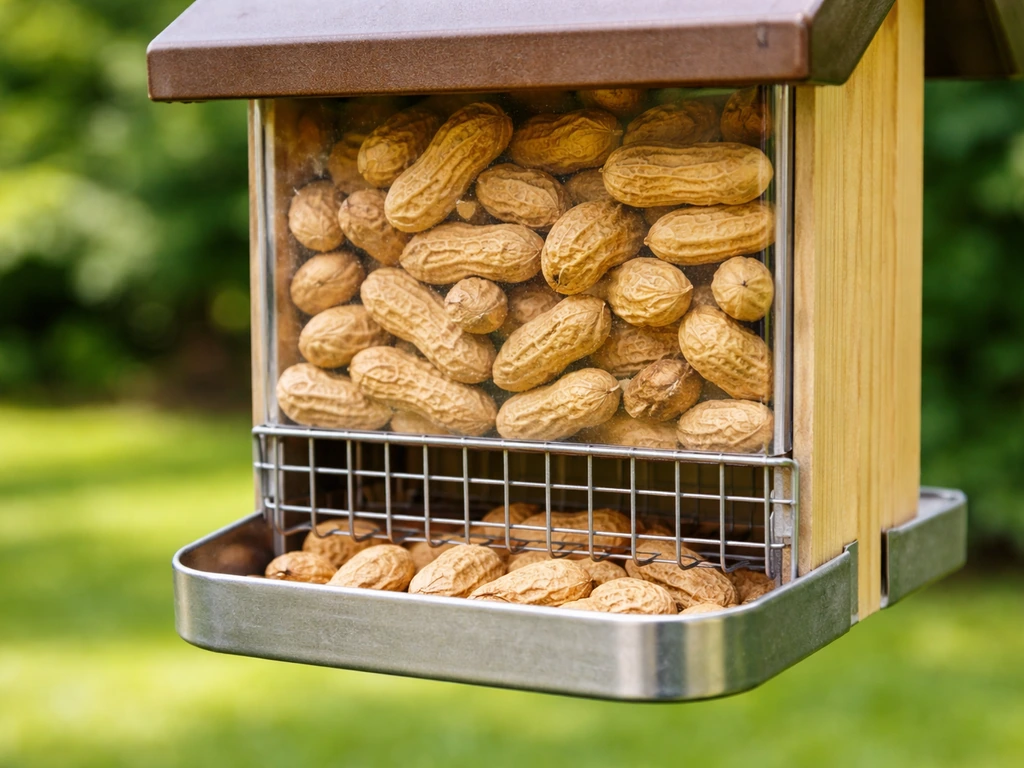
| Platform/Tray | Flat open surface, raised or hanging | Wood, plastic mesh, or metal screen | Mixed seed, peanuts, fruit |
| Suet Cage | Rectangular wire mesh cage | Coated steel or hardware cloth | Suet cakes |
| Window Mount | Small clear tray or box with suction cups | Clear acrylic or polycarbonate | Seed or nectar |
| Pole-Mounted | Any feeder style on a freestanding post system | Metal pole, various feeder materials | Varies by feeder attached |
What each feeder type actually looks like up close
Hopper feeders
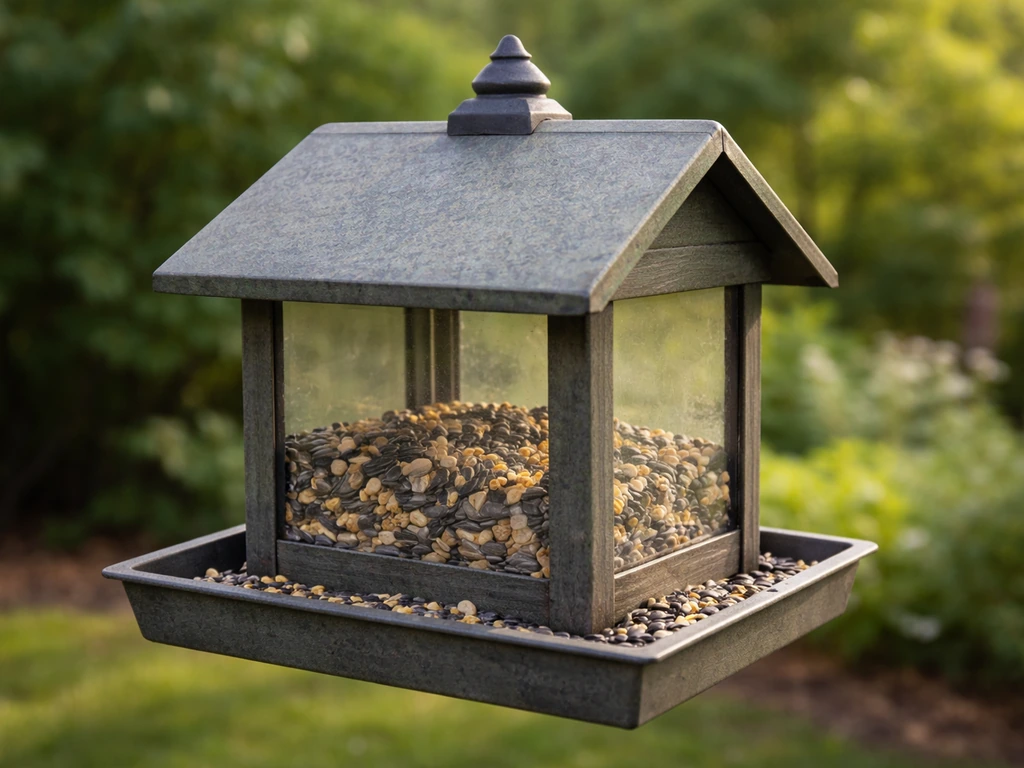
A hopper feeder looks like a tiny barn or house. It has four walls, a peaked or sloped roof, and a seed tray or trough along the bottom edge where birds land and feed. The roof overhangs the tray to shed rain and snow. Most are 10 to 18 inches tall, and you'll usually see two long perches running the length of both sides.
The seed sits inside the enclosed hopper cavity and gravity-feeds down to the tray as birds eat. Materials range from cedar wood (warm, natural color) to recycled plastic (often dark green, black, or barn red) to all-metal construction with a removable peak roof. A good one like the Perky-Pet Squirrel-Be-Gone II has a visible metal body, a lift-off roof for filling, and can hold up to 8 lbs of seed.
If you see something that looks like a miniature house hanging from a chain or sitting on a post, it's almost certainly a hopper.
Tube feeders
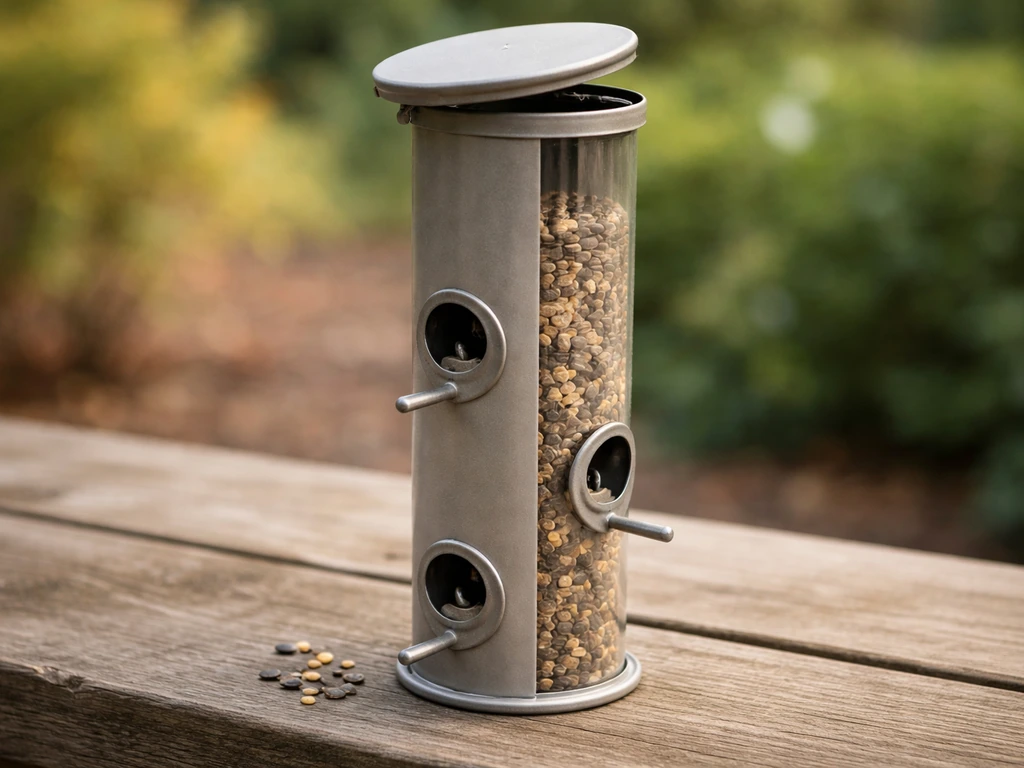
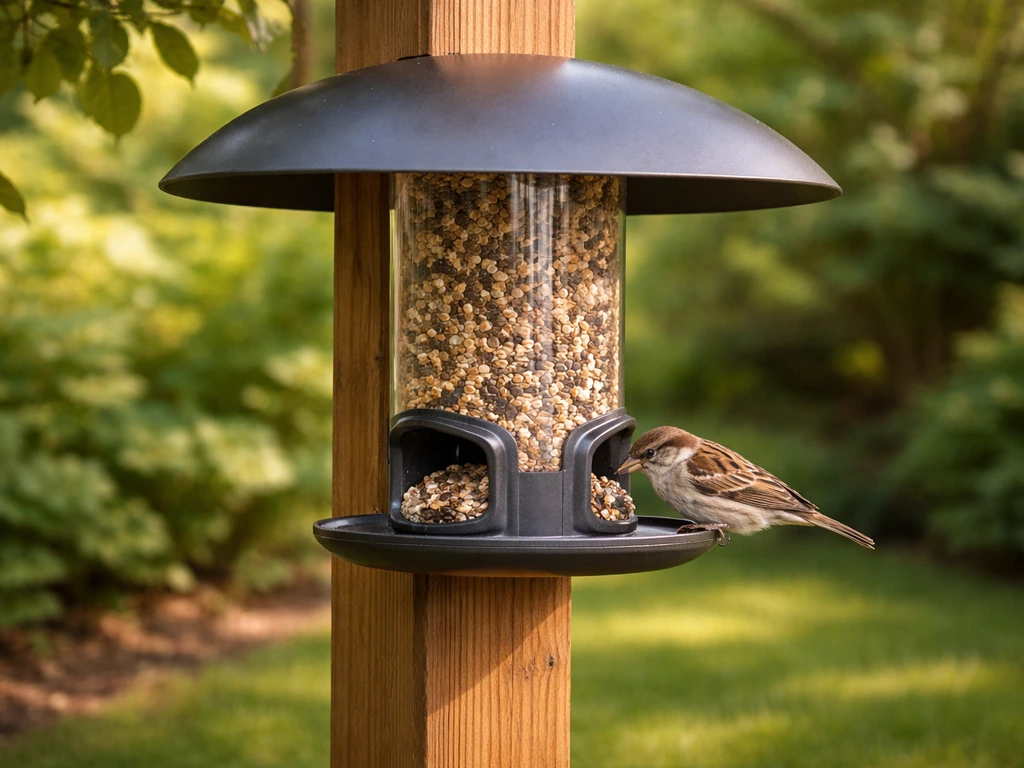
Tube feeders are exactly what the name suggests: a hollow cylinder, usually 12 to 20 inches tall and 3 to 5 inches in diameter, capped on top with a lid and sealed at the bottom with a drainage plug. Around the body you'll see multiple small circular or oval ports, each one paired with a short perch rod poking out horizontally below it.
The whole feeder is typically clear or lightly tinted polycarbonate so you can see the seed level at a glance. Some have a metal mesh body instead of smooth plastic, which improves grip for clinging birds and deters squirrel chewing. Nyjer/thistle tube feeders look the same but have smaller, slit-like ports rather than round holes, because the tiny black seeds would pour out of a larger opening.
Platform and tray feeders
A platform feeder is basically a shallow open box or flat tray with a mesh or screen bottom for drainage. No walls, no roof, no enclosed cavity. Some versions have a short lip around the edge to keep seed from blowing off immediately, and fancier ones have a small overhanging roof on posts above the tray. They're usually 12 to 24 inches wide. The total profile is low and open, which is intentional: ground-feeding birds like mourning doves, sparrows, cardinals, and juncos are uncomfortable with enclosed or elevated designs, so the wide-open look invites them in. Because the food is fully exposed, you'll also notice seed shells and debris collecting on the tray faster than any other feeder style.
Suet cage feeders
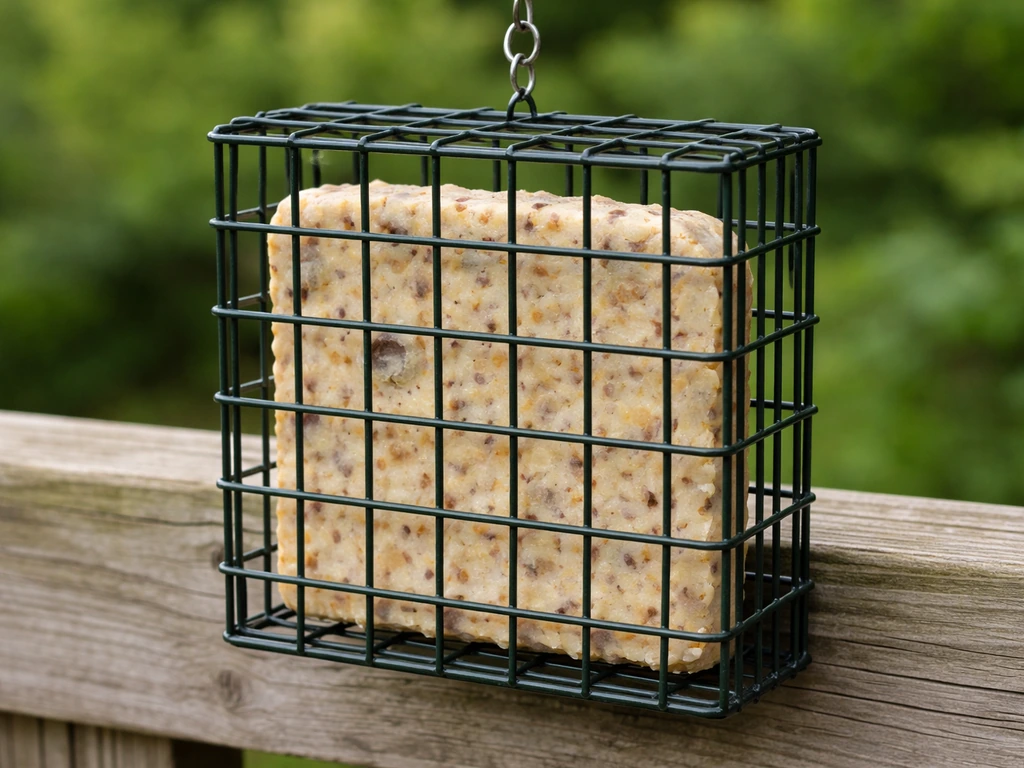
A suet feeder looks like a small rectangular cage, roughly 5 by 5 inches square and 2 inches deep, made from coated steel wire mesh. You press a standard suet cake (usually 11 oz) into the cage and snap or hinge the lid shut. Most hang from a single hook at the top. Some designs add a wooden or plastic back panel to help the feeder lie flat against a tree trunk. Tail-prop suet feeders are longer, around 12 to 18 inches, with an extended wire grid below the cage so woodpeckers can brace their tail feathers while feeding, which is a visible distinguishing feature you won't see on standard cage styles.
Window feeders
Window feeders are small, clear, and flat. The typical design is a tray about 8 to 12 inches wide and 4 to 6 inches deep in clear acrylic, with three or four suction cups on the back that press directly against a glass pane. Lee Valley's version is a classic example: a transparent box shape, mounted flush to the window so you're watching birds feed from inches away.
Hummingbird window feeders look slightly different: they're smaller, with dedicated circular port assemblies (each with a small flower-shaped surround in red or orange) positioned at face level so the hummingbird hovers right at the glass. The suction cup attachment and transparent body are the two giveaways that you're looking at a window feeder.
Pole-mounted setups
Pole mounting isn't a feeder type on its own, it's a delivery system. You're looking at a metal post, usually 4 to 8 feet tall with a 1-inch diameter, driven into the ground or weighted in a base. At the top there's a mounting bracket or hook that holds one or more feeders. The most recognizable visual feature is a squirrel baffle: a cone or dome shape (typically 12 to 18 inches wide) clamped around the pole below the feeder. Without the baffle, it's just a post with a feeder hanging on it. With the baffle, you get that distinctive mushroom-cap or inverted-cone silhouette about halfway up the pole.
Matching feeder appearance to the birds you want
The shape and design of a feeder isn't arbitrary. Bird species have specific feeding postures, beak sizes, and comfort levels with enclosed spaces. Here's how the visible design connects to likely bird visitors.
| Target Bird | Best Feeder Look | Key Visual Clue |
|---|---|---|
| Hummingbirds | Red or orange bottle/reservoir with small circular ports | Nectar ports, red accents, no perches or tiny perches |
| Finches (goldfinch, house finch) | Narrow tube with small nyjer ports and short perches | Slit ports, slim cylinder, often yellow accents |
| Cardinals | Hopper or wide platform with large perches or open tray | Wide open feeding area, sturdy broad perches |
| Woodpeckers | Suet cage, especially tail-prop style with extended lower grid | Wire mesh cage, extended backing or lower tail rest |
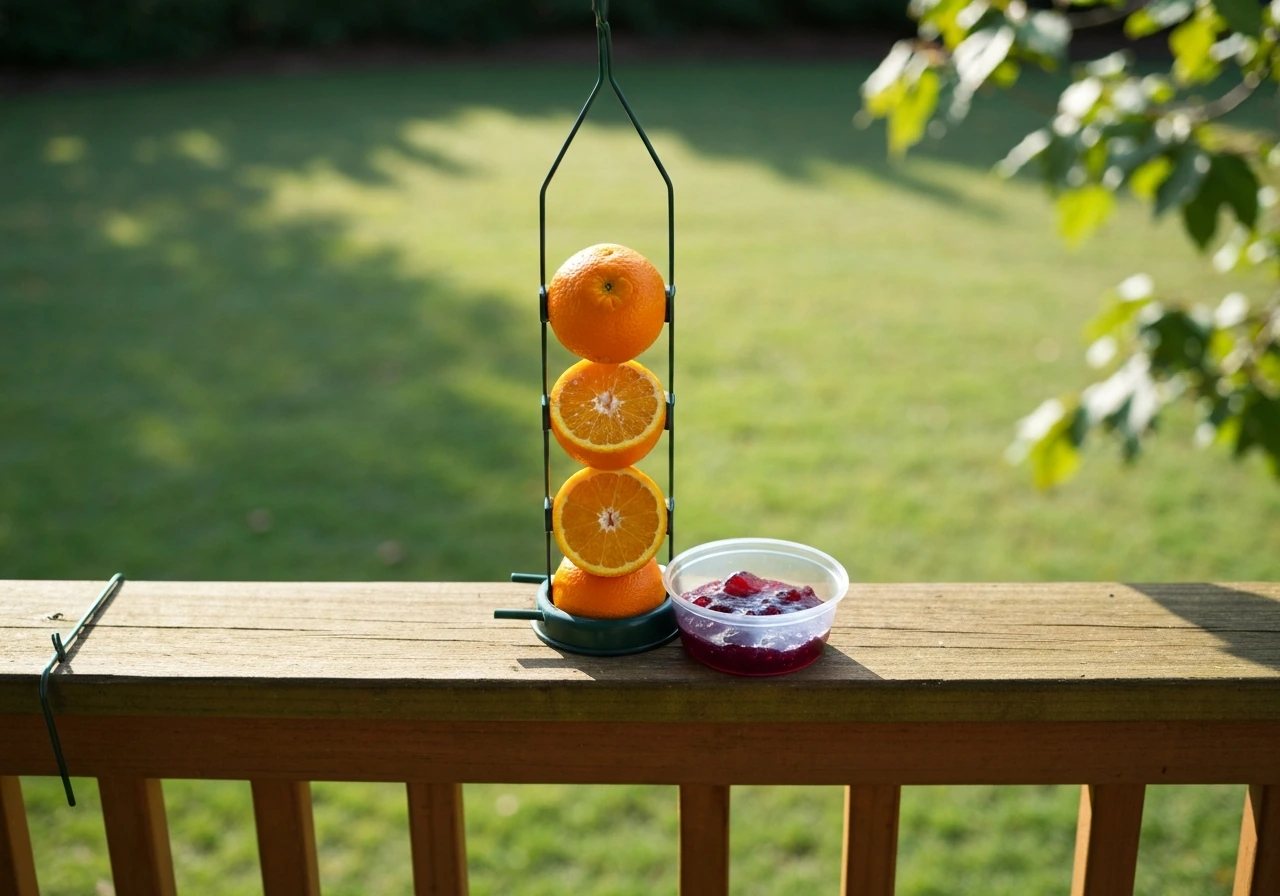
| Orioles | Orange-colored feeder with jelly cups, fruit spikes, and wide perches | Visible orange color, multiple feeding stations |
| Bluebirds | Enclosed box with 1.5" entry holes and a plexiglass viewing panel | Entry holes in wooden ends, clear window panel |
| Blue jays | Large hopper or platform with ample perch space | Big, open design with room for a larger bird to land |
| Mourning doves | Low platform tray or ground-level spread | Open, flat, low to the ground |
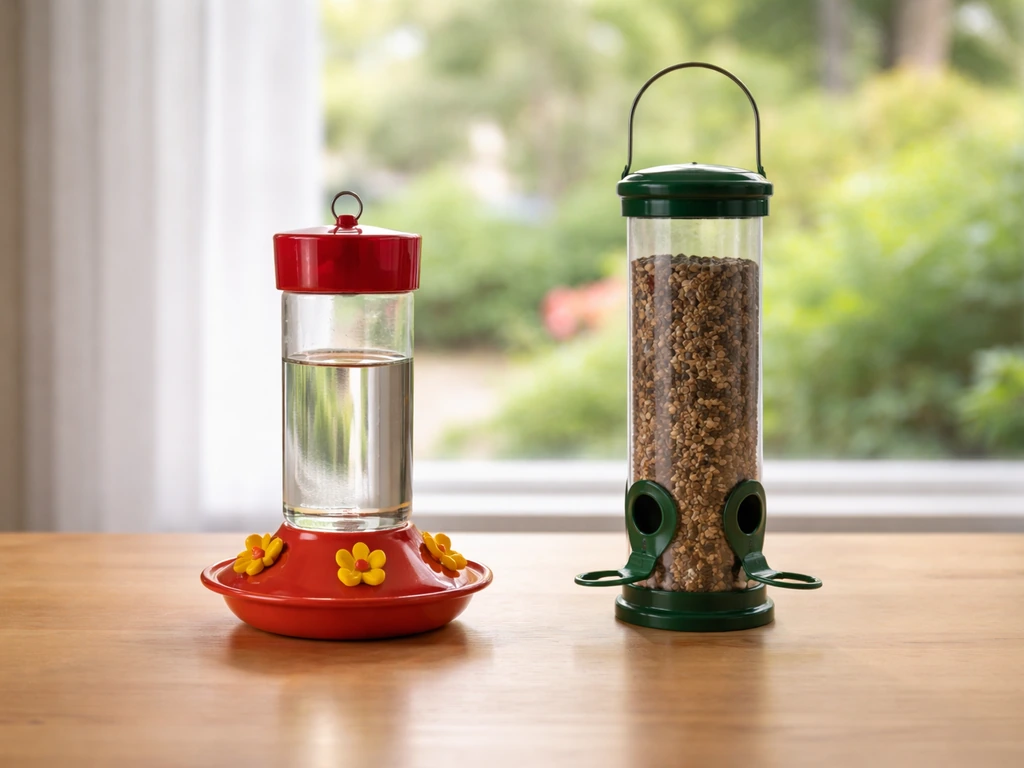
A few of these are worth calling out in more detail. Hummingbird feeders are the most visually distinct because they hold nectar rather than seed: look for a red or orange body, a liquid reservoir (often bottle-shaped or disc-shaped), and tiny circular ports, sometimes ringed with plastic flower shapes. There are no perches on many models because hummingbirds hover to feed.
Oriole feeders share some of that same nectar-feeder DNA but are sized up and almost always orange rather than red. They usually feature both a nectar reservoir and small cup wells for grape jelly plus a spike for orange halves. If you're curious about how these compare visually in more detail, oriole feeders and finch feeders each have their own distinct design language worth exploring separately.
Perky-Pet describes its oriole feeder with a two-position perch adjuster and dedicated perch geometry and feeding openings sized for orioles oriole feeders and finch feeders each have their own distinct design language. For Baltimore orioles, the best feeder is usually one that supports the kind of foods they prefer, like jelly, fruit, or nectar, while still offering a stable, easy-to-clean design best bird feeder for baltimore orioles.
Finch feeders have their own distinct features too, so once you know what style to look for, you can spot them quickly. Oriole feeders typically use a specialized design, so knowing what they look like helps you spot the right one for these birds.
Bluebird feeders look unlike anything else in this list. The typical design is a small wooden box with entry holes drilled in the ends (1.5 inches diameter) and a clear plexiglass front panel so you can watch birds feed inside. This enclosed design keeps out starlings and house sparrows while letting bluebirds duck in comfortably. If you see a feeder that looks like a cross between a birdhouse and a window feeder, it's very likely a bluebird-specific design.
What makes a feeder look (and function) better than average
When you're comparing feeders in a store or scrolling through photos online, these are the physical features worth looking for. They're not just decorative, they each solve a real problem.
- Port size and count: Tube feeders with 4 to 8 ports accommodate more birds simultaneously. Ports that are too large spill seed; ports that are too small frustrate larger-beaked birds.
- Perch length and style: Longer perches (3 inches or more) accommodate cardinals and jays; short stubby perches or ring perches favor small finches and chickadees and naturally deter larger bully birds.
- Seed capacity: Visible seed volume matters practically. A feeder holding 4 to 5 lbs (like the Brome Squirrel-Buster Plus at 5.1 lbs) needs refilling less often in winter than a small 1 lb tube.
- Weatherproof roof: A wide overhanging peaked or sloped roof keeps seed dry. If the roof barely clears the feeding tray, expect soggy clumping in rain.
- Drain holes: Look for small holes or a mesh bottom in any tray design. Without them, standing water rots seed fast.
- Baffle integration: A built-in weight-sensitive cage around the ports (as on the Squirrel-Buster style) or a separate dome-shaped polycarbonate baffle above or below the feeder signals active squirrel deterrence.
- Easy clean access: Removable roofs, bottom plugs that unscrew, and ports that pop out for brushing are worth looking for. You'll clean this thing more than you expect.
How feeder appearance changes across brands and special features
Squirrel-proof and rat-resistant designs
Squirrel-resistant feeders look noticeably different from standard ones. The most obvious version is a tube or hopper feeder surrounded by a metal cage or wire barrier, like the Perky-Pet Easy Feeder, where the outer cage is wide enough for small birds to pass through but blocks squirrels from reaching the ports.
Another style uses a weight-activated closing mechanism: the feeder looks normal from a distance, but when a heavy animal lands on the perch, a metal shroud drops down over the ports. You can't easily see the mechanism, but you'll notice the heavier construction and the slightly recessed ports behind a protective collar.
The Brome Squirrel-Buster Plus, at 28 inches tall, is a good example: it looks like an unusually solid, well-engineered tube feeder with no obvious perch bar, because the perch ring is spring-loaded.
Weather and winter-ready feeders
A feeder designed to survive winter typically looks heavier and more enclosed than a warm-weather model. The signs: an all-metal or powder-coated steel body instead of thin plastic, a deep overhanging roof, and thick-walled construction that won't crack in a freeze. Perky-Pet's all-metal hopper design is a good example: the removable peak roof and wide tray look sturdy rather than decorative. A polycarbonate dome baffle, like the Perky-Pet transparent squirrel baffler, also does double duty as a rain guard: you'll see it positioned above the feeder like a clear umbrella, catching water before it pours down into the seed.
Smart camera and solar-powered feeders
Smart bird feeders with built-in cameras have a distinctive look: there's a small camera housing (usually a rounded bump or a small module in a corner of the roof or body) and sometimes an LED ring around it for low-light capture. Solar-powered versions add a small panel on the roof surface, usually a dark rectangular cell about 2 by 3 inches. These feeders tend to be bulkier and more industrial-looking than traditional wooden or simple plastic feeders, and they often connect via USB-C charging ports visible somewhere on the body. If you see what looks like a security camera bolted onto a bird feeder, you're looking at one of the newer smart feeder designs.
Anti-spill and easy-clean designs
Anti-spill feeders often have a deeper tray lip, a tighter fit between the seed tube and the tray below, or a catch tray with higher walls to collect hulls rather than scatter them. Easy-clean designs show their intention in physical details: a base plug that unscrews rather than snapping apart, a roof that lifts off with a single latch, or ports that pop out individually (as on some Perky-Pet window hummingbird models) so you can run a toothbrush through each one. If you have to fully disassemble a feeder with a screwdriver just to clean it, you probably won't do it often enough.
Using what you see to diagnose problems
A lot of common bird feeder problems are visible if you know what to look for. Here's how to read what you're seeing.
- Seed piling up on the ground below a platform feeder: normal, since birds kick seed off open trays while foraging. Mourning doves and sparrows will actually clean this up. If it's creating a rodent problem, switch to a tray with higher sidewalls or a tube feeder for the same seed.
- Cracks near ports on plastic tube feeders: usually weather stress or over-tightened perch rods during assembly. This is where the feeder starts leaking water into the seed column and causing mold. Replace the feeder or reseat the perch rod without forcing it.
- Squirrels bypassing the baffle: check the pole placement. If a squirrel can jump from a branch, fence, or deck railing within about 10 feet horizontally or 5 feet vertically, no baffle will stop them. The fix is relocation, not a new feeder.
- Hummingbirds being dominated by one aggressive bird: this is a behavioral issue but has a visual fix. Add a second or third feeder positioned around a corner or out of line of sight from the first so the dominant bird can't guard both at once.
- Seed clumping or going moldy: the feeder has inadequate drainage or the roof doesn't extend far enough. Look for drain holes in the tray. If there aren't any, drilling a few 1/4-inch holes in the base tray is a fast DIY fix.
- Birds ignoring the feeder entirely: check the port height. If perches are set too high relative to the ports, birds have trouble reaching the seed. Also check if the feeder is placed too close to high-traffic areas or too far from cover like shrubs.
What DIY and homemade feeders typically look like
Homemade feeders have a recognizable upcycled look. The most common is the plastic bottle feeder: a 1 or 2-liter bottle (or a sports bottle) hung upside down or sideways with small holes or wooden dowel perches poked through the lower portion. The USDA Forest Service has published plans for bottle-based hummingbird feeders that use the bottle neck as the nectar port, often with a red ribbon or tape tied around the mouth to attract the birds. NOAA's marine debris program documents have also shown cardinals using simple bottle feeders hung with string, which tells you the design works even without professional construction.
DIY platform feeders usually look like a shallow wooden box or a simple flat board with a lip nailed around the edges and drain holes drilled in the bottom. Youth program plans from groups like Habitat for Humanity show a classic design: a flat platform base, a vertical back board for wall or fence mounting, and a small overhanging roof piece above. It's one of the easier weekend builds and works well for larger birds like cardinals, jays, and doves.
DIY suet feeders are typically made from hardware cloth (1/2-inch galvanized mesh) formed into a rectangular cage shape with a hinged or folded-over top for loading suet cakes. Home Depot's instructions describe this as a simple box assembly with wire cutters and pliers, and the finished product looks nearly identical to commercial suet cages. It's a legitimate, cost-effective option if you go through suet quickly in winter.
When DIY makes sense (and when it doesn't)
DIY feeders make the most sense for hummingbirds and suet setups. The bottle hummingbird feeder is genuinely functional and costs almost nothing; just keep the nectar fresh and add red accents near the port. Suet cages from hardware cloth are equally practical and durable. For tube feeders and hoppers, though, the commercial options are usually more cost-effective than building from scratch once you factor in materials and time, and the port sizing on commercial tubes is already calibrated for specific seed sizes. For any feeder you build yourself, the key visual check is the same as for store-bought: does it have drainage, is it easy to clean, and can you refill it without fully disassembling it?
FAQ
What does a bird feeder look like if it has no roof or walls?
That usually points to a platform feeder. Look for a low, open tray with a mesh or screen bottom for drainage, seed exposed on top, and often a shallow edge lip (or an optional tiny overhang on posts). It will look wider and flatter than any hopper or tube design.
How can I tell a tube feeder from a hopper feeder in a quick glance?
Tube feeders are a single vertical cylinder, typically with several small round or oval side ports and short perch rods below each port, and you can often see the seed level through plastic. Hopper feeders look like a tiny house with a roof, they have a mostly enclosed seed cavity, and the seed drops into a tray at the bottom where birds land.
Are there any feeders that look like “ground feeders” but are actually elevated?
Yes, some platform feeders include a small roof or decorative posts above the tray, which can make them seem taller. The key visual cue is still an open, shallow tray with no enclosed hopper cavity. If you see an enclosed chamber above the food, it is more likely a hopper or tube feeder, not a true platform style.
What does a hummingbird feeder look like compared to a seed feeder?
It typically looks like a red or orange reservoir with circular feeding ports at face level, and many models have no perches because hummingbirds hover. If you see liquid access cups or bottle/disc-shaped nectar reservoirs rather than seed ports, it is almost certainly nectar-focused.
How can I recognize an oriole feeder from the outside?
Oriole feeders are usually orange and sized larger than finch feeders, and they often include multiple nectar elements plus cup wells for grape jelly, with a distinct orange-halves spike on many designs. If you see jelly cups plus a reservoir, that combination is a strong visual tell.
What does a window feeder look like when it’s mounted on glass?
It will be a small clear acrylic tray box, flush to the window, with several suction cups across the back. For hummingbird window feeders, look for smaller transparent or port modules at face height, often with red or orange flower-shaped surrounds around the ports.
What is the distinctive look of a squirrel baffle on a pole-mounted setup?
You should see a cone or dome-shaped “mushroom cap” clamped around the pole below the feeder, usually 12 to 18 inches wide. Without that collar or dome, the feeder will just look like a post with a hook, and squirrels can access many hanging feeders more easily.
How do winter-rated feeders usually look different from regular ones?
They tend to look heavier and more enclosed, often using all-metal or powder-coated steel rather than thin plastic. Common winter tells include a deeper overhanging roof and thicker construction that does not look lightweight or flimsy.
What does an anti-spill feeder look like if I am trying to reduce mess?
Visually, anti-spill designs have tighter clearance between seed container and tray, deeper tray lips, or built-in catch trays that collect hulls instead of letting them scatter widely. If the tray walls look higher or the seed ports sit recessed behind protective collars, that often indicates reduced spillage.
Can I identify a smart bird feeder just by sight?
Usually, yes. Look for a small camera housing on the body or roof, sometimes with a ring light, and for a solar panel on top of the feeder (often a dark rectangular cell). Some also show a charging port on the exterior, which contributes to a more industrial, “tech” silhouette.
What does a tail-prop suet feeder look like?
It looks longer than a standard suet cage (roughly 12 to 18 inches) and includes an extended wire grid below the main suet rectangle for woodpeckers to brace. If you see a suet cage plus a downward tail-gripping platform, it is likely tail-prop designed.
If I see a bird feeder that looks homemade, what shapes are most common?
Bottle feeders are the most common DIY look, typically a plastic bottle hung upside down or sideways with holes or dowel perches near the lower portion. DIY platform feeders often look like a shallow wooden box or board with a lip and drilled drain holes.
What visual signs tell me a homemade or any feeder is likely to be hard to use?
If it requires full disassembly with tools to refill or clean, it will look like multiple parts screwed together or a complex mechanism with no obvious lift-off roof or accessible tray. Feeder designs with a simple lift-off roof, unscrewing base plug, or removable ports are usually easier to maintain.