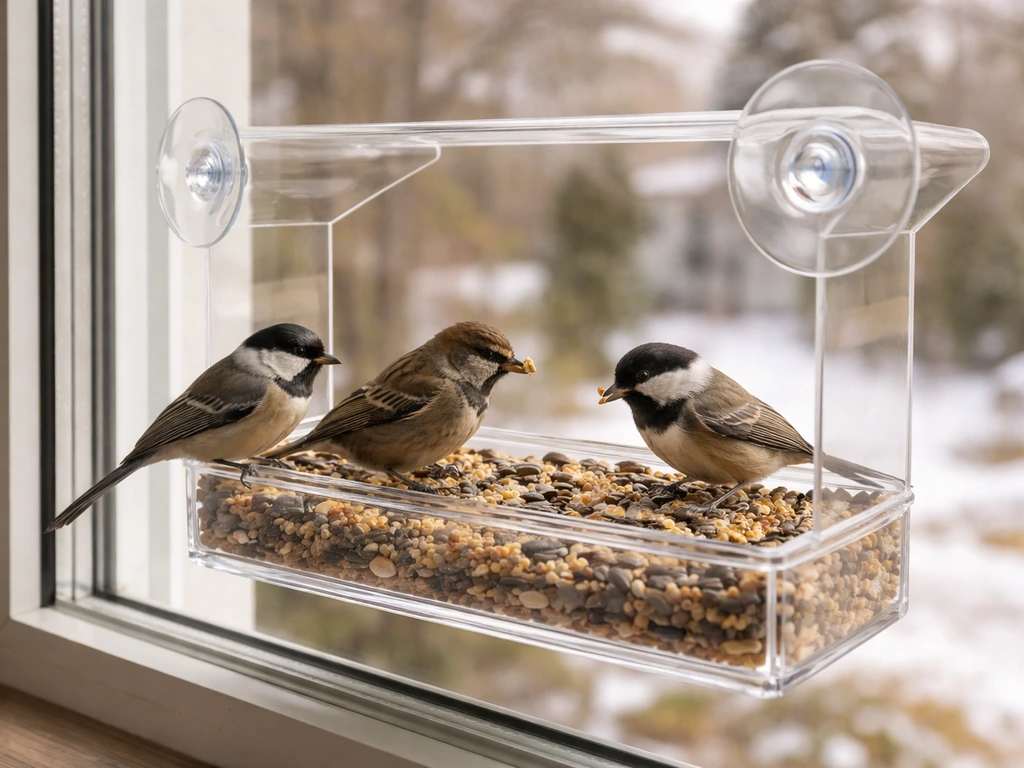
The best window bird feeder for most people is a clear acrylic suction-cup model that mounts directly to the glass, sits within 3 feet of the window, and gives you an unobstructed close-up view of visiting birds. That said, the right choice really depends on which birds you want to attract, what your window looks like, and how much you're willing to deal with cleaning and refilling. This guide walks through all of that so you can pick one and get it working today.
Best Bird Feeder Window Guide: Mount, Choose, and Attract Birds
Marcus Hendricks
11 Apr 2026
How to choose the best window bird feeder
Fit, mounting method, and viewing angle are the three things that actually determine whether a window feeder works for you, and they're often underexplained on product pages. Here's what you need to think through before buying.
Does it fit your window?
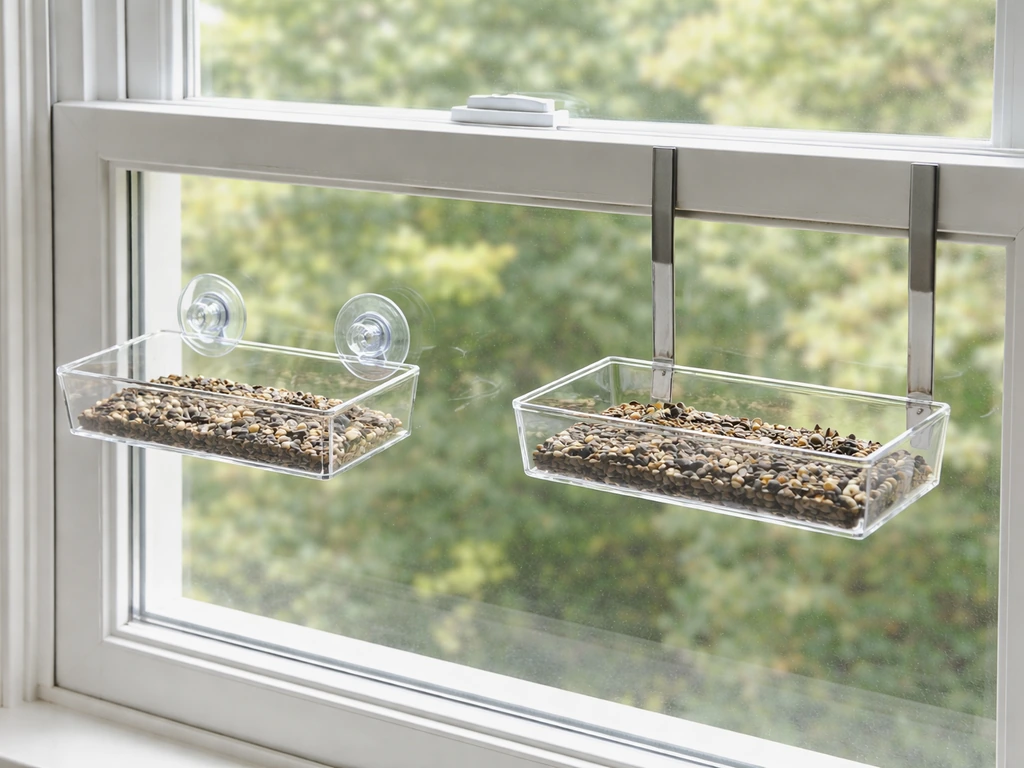
Window feeders come in two main mounting approaches: suction cups that grip directly to the glass pane, and bracket or ledge mounts that hook over the sash of a double-hung window. Suction cup models work on any smooth, clean glass surface, but they struggle on textured, frosted, or older wavy glass. Sash-mount styles work regardless of glass texture but add more bulk and require you to leave the window cracked open slightly. Before buying, look at your actual window and figure out which type applies.
Weight limits matter more than most buyers realize. A small acrylic tray with two suction cups might hold a combined seed-plus-feeder weight of 2 to 3 pounds comfortably. Larger hopper-style window feeders can push 5 to 8 pounds when full, and at that weight you really need oversized or industrial-grade suction cups, ideally paired with at least four contact points on the glass. If a product page doesn't list a weight limit, that's a red flag.
Viewing angle and feeder placement
The whole point of a window feeder is watching birds up close, so placement relative to your eyeline matters. Mounting at seated eye level (roughly 3 to 4 feet from the floor) gives you the best view when you're at a desk or dining table. If the feeder is too high, you're looking up at the birds' bellies. Too low and you see mostly their backs. Most people get this wrong the first time, so measure before you drill or stick.
There's also a safety reason to keep the feeder close to the glass. Research from ornithology organizations consistently shows that placing a feeder within 3 feet of a window prevents birds from building up enough speed to be seriously injured if they hit the glass. The other safe zone is 30 feet or more away from the window. That middle range of roughly 3 to 30 feet is the danger zone for window collisions, so window feeders are actually one of the safer placements you can choose. If you want to dig deeper into what makes a window bird feeder work well, safety and proximity to the glass should be near the top of your checklist.
Ease of cleaning
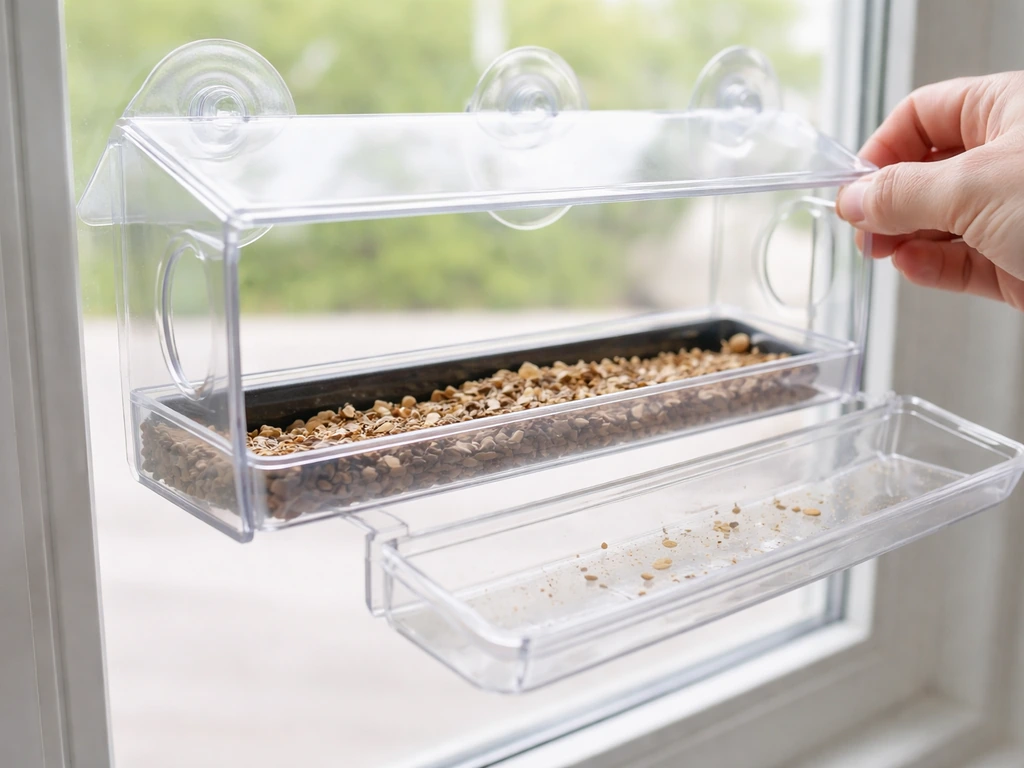
Window feeders get dirty fast because birds are right there, and mold in a wet tray is a real health hazard for them. Look for feeders that detach from the suction cups for cleaning, with smooth interiors and no sharp corners that trap wet seed. Avoid feeders with tiny drainage holes that clog after one rain. Some models have a removable seed tray that slides out without taking the whole feeder off the window, which saves a lot of hassle over the long run.
Top-rated window feeder styles (and when each works)
There are a handful of distinct window feeder styles, and each solves a different problem. Here's a straight comparison of the main types.
| Style | Best For | Typical Capacity | Key Trade-off |
|---|---|---|---|
| Clear acrylic tray (suction cup) | Close-up viewing, small to medium birds | 1–2 cups of seed | May sag with heavy seed load or in heat |
| Clear acrylic hopper (suction cup) | Seed storage, less frequent refilling | 2–4 cups of seed | Heavier; needs strong suction or 4+ cups |
| Sash/ledge mount hopper | Larger birds, textured glass, winter feeding | 4–8 cups of seed | Requires cracked window; more obtrusive |
| One-way mirror window feeder | Watching without birds seeing you | 1–2 cups of seed | Pricier; reflective surface can deter some birds in bright light |
| Suet cage window mount | Woodpeckers, nuthatches, clinging birds | 1–2 suet cakes | Limited to suet or suet-style blocks |
| Hummingbird window feeder (tube or disc) | Hummingbirds only | 4–12 oz nectar | Requires regular nectar changes every 2–3 days in warm weather |
The clear acrylic tray is the starting point for most people, and it's genuinely good for what it does. The one-way mirror style is a step up if you have curious cats or kids who tend to startle birds by moving near the window. You can read a detailed breakdown of the best window bird feeder with one-way mirror if that style appeals to you. For most households, the basic acrylic hopper with strong suction cups and a drainage tray is the most practical everyday option.
Best options by the birds you want to attract
Species matters a lot when picking a window feeder. The wrong feeder for the bird you want will just sit empty or get taken over by the birds you don't want. Here's how to match feeder style and seed to your target visitors.
Finches and small songbirds
House finches, goldfinches, and chickadees are the easiest window feeder visitors to attract. They're comfortable landing on small surfaces and will readily use a basic acrylic tray loaded with black oil sunflower seed or nyjer (thistle) seed. For goldfinches specifically, a small tube feeder with nyjer ports is more efficient than a flat tray. These birds are light, so even a modest suction cup setup holds them fine.
Cardinals and blue jays
Cardinals and jays are larger and heavier, and they prefer a stable, wide platform. A suction cup tray feeder can work for cardinals if it's at least 6 inches wide and has a lip to hold seed, but jays often need something more substantial. A sash-mount hopper with a wide perching ledge is more reliable for these species. Load it with safflower seed or striped sunflower seed for cardinals, or a general mixed seed blend for jays. Keep in mind that jays can be aggressive with smaller birds, so if you're running one feeder for multiple species, positioning matters.
Woodpeckers and nuthatches
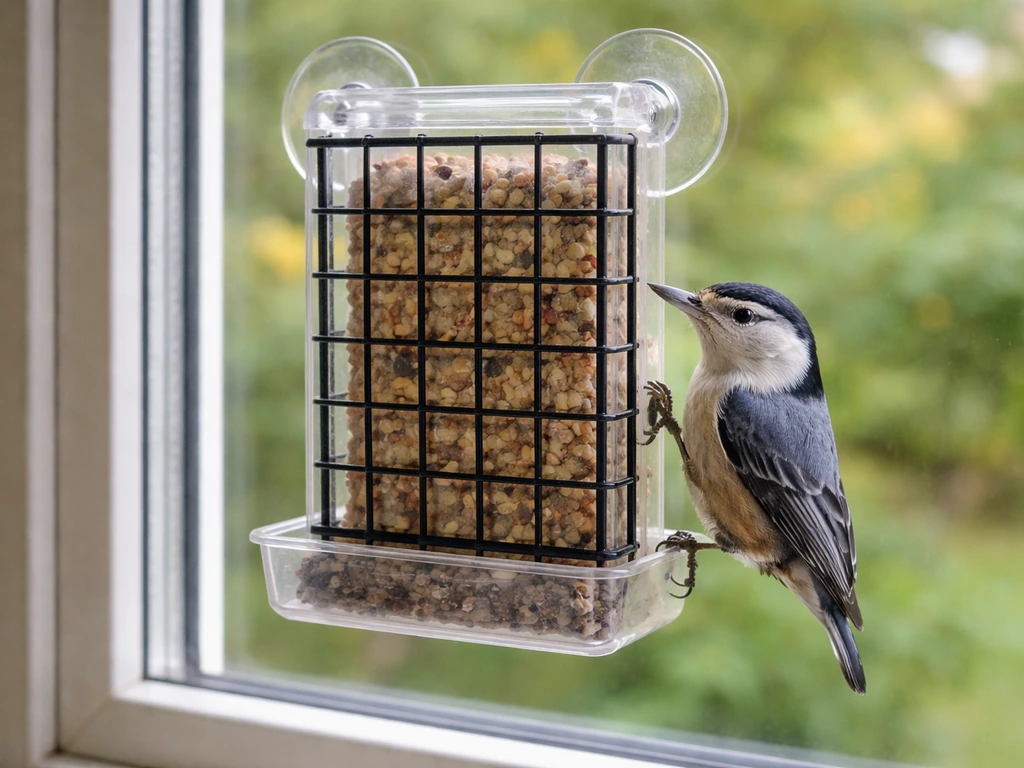
These are the birds that really benefit from a window suet feeder. Downy woodpeckers, hairy woodpeckers, and white-breasted nuthatches are all comfortable clinging vertically, so a suet cage mounted with suction cups is perfect. You can also use a peanut butter log feeder in a window mount format. Downies are small enough that suction-mounted suet cages work well; hairy woodpeckers are larger and may need a sturdier bracket.
Hummingbirds
Window-mounted hummingbird feeders are some of the most satisfying feeders you can own because you get face-to-face views at just a few inches. Look for a disc or tube style with bright red ports and a capacity of at least 8 oz so you're not refilling daily in peak summer. The key issue is nectar freshness: in warm weather, change the nectar every 2 to 3 days to prevent fermentation. In cooler spring or fall weather, every 4 to 5 days is usually fine. Position the feeder where it gets morning sun but is shaded in the afternoon to slow fermentation.
Doves and ground-feeding birds
Mourning doves prefer to feed on or near the ground and don't adapt well to small window trays. A platform-style window feeder mounted low (close to the windowsill or on a ledge extension) with millet or cracked corn works better than a standard hanging or suction-cup tray for these birds.
Orioles and bluebirds
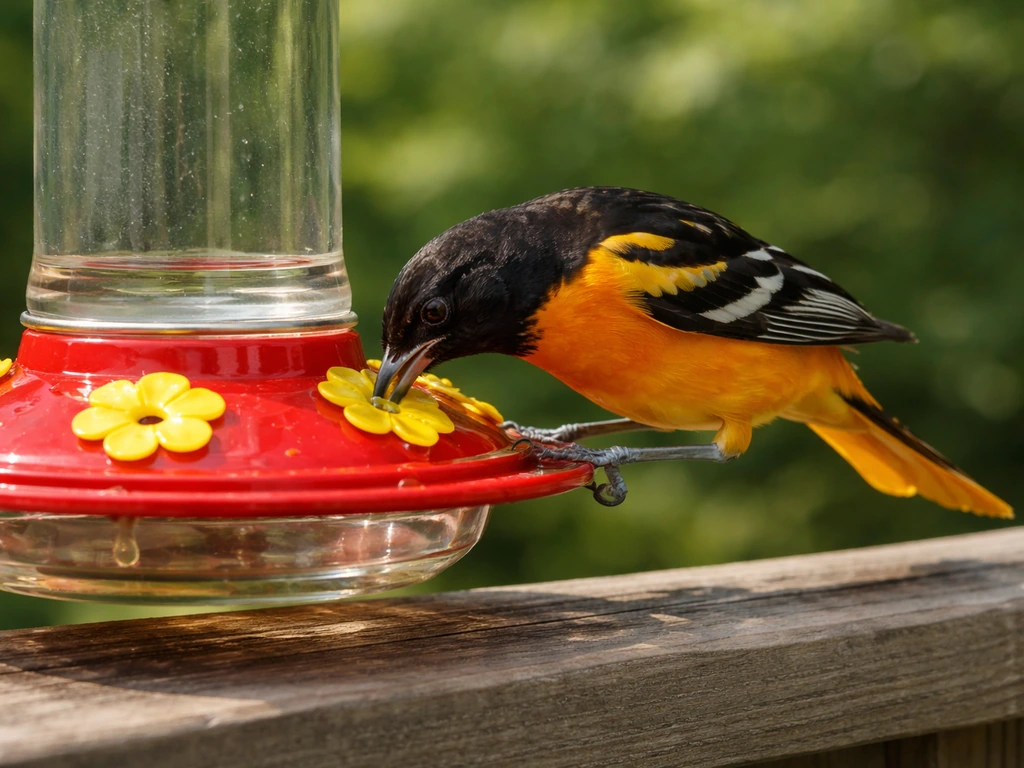
True window feeders for orioles and bluebirds are rare, mostly because these species are skittish and tend to avoid close window contact. You'll have better luck with a pole-mounted or hanging feeder placed 6 to 15 feet from the window for viewing, rather than a suction-cup model right on the glass. If you're determined to use a window-mounted option for orioles, look for a jelly feeder with an orange-colored port, which mimics the citrus fruits orioles naturally seek out.
Weather, durability, and keeping birds safe
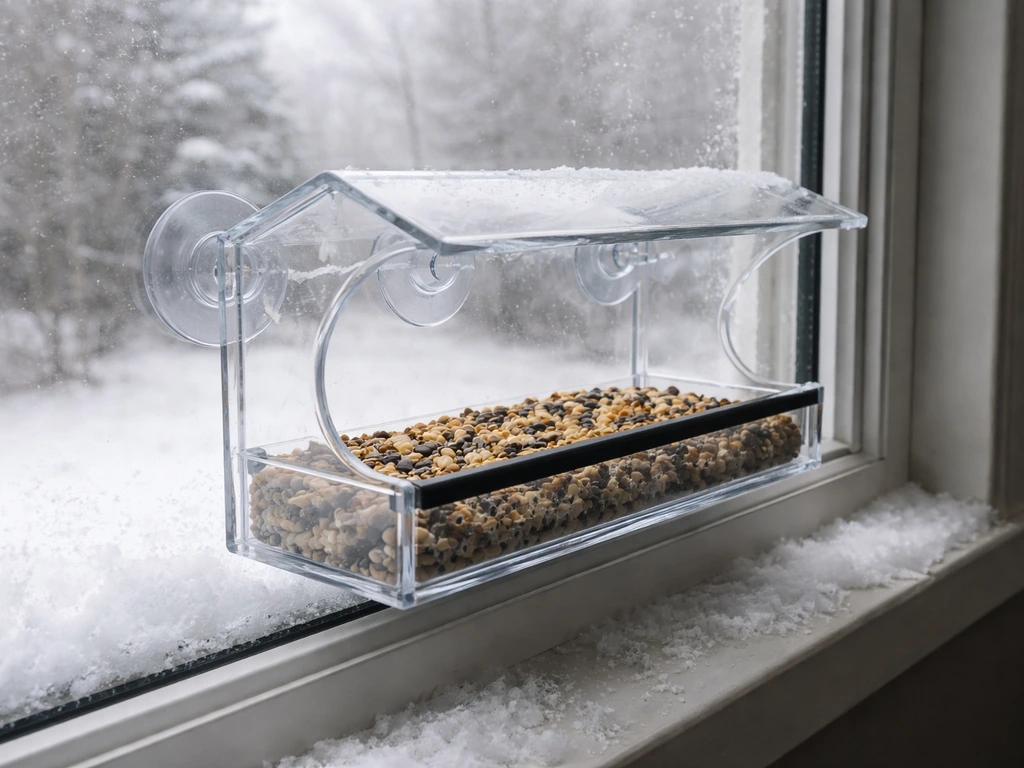
Window feeders take a beating from the elements because they're essentially exposed to whatever hits your window. Rain, UV exposure, and winter freezes are the three main durability concerns.
Cheap acrylic yellows and becomes brittle within one or two seasons of UV exposure. Look for feeders made from UV-stabilized acrylic or polycarbonate, which hold up several years longer. Some manufacturers advertise "crystal clear" acrylic that looks great in photos but clouds over by the second summer. If a product doesn't mention UV stabilization, assume it doesn't have it.
In winter, the freeze-thaw cycle is rough on suction cups. Suction cups lose their grip in very cold temperatures (below about 20°F / -7°C), and a full feeder falling off the window in February makes a mess and scares birds off for days. If you feed through winter, use feeders with suction cups rated for cold weather, or supplement with a sash-mount model that doesn't rely on suction. Keeping the glass clean also dramatically improves suction cup performance in any season.
On the safety side, window collisions are a genuine concern. The 3-feet-or-closer rule mentioned above really does help, but you can add an extra layer of protection by applying window alert decals or UV-reflecting window film around the feeder. Birds see UV light that humans don't, and these products make the glass more visible to them while being nearly invisible to you. For households where cats are part of the equation, the placement and feeder design choices change somewhat. The best window bird feeder for cats guide covers how to balance safe bird access with keeping indoor cats entertained without turning the window into a hunting post.
Dealing with pests, mess, and problem behaviors
Squirrels and larger pests
Squirrels can reach a window feeder if there's any nearby surface to launch from: a tree branch, a deck rail, a flower box, an air conditioner unit. Extension guidance also notes that how you place and approach seed can attract squirrels and other rodents, so using squirrel-resistant design and managing access helps reduce unwanted visits [squirrels and other rodents, emphasizing design/position controls to reduce access](https://beht. osu. edu/sites/ubeht/files/imce/Squirrel-proof%20feeder%20pub%20-%20U%20of%20Neb-Lincoln.
pdf). If your feeder is truly on a smooth glass pane with no adjacent surfaces within about 5 feet horizontally and 10 feet above, squirrels usually can't reach it. But if there's any launch pad nearby, they'll figure it out. The most effective deterrent in this case is a feeder with a squirrel-resistant design (weight-activated closing ports), or simply keeping the area around the window clear of perchable surfaces.
For example, the Squirrel-X wraparound squirrel baffle is designed to block squirrels from reaching a feeder using a squirrel-resistant, wraparound design weight-activated closing ports.
Rats and mice
Spilled seed on the ground below a window feeder is one of the fastest ways to attract rats, especially in urban or suburban areas. Use a tray feeder with a lip to catch hulls and debris, and do a seed sweep below the window every couple of days. Switching to no-mess seed blends (pre-hulled sunflower chips, nyjer in a sock feeder) significantly reduces ground litter. If rodent pressure is high in your area, consider moving entirely to suet or nectar at the window, which produce almost no ground mess.
Bird aggression and feeder hogging
House sparrows, European starlings, and house finches tend to dominate window feeders if you let them. The easiest fix is using a feeder with perch designs that physically favor smaller birds or that make it awkward for the dominant species. Tube feeders with upward-facing ports (where birds have to cling upside down) deter house sparrows but not goldfinches or chickadees. Spreading feeding across two or three different feeder types and positions also reduces bottlenecks.
Birds not using the feeder
If birds visit but don't land, the seed may be old or wet. Window feeders get humid quickly, and seed that's been sitting in a wet tray for more than a day or two will smell off to birds even if it looks fine to you. Empty, wash, and dry the feeder, add fresh seed, and give it 3 to 5 days.
If there's still no activity, check whether the feeder is placed near a lot of human foot traffic or on a very busy window. Birds may need a week or two to discover and feel comfortable with a new setup. Community experience from real users can be really helpful here. Reading through the best window bird feeder picks discussed on Reddit often surfaces practical troubleshooting tips that don't make it into manufacturer guides.
Installing your window feeder the right way
Correct installation is the difference between a feeder that stays put for two years and one that crashes to the ground in week three. Follow these steps in order for a solid setup.
- Clean the glass thoroughly with rubbing alcohol or glass cleaner and let it dry completely. Even a thin film of grease or grime will prevent suction cups from sealing properly.
- Wet the suction cups lightly with water just before pressing them onto the glass. This improves initial adhesion. Press firmly and hold for 10 to 15 seconds per cup.
- Start with an empty feeder and test the mount for 24 hours before adding seed. This tells you whether the cups are gripping well before you add weight.
- Mount the feeder so the bottom of the seed tray is at or slightly below your seated eye level for the best viewing angle.
- Position the feeder within 3 feet of the glass edge or window frame to prevent high-speed bird collisions. Avoid placing it directly opposite a reflective surface like a mirror or another window.
- In summer, try to place the feeder on a window that gets morning light and afternoon shade. This slows seed spoilage and nectar fermentation.
- In winter, check suction cup adhesion weekly. Cold glass and freeze-thaw cycling can loosen even well-seated cups. Remove and reseat them at the first sign of slippage.
- Clean the feeder every 1 to 2 weeks with a mild bleach solution (1 part bleach to 9 parts water), rinse thoroughly, and dry before refilling. In summer or wet weather, weekly cleaning is the minimum.
If you're mounting on a double-hung window and want the option to move the feeder around or try different positions before committing, the Better Crafter window bird feeder is worth a look for its flexible sash-mount design that doesn't rely solely on suction cups.
Making it work all year
Year-round window feeding requires small seasonal adjustments rather than a full overhaul. In spring and summer, focus on fresh seed, frequent cleaning, and nectar freshness if you run a hummingbird feeder. In fall, switch to high-fat seeds like black oil sunflower and peanuts to help birds build fat reserves before migration. In winter, suet is your best friend: it doesn't freeze solid like wet seed does, it's calorie-dense for cold-weather survival, and woodpeckers and nuthatches that wouldn't normally visit in warmer months will show up reliably for it.
One habit that makes a real difference is keeping a simple log of which species you see and when. It sounds fussy, but after one season you'll notice patterns, like which weeks cardinals are most active, when your goldfinches switch from sunflower to nyjer, and when the first hummingbird shows up in spring. That information helps you adjust what you're offering and when, which makes your window feeder dramatically more active over time.
FAQ
How high should a best bird feeder window be mounted for the most enjoyable view?
For the closest, safest viewing, most people do best placing the feeder at seated eye level, then fine-tuning based on your setup. If you stand when you watch, measure from standing eye height instead. Also consider window glare, if your glass reflects your room lights at certain times, move the feeder slightly left or right so birds don’t appear to “hide” behind reflections.
What should I do if birds keep hitting my window even though the feeder is close?
Treat “clear” and “visible” differently. If you notice birds repeatedly hitting the glass, even with proximity in mind, add the protection layer (alert decals or UV-reflecting film) around the feeder area and re-check at different times of day. Birds may approach only under certain lighting, so test in morning and late afternoon rather than once.
Why does my window feeder keep falling off, and how can I stop it?
Suction cups perform best on spotless, dry glass. Clean with a glass-safe degreaser, then wipe with a lint-free cloth and let the surface fully dry before mounting. Avoid mounting on dusty edges where air gaps form, and press firmly for 30 seconds, then check again after 1 hour because suction can settle.
Will a suction-cup best bird feeder window work on textured or wavy glass?
If your window is textured, frosted, or wavy, suction-only mounting often underperforms because it can’t create a tight seal. In those cases, choose a sash-mount style that hooks over the window frame, or use a bracket system designed to fit your exact window type. If you only want suction, you may need to relocate to a smoother pane.
How do I estimate whether my window feeder’s suction cups can handle the full load?
If the product doesn’t list a specific maximum load, assume it’s not appropriate for heavier hopper feeders, especially once seed absorbs moisture. A practical check is to weigh the empty feeder, weigh the full seed amount separately, and compare to the stated limit (if provided) or the manufacturer’s category guidance. When unsure, downsize to a tray or keep hopper fullness lower.
What if birds visit but never land on the feeder?
Most backyard birders wait out the “discovery lag,” usually 3 to 5 days, but sometimes up to 2 weeks if the feeder is new or the birds are cautious. If no birds land, try fresh seed that matches the target species, move it closer to cover like shrubs (while still staying near the window), and reduce human activity near the feeder during peak hours.
How can I reduce spooking if birds approach but leave immediately?
Noise and sudden movement matter. If you have cats, use a one-way mirror style or position the feeder so your cat can’t sit directly behind it. If kids or indoor foot traffic pass often, move the feeder slightly so the approaching path is predictable, and avoid mounting where people routinely lean or shake the glass.
What design features make a window feeder easier to clean and less likely to get moldy?
For easy cleaning, choose a model that detaches from the suction cups or has a tray that slides out without removing the whole unit. Avoid designs with sharp corners and tiny drainage holes that clog, and rinse with warm water, then dry completely before refilling. Wet seed left in a humid tray for more than a day or two tends to smell off and discourages visits.
Is a window feeder still safe if it’s inside the 3-foot zone but glare is an issue?
Yes, but with a caveat. Even in the safe 3-feet-or-closer range, collisions can still happen if birds can’t see the glass clearly or if lighting creates reflections. Put the feeder near the center of the viewing area, add alert decals or UV film, and make sure the feeder doesn’t end up centered directly on a high-glare reflection spot.
Can I use a small tray-style suction feeder for cardinals or will I need a bigger setup?
If you want to feed larger birds like cardinals but you only have a small tray, focus on stability and lip height. Use a wider platform tray (around 6 inches wide or more) and a seed type cardinals prefer like safflower or striped sunflower. For jays, plan for a more solid mount because they can displace smaller birds at small trays.
How often should I replace nectar in a window hummingbird feeder in hot weather?
For hummingbirds, location is just as important as nectar. Aim for morning sun with afternoon shade, and keep a consistent schedule for changing nectar based on local heat. Also use an appropriate nectar concentration, and rinse the ports between refills so residue doesn’t build up and affect flow.
Why don’t mourning doves use my window feeder, even though other birds do?
If you’re targeting doves, a ground-feeding preference changes the plan. Instead of a standard suction-cup tray on the glass, mount a platform style low near the sill or on a ledge extension, then use millet or cracked corn. This reduces the “landing friction” that doves often face with small window trays.
What’s the best approach for orioles and bluebirds if they avoid the window feeder?
Orioles and bluebirds often avoid close glass contact. If you’re determined to try a window-mounted option, jelly feeders with an orange-colored port can sometimes work better than standard seed trays, but expect lower success than with pole or hanging feeders placed several feet away.
How do I keep squirrels and rats from being attracted by seed falling below the feeder?
To limit ground mess, choose a tray with a lip that catches hulls and debris, then do a quick seed sweep every couple of days. If rodent activity is high, switch to no-mess options like pre-hulled seeds or suet in a window mount, because spilled hulls are the main rat attractant.
How can I stop house sparrows or starlings from taking over a window feeder?
When you see one dominant species repeatedly (common with house sparrows and starlings), adjust the feeder mechanics. Consider perch designs that physically disadvantage larger dominant birds, use tube feeders with upward-facing ports for certain sparrows, and spread food across two or three feeder types so bottlenecks are less likely.
What troubleshooting steps should I try first if bird activity drops suddenly?
Track changes as variables, not as a random scramble. Keep the feeder at the same height, then try one adjustment at a time, like seed type, placement relative to cover, or cleaning frequency. If birds stop after a move, give it a week or two for re-discovery, then repeat small changes rather than switching feeder types daily.
What should change with a window bird feeder from summer to winter?
If you’re feeding year-round, don’t treat it as one setup. In warm months prioritize nectar freshness (if hummingbirds visit) and more frequent cleaning, in fall increase high-fat seeds so birds build reserves, and in winter switch toward suet for reliability during freezes. Small seasonal seed changes usually beat a complete redesign.
Next Article
Best Bird Feeder for Baltimore Orioles: Buyer Guide
Choose the best bird feeder for Baltimore orioles: styles, features, placement tips, and fixes for heat, pests, and acce