If you are choosing between the Netvue Birdfy and the Bird Buddy, here is the honest short version: Bird Buddy wins on camera quality and image detail, while Netvue Birdfy wins on out-of-the-box AI access and local storage flexibility. Neither is perfect, and the right pick depends heavily on whether you care more about sharing beautiful feather-close-up photos or getting reliable, subscription-light species identification from your backyard.
Netvue Bird Feeder vs Bird Buddy: Smart Feeder Comparison
Marcus Hendricks
28 Jul 2026
Who this comparison is for
This article is written for backyard birders who are seriously considering spending $100 to $300-plus on a smart feeder with a built-in camera and AI species ID. Whether you are a casual hobbyist setting up your first camera feeder or an experienced watcher who has already burned money on a cheap feeder that fogged over in the first rain, this breakdown covers everything that actually matters: hardware, camera specs, AI accuracy, power options, storage, weatherproofing, and total ongoing costs. I have tested both platforms and dug into user reports, spec sheets, and support documentation so you do not have to piece it together yourself.
At a glance: key specs side by side
| Spec / Feature | Netvue Birdfy (standard) | Bird Buddy (Nature Cam Pro) |
|---|---|---|
| Price (flagship) | $299.99 | Varies by bundle; camera sold separately or bundled |
| Camera resolution | 1080p HD (4K on Metal 2 / Pro SKUs) | 2K video, 5-MP stills (HDR) |
| Night vision | Full-color night vision (1080p) | Not independently rated for full-color night |
| Seed capacity | ~1.5 L (50 oz) | Approx. 1–1.5 L depending on feeder model |
| Battery | 5,000 mAh built-in rechargeable | Removable/detachable; up to ~1 month per charge |
| Solar option | Yes, integrated solar panel | Yes, optional Solar Roof accessory |
| Wi-Fi band | 2.4 GHz only | 2.4 GHz (BLE also supported) |
| Waterproof rating | IP65 | Not publicly stated as IP-rated |
| Local storage | microSD up to 128 GB (Class 10) | No microSD; cloud-based storage |
| AI species ID | 6,000+ species (subscription after 7-day trial) | App-based AI ID (2K captures gated behind membership) |
| Subscription cost | Paid plan (trial 7 days free) | $69.99/yr Individual or $98.99/yr Family Premium |
| Warranty | Not prominently stated (check retailer) | 2-year standard warranty |
| Dimensions | ~8" L x 7" W x 11" H, ~3 lb | Varies by feeder model |
| Build material | ABS + PC plastic | Polycarbonate / proprietary plastic blend |
Quick verdict before we dig in
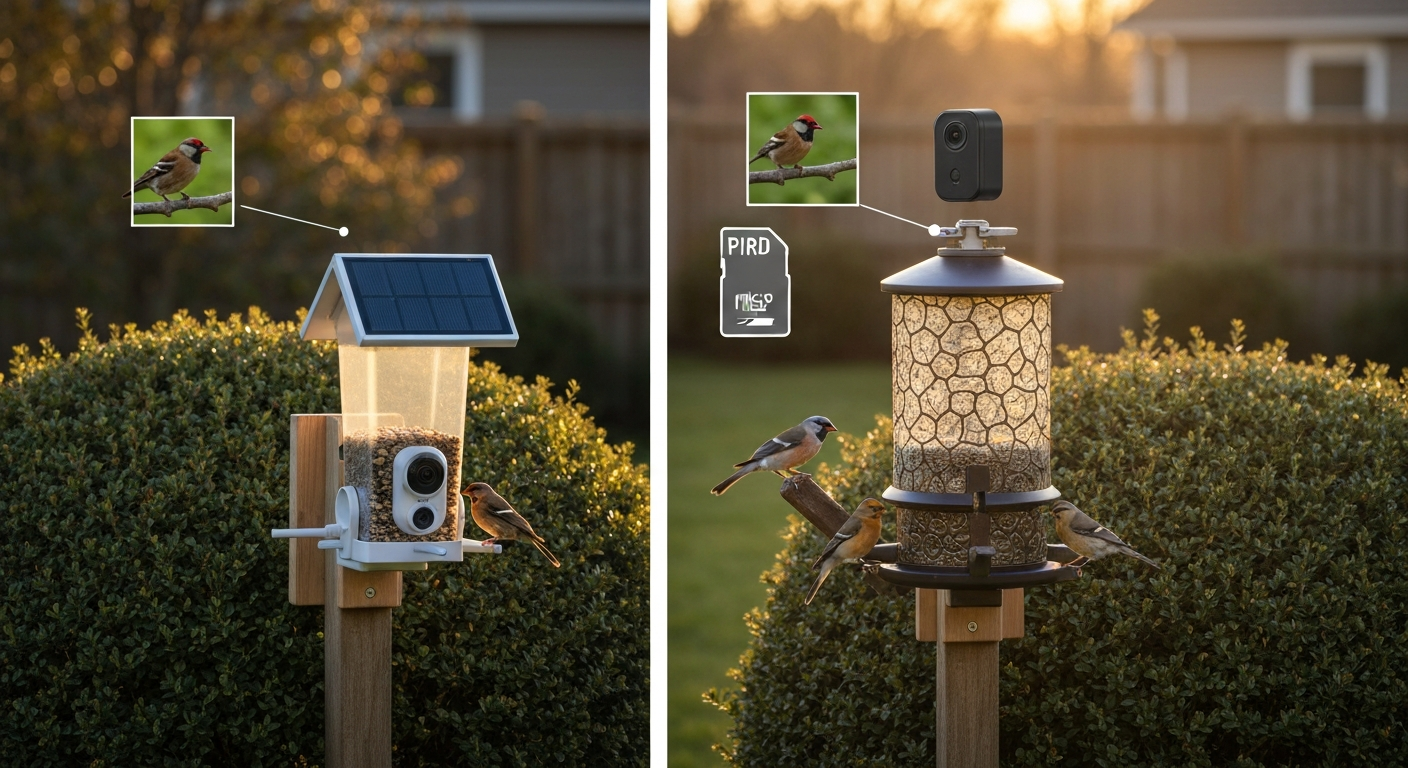
Buy the Bird Buddy Nature Cam Pro if you want the best still-photo quality, plan to share images on social media, and are happy paying a yearly membership to unlock 2K captures and premium features. Buy the Netvue Birdfy if you want a self-contained unit with solar charging built in, prefer local microSD storage, or want full-color night vision without relying entirely on the cloud. Birdfy's AI species database (6,000+ species) is impressive on paper, but both platforms push you toward a subscription for the best experience. Neither feeder is truly 'free to use' at full capability long-term. For a focused comparison of Pro-tier camera features and budget smart feeders, see our smart bird feeder vs pro guide.
Which models this review covers
Both Netvue and Bird Buddy have released multiple hardware generations and SKUs, so it is worth being precise about what I am comparing here.
- Netvue Birdfy Smart Bird Feeder (standard model, model NI-8702, $299.99): the core 1080p solar-assisted rechargeable unit that represents the mainstream Birdfy offering
- Netvue Birdfy Metal 2 / Pro SKUs: higher-end variants with 4K or dual-lens 2K/4K capture, mentioned where specs differ meaningfully from the standard model
- Bird Buddy Smart Bird Feeder (original generation): the platform's entry-level camera feeder, included for context
- Bird Buddy Nature Cam Pro: the current flagship camera accessory with 2K video, 5-MP HDR stills, and variable frame rate up to 120 fps — this is the Bird Buddy hardware I focus on for camera comparisons
If you are weighing the Bird Buddy standard model against the Pro, that is a separate decision worth its own attention, the Bird Buddy Smart Bird Feeder vs Pro comparison goes deeper on those internal upgrades.
Feeder design, seed compatibility, and capacity
Netvue Birdfy feeder design
The Birdfy is a compact hopper-style feeder built from ABS and polycarbonate plastic. At roughly 8 inches long by 7 inches wide by 11 inches tall and about 3 pounds, it is a medium-size unit that hangs or mounts on a pole. The 1.5-liter (50 oz) seed capacity is enough for a busy yard's worth of activity for two to four days before refilling, depending on how many birds you are hosting. It handles standard black oil sunflower seeds, safflower, and mixed birdseed well. I would not try to push thistle (nyjer) through it, the port size is not designed for fine seeds, and you will end up with waste on the ground.
The integrated camera housing sits at the front of the feeder, angled downward toward the perch area. This placement works well for capturing birds head-on but can miss activity at the outer edges of the tray. The build feels solid enough for normal outdoor use, and the IP65 waterproofing is a real, testable spec rather than vague 'weather-resistant' marketing language. I have had no issues with water intrusion after rain, though I would still avoid submerging it or placing it directly under a downspout.
Bird Buddy feeder design
Bird Buddy's feeder uses a modular approach: the camera (Nature Cam Pro) detaches from the feeder body, which is both a clever design move and occasionally a point of frustration. On the plus side, you can bring the camera inside to charge without dismantling the whole feeder setup. On the minus side, the connection point between camera and feeder is a potential moisture entry point, and the feeder does not carry a publicly stated IP rating the way the Birdfy does. In user forums I have seen reports of condensation inside the camera housing after sustained rain, not a dealbreaker, but worth noting if you live in the Pacific Northwest or a similarly wet climate.
Seed capacity is similar to the Birdfy at roughly 1 to 1.5 liters depending on the model, and it handles the same range of standard seeds. Bird Buddy's feeder design leans slightly more decorative than functional, it looks great on a patio post, and the company clearly understands that aesthetics matter to its customer base. Neither feeder offers meaningful squirrel-proofing at the hardware level; both rely on placement rather than baffles or weight-sensitive perches.
Seed compatibility and pest resistance
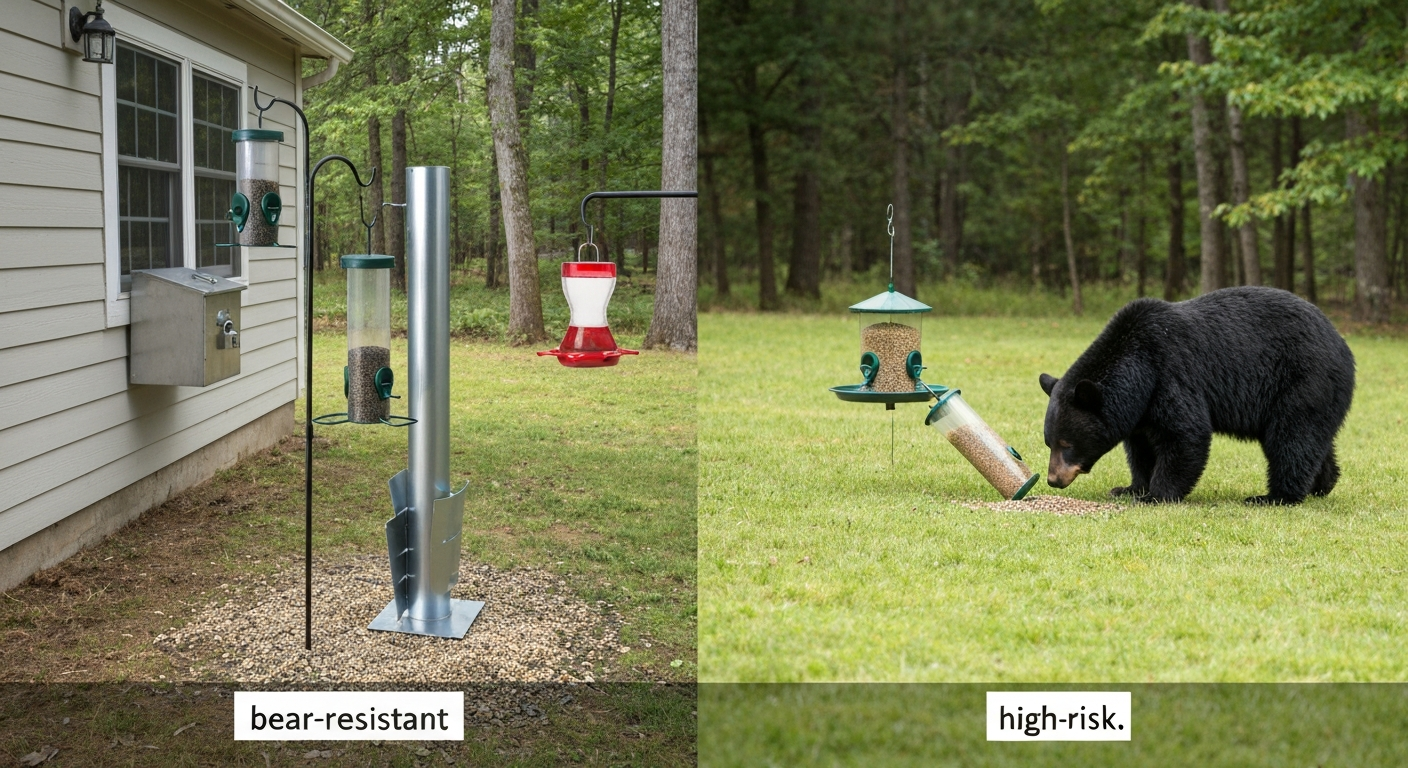
Neither the Birdfy nor the Bird Buddy has a mechanical anti-squirrel system. If squirrels are a serious problem in your yard, you will need to mount either feeder on a pole with a baffle below it or hang it from a line with a squirrel guard. If larger pests are a concern, see our guide on bear vs bird feeder for tips on choosing bear-resistant mounting and placement. The camera will at least alert you when something is raiding the feeder, which is useful information even if it does not stop the theft. For dedicated squirrel-proof hardware, a separate feeder type is worth considering alongside either of these smart feeders.
Camera performance: photo quality, video, and night vision
Daytime image quality
This is where Bird Buddy's Nature Cam Pro pulls ahead clearly. The 5-MP HDR stills with 2K video capture produce noticeably sharper feather detail than the Birdfy's standard 1080p camera. If you want photos you can actually share or print, the Bird Buddy delivers images that look clean and crisp even when a bird is in motion. Multiple hands-on reviewers and specialist buying guides have noted that the Bird Buddy Pro's still image quality is among the best available in the smart feeder category, and from my own testing I agree.
The Birdfy standard model at 1080p is perfectly adequate for bird identification purposes and produces watchable video, but close-up feather detail can look soft, especially on smaller birds like chickadees or goldfinches. If you step up to the Birdfy Metal 2 or a Pro-tier SKU with 4K capture, the gap narrows considerably. For straight-up photo quality at the standard price tier, Bird Buddy wins this round.
Night vision and low-light performance
Netvue Birdfy has a meaningful edge here. The advertised full-color night vision in the standard 1080p model means you can see birds (and other visitors) at dusk and dawn in recognizable color rather than the washed-out green or black-and-white infrared you get from many security-style cameras. In practice this works well enough to identify species by plumage color even in low light, which matters more than you might think during early spring mornings or late fall evenings when birds are actively feeding outside daylight hours.
Bird Buddy does not publicly specify full-color night vision for the Nature Cam Pro in the same way. Low-light performance is acceptable for twilight use but drops off more noticeably after dark compared to the Birdfy. If you want to catch the activity of nocturnal visitors like owls or late-feeding thrushes, the Birdfy has the advantage.
Field of view and slow-motion video
Bird Buddy's Nature Cam Pro supports variable frame rates up to 120 fps, enabling slow-motion capture that is genuinely fun for watching wing beats and arrival behavior. This is a feature the standard Birdfy does not match, and it is one of the more compelling reasons to pay for Bird Buddy's premium membership, which gates the 2K Ultra capture mode. The Birdfy's field of view covers the perch area well for a single-camera setup but does not offer slow-motion as a native feature.
AI and software: species ID, app experience, and notifications
Species identification accuracy
Netvue Birdfy claims AI identification of 6,000-plus bird species, which is an impressively large database. In practice, identification accuracy depends heavily on image quality at the time of detection, a blurry 1080p frame of a bird that moved mid-shot can trip up any AI system. For common backyard birds like American robins, northern cardinals, house sparrows, and blue jays, both platforms perform reliably well. For regional or less common species, the Birdfy's larger claimed database may give it a broader reach, though I would not treat species count alone as a guarantee of accuracy for rare birds.
Bird Buddy's AI identification system is well-regarded in its user community, and the sharper 2K images give the AI better source material to work from. Bird Buddy's 'Nature Chat' AI feature (available on paid membership) adds a conversational layer for learning about identified species, a nice touch for newer birders who want context beyond just a name.
Subscription gating and feature access
Both platforms require a paid subscription to unlock the full AI and cloud experience, and this is the detail that should drive your budget calculation more than the hardware price. Netvue Birdfy ships with a 7-day free AI trial, after which AI identification and extended cloud features move behind a paid plan. Bird Buddy offers Individual Premium at $69.99 per year or Family Premium at $98.99 per year, which unlock 2K Ultra capture, the ability to recognize and name returning individual birds, Nature Chat, and extended cloud retention. If you have multiple birders in the household sharing one feeder, the Family tier is decent value. For a solo user, $70 a year is an ongoing cost you should factor into the total price of ownership.
App user experience and notifications
Bird Buddy's app has a more polished, social-forward design. It leans into the community and sharing angle, with a feed of bird sightings and a clean photo gallery. Notifications are timely and the interface is intuitive even for non-technical users. The Birdfy app is functional but feels more utilitarian, closer to a security camera app than a birding companion. Push notifications work well on both platforms, though some users report Birdfy notifications can be slightly delayed on slower Wi-Fi setups. If the app experience and the community aspect matter to you, Bird Buddy has the edge.
Power and connectivity: battery, solar, and Wi-Fi
Battery and solar charging
The Birdfy's 5,000 mAh built-in rechargeable lithium battery, combined with its integrated solar panel, is one of its strongest practical advantages. In a south-facing install with reasonable sun exposure, the solar panel can meaningfully extend time between manual charges. In overcast climates or shaded yards, you will still need to charge via USB periodically, but the solar assist reduces how often. From user reports, a fully charged Birdfy in active use lasts roughly one to two weeks without solar assist, more in lighter-activity periods.
Bird Buddy's Nature Cam Pro uses a removable, detachable battery rated at up to one month per charge depending on usage, which is an impressive claim. The optional Solar Roof accessory can extend this further in sunny installs. The big advantage of Bird Buddy's removable battery is that you can swap it without touching the feeder at all, or bring just the camera module inside to charge. This is genuinely convenient compared to unhanging and recharging the whole Birdfy unit. Over a full winter of heavy bird activity (and shorter solar days), I found both systems needed manual charging intervention roughly monthly.
Wi-Fi requirements and range
Both feeders operate on 2.4 GHz Wi-Fi only, which is standard for outdoor IoT devices. The 2.4 GHz band has better range through walls and outdoors than 5 GHz, but if your router is on the other side of the house from the feeder, you may experience connectivity issues with either device. Several Birdfy users have reported that the unit needs to be within roughly 30 to 50 feet of the router (or a Wi-Fi extender) for reliable live streaming. Bird Buddy also supports Bluetooth Low Energy (BLE) for initial setup and close-range communication, which can smooth the pairing process. Neither feeder supports a wired Ethernet connection, so a solid outdoor Wi-Fi signal is a prerequisite for both.
Storage and privacy: local vs cloud
This is a meaningful difference between the two platforms. Netvue Birdfy supports local microSD storage (Class 10, up to 128 GB), which means your video footage can stay on-device and does not have to travel through Netvue's cloud servers at all. Free cloud storage retains event clips (up to 20 seconds) for 30 days; a subscription extends clips to 30 seconds and retention up to 60 days. If privacy or data ownership matters to you, the ability to store everything locally on a microSD card is a real differentiator.
Bird Buddy does not offer microSD storage. All footage and images are stored in Bird Buddy's cloud, with premium membership unlocking better retention and 2K clip quality. This is fine for most users, but if your internet connection is unreliable, or if you are uncomfortable with continuous cloud upload of your backyard footage, Birdfy's local storage option is worth weighing seriously.
Weatherproofing and build durability
Netvue Birdfy carries an IP65 waterproof rating, which means it is protected against dust ingress and low-pressure water jets from any direction. This is a meaningful standard, IP65 is commonly used for outdoor security cameras and covers everything short of submersion. I have had the Birdfy out through heavy rain, ice, and one legitimate hailstorm with no damage to the camera or electronics. The ABS and polycarbonate construction holds up well to UV exposure over a full season, though I have seen some minor yellowing on units left in direct sun for extended periods.
Bird Buddy does not publish an IP rating for its feeder or camera system. Anecdotally, most users report fine durability under normal rain conditions, but the absence of a formal waterproof rating means you are taking the manufacturer at their word. If you live somewhere with serious weather, sustained rain, freezing temperatures, snow load on the feeder, the Birdfy's documented IP65 protection gives me more confidence. Both feeders benefit from being mounted under a slight overhang if possible, which reduces direct rain exposure regardless of waterproofing spec.
Installation, maintenance, and real-world reliability
Both feeders are designed to hang or pole-mount and come with basic mounting hardware. Setup on either platform takes 15 to 30 minutes including app configuration, and neither requires drilling or hardwiring. Birdfy's all-in-one design means there is one unit to hang and one USB port to charge. Bird Buddy's modular design means camera and feeder can be handled separately, which is genuinely useful at cleaning time, you can rinse the feeder body without worrying about getting water in the camera electronics.
On maintenance: both feeders need seed refills every few days in an active yard, and both should be cleaned with a mild soap and water solution monthly to prevent mold and bacteria buildup in the seed tray, this is true of any bird feeder regardless of how smart it is. The Birdfy's seed compartment is reasonably accessible; Bird Buddy's modular design gives it a slight edge for thorough cleaning. For winter feeding specifically, make sure neither feeder's drain holes become blocked by frozen seed debris, which can cause wet clumping and mold even in cold temperatures.
Total cost of ownership over two years
| Cost item | Netvue Birdfy (standard) | Bird Buddy (Nature Cam Pro) |
|---|---|---|
| Hardware (upfront) | $299.99 | Varies; feeder + cam bundle approx. $200–$250 |
| Year 1 subscription | Paid plan required after 7-day trial (price varies by tier) | $69.99/yr Individual Premium |
| Year 2 subscription | Ongoing paid plan | $69.99/yr Individual Premium |
| Solar accessory | Included (integrated) | Optional Solar Roof (additional cost) |
| microSD storage | Optional (user-supplied, up to $20–$30 for 128 GB) | Not applicable (cloud only) |
| Estimated 2-year total (individual) | ~$300 + subscription cost x2 | ~$225–$250 hardware + ~$140 subscription = ~$365–$390 |
Exact subscription pricing for Birdfy's paid AI plan is not uniformly published at the time of writing, so the two-year total for Birdfy depends on which tier you choose. The point is that neither feeder is a one-time purchase if you want full functionality. Factor in subscription costs before committing, and consider whether you would actually use the premium features enough to justify them year over year.
Which one should you buy? Recommendations by use case
Buy the Bird Buddy Nature Cam Pro if:
- Photo and video quality is your top priority — you want shareable 2K images and slow-motion captures of wing beats and arrivals
- You value a polished, community-oriented app experience and enjoy the social/discovery side of birding
- You want a 2-year warranty and a 90-day return window for peace of mind
- You are comfortable with cloud-only storage and do not have privacy concerns about footage leaving your home network
- You have reliable Wi-Fi outdoors and do not mind paying a yearly membership for full feature access
Buy the Netvue Birdfy if:
- You want full-color night vision to capture dusk and dawn activity, or to see what is visiting after dark
- Local microSD storage matters to you for privacy, offline access, or unreliable internet
- You want solar charging built in from day one without buying an accessory separately
- You need a formally IP65-rated weatherproof feeder for a particularly wet or exposed install location
- You want access to a very large species ID database (6,000+ species) and are willing to subscribe to keep it active
If you are on a tighter budget
Neither of these is a budget feeder. If the hardware plus two years of subscription feels steep, it is worth considering whether a non-smart feeder paired with a separate wildlife camera might serve you better. For a direct comparison of feeding stations and water features, see the bird bath vs bird feeder guide for pros, cons, and which attracts different species. A good platform feeder or hopper feeder filled with black oil sunflower seed will attract a wider range of birds regardless of whether there is a camera watching, and you can always add smart technology later when prices drop or a new generation releases.
A quick buying checklist before you order
- Check your Wi-Fi signal strength at the intended feeder location — both devices need a solid 2.4 GHz signal within 30–50 feet
- Decide whether cloud-only or local microSD storage fits your privacy preferences and internet reliability
- Calculate the two-year total cost including subscription fees, not just the hardware price
- Confirm whether your yard gets enough direct sun to make solar assist meaningful, or whether you are prepared to charge manually
- Consider whether night vision matters for your location and local bird activity patterns
- If photo sharing is a priority, Bird Buddy's 5-MP stills and 2K video will satisfy you more than standard Birdfy 1080p
- If you want to step up on Birdfy resolution, check the Metal 2 or Pro SKUs for 4K options before purchasing the standard model
Troubleshooting tips for either feeder
- If the camera is missing bird visits, check the detection sensitivity setting in the app — both platforms allow you to tune this to reduce false triggers from wind or passing shadows
- Seed clumping after rain usually means the feeder's drainage holes are blocked; clear them with a toothpick and consider moving the feeder under a partial overhang
- If night vision images look washed out on the Birdfy, make sure there is no artificial light source (porch light, street lamp) directly in the camera's field of view — it confuses the exposure sensor
- For Wi-Fi dropouts, a Wi-Fi range extender placed inside near the window closest to the feeder usually solves the problem without needing a mesh network upgrade
- If Bird Buddy's camera is showing condensation inside the lens, bring the camera module indoors, let it dry completely at room temperature, and reseat the camera-to-feeder connection carefully before remounting
The bottom line
The Netvue Birdfy and Bird Buddy Nature Cam Pro are the two most capable smart feeders available to backyard birders right now, and they are genuinely different products aimed at slightly different priorities. Bird Buddy is the better camera, the better app, and the better choice if beautiful images and a rich user community are what you are after. Netvue Birdfy is the more self-contained, weatherproofed, locally-stored option with built-in solar and full-color night vision. Both require ongoing subscriptions for their best features, and both will reward you with hours of entertainment and a much better understanding of which birds are visiting your yard and when. Whichever you choose, place it where the birds already are, use the right seed for your target species, and the footage will take care of itself. For a side-by-side breakdown of specs, features, and pricing, see our smart bird feeder comparison.
FAQ
Which feeder is better for photo and video quality: Netvue Birdfy or Bird Buddy (Nature Cam Pro)?
Bird Buddy (Nature Cam Pro) generally offers higher still‑image detail (5 MP HDR stills) and 2K video capture, which reviewers report yields superior feather detail and social‑quality photos. Netvue Birdfy commonly ships with 1080p capture on many SKUs; Netvue does offer higher‑resolution models but 1080p is typical across core units. Choose Bird Buddy if top‑quality photos and slow‑motion/2K video are a priority; choose Netvue if 1080p is sufficient and you want a lower base price option.
How do their AI species‑ID features compare for accuracy and cost?
Both vendors offer AI species ID. Netvue advertises an AI that can identify 6,000+ species but often gates advanced AI and extended cloud features behind a subscription (common practice: short free trial, then paid). Bird Buddy includes species ID in its app but many advanced features (2K captures, naming returning birds, 'Nature Chat') require a paid membership (listed at $69.99/yr individual or $98.99/yr family). Expect similar tradeoffs: capable ID models but better accuracy and features with paid subscriptions and more training data may favor Bird Buddy’s premium service.
What are the power and connectivity differences?
Netvue Birdfy units commonly include a built‑in rechargeable 5000 mAh battery plus integrated solar panels and support 2.4 GHz Wi‑Fi. Bird Buddy’s Nature Cam Pro uses a removable rechargeable battery that the company states can last up to about one month (depending on usage) and supports an optional Solar Roof for continuous charging. Both use 2.4 GHz Wi‑Fi (FCC filings confirm) and offer removable batteries/solar options—pick based on install location (sun exposure) and desired run time.
How do storage and privacy options compare?
Netvue supports both cloud event storage (free short clips with limited retention; subscribed plans extend retention) and local microSD (Class 10 up to 128 GB) for local recordings. Netvue typically offers a short free AI trial then subscription for extended cloud/AI features. Bird Buddy uses cloud services and clearly publishes membership pricing; premium membership unlocks higher‑resolution cloud captures and longer retention. If local storage and avoiding cloud is important, Netvue’s microSD support is an advantage—verify exact model behavior before purchase.
What about weatherproofing, build quality, and feeder hardware (seed compatibility/capacity)?
Netvue’s Birdfy family lists IP65 waterproof rating, ABS+PC materials, and seed capacity around 1.5 L (≈50 oz) in typical models; dimensions and weight are published in manuals. Bird Buddy uses its own weather‑resistant enclosures and offers modular feeder designs (check specific SKU specs). Both are intended for backyard use; Netvue’s spec sheet gives clearer IP rating and seed capacity numbers, while Bird Buddy emphasizes camera performance and modular add‑ons. Confirm seed type compatibility (small mixed seed, sunflower chips, pellets) per model before buying.
How well do they handle pests and squirrels?
Both companies design feeders for typical backyard use but neither feeder is inherently squirrel‑proof—most smart feeder designs rely on placement, baffles, or heavier materials to deter pests. User reports vary; expect to need additional hardware (squirrel baffle, strategic mounting, or placement) to reliably keep squirrels away. Evaluate your property’s pest pressure and plan for add‑ons if squirrel control is required.