A cylinder bird feeder (also called a tube feeder) is one of the most versatile and bird-friendly feeders you can buy. If you want to attract chickadees, finches, nuthatches, and other small songbirds without constantly fighting squirrels and spilled seed, a well-chosen tube feeder mounted on a pole with a baffle is the single best setup for most backyards.
Best Cylinder Bird Feeders: How to Choose and Maintain
Marcus Hendricks
18 May 2026
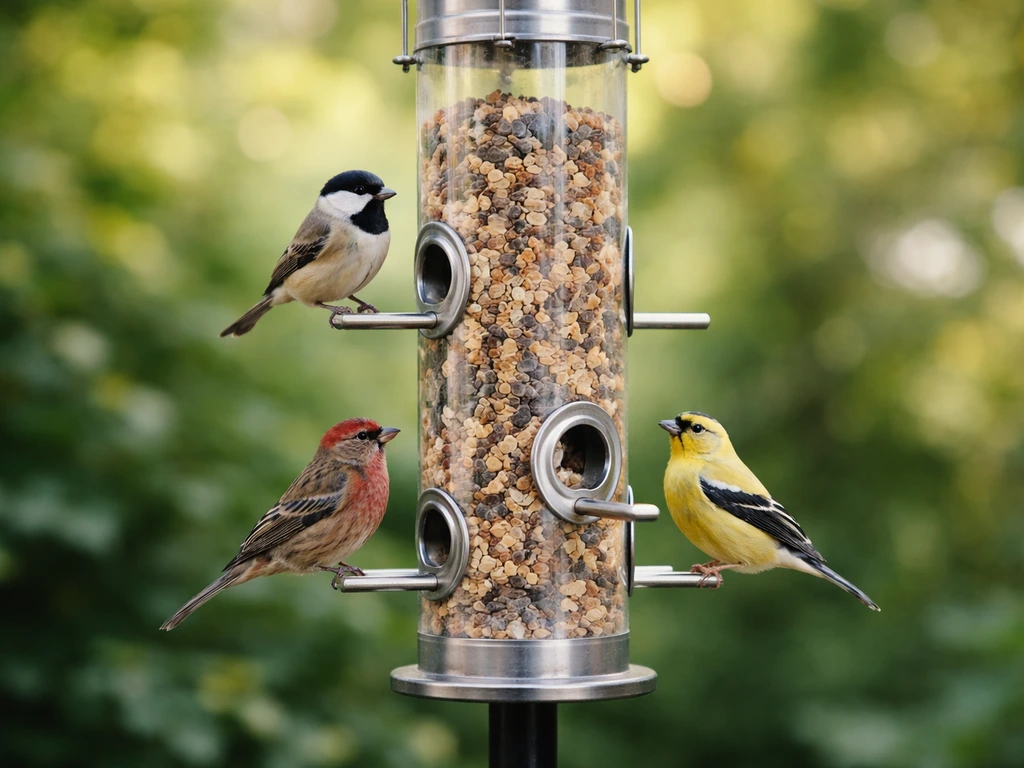
The best cylinder feeders have multiple ports with individual perches, UV-stabilized polycarbonate or metal construction, an internal seed baffle to keep seed flowing, and either a weight-activated squirrel-deterrent system or compatibility with a separate pole baffle. For most people, a 4- to 6-port tube feeder filled with black-oil sunflower seed or nyjer, mounted 8 to 10 feet from any launch point, will outperform almost any other feeder style for sheer bird volume and manageable maintenance.
To pick the best tube bird feeders for your yard, focus on port count, seed compatibility, and squirrel-proofing first.
What actually makes a feeder a "cylinder" or tube feeder
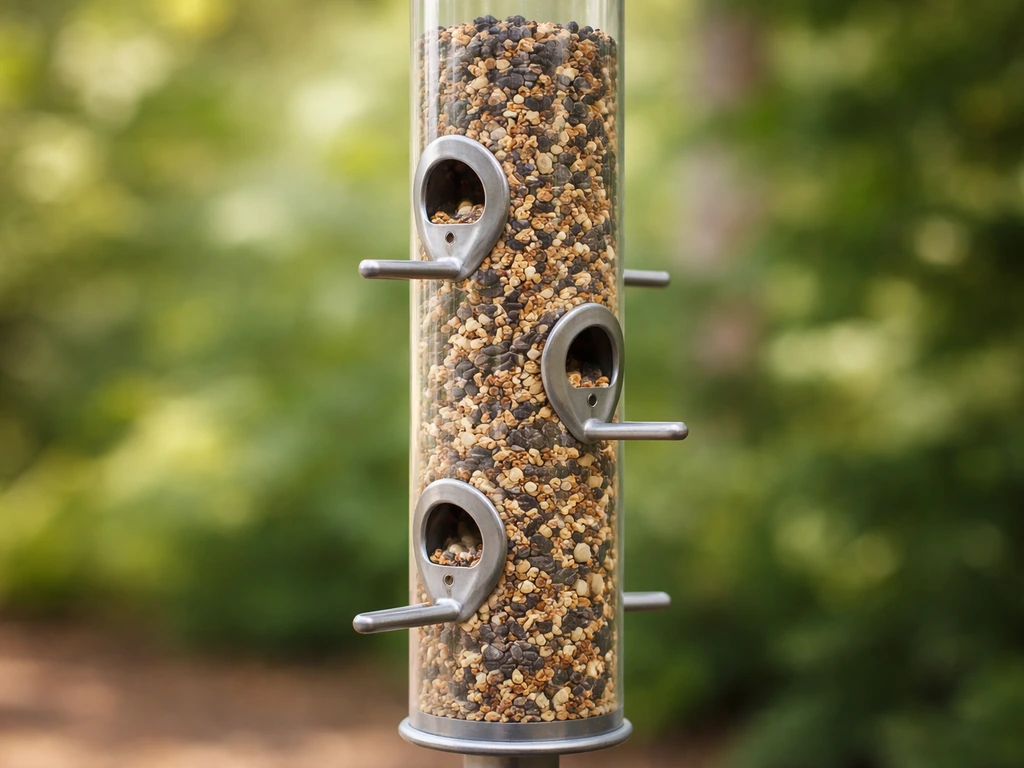
A cylinder bird feeder is a hollow tube, usually made from clear plastic or glass, with seed stored inside and multiple feeding ports drilled into the sides. Birds perch on individual perches next to each port and pull seed directly out while the rest of the seed stays protected inside the tube. That's the defining feature: seed is enclosed, birds feed from the outside. This is different from a hopper feeder (which looks like a little house and exposes seed in an open trough) and a platform feeder (a flat, open tray). Tube feeders keep seed drier, waste less, and are generally easier to squirrel-proof than open platform or hopper designs.
The terms "cylinder" and "tube" feeder are interchangeable in practice. Some manufacturers brand their tube feeders as cylinder feeders for marketing reasons, but the construction is the same. What varies is size (a small 2-port feeder versus a large 8-port model), material (polycarbonate, glass, or stainless steel), and added features like weight-activated port closers or mesh cages. Triple tube feeders, which bundle three tubes together for higher capacity, are a variation worth knowing about if you have heavy traffic.
Features that actually matter when buying
Ports, perches, and seed compatibility
Port size is the most important spec nobody talks about enough. Small ports (around 3/16 inch) are designed for nyjer (thistle) seed and are ideal for finches and pine siskins. Larger ports (3/8 inch or bigger) handle black-oil sunflower, safflower, and mixed seed for chickadees, nuthatches, house finches, and cardinals. If you buy a nyjer feeder and fill it with sunflower, seed will jam and rot.
Get the port size matched to your seed from day one. Perch placement also matters: perches above the ports favor clinging birds like goldfinches and siskins, while perches below work for more species. Look for individual, rigid perches rather than a single ring perch, since ring perches can encourage aggressive birds to monopolize the feeder.
Capacity and tube length
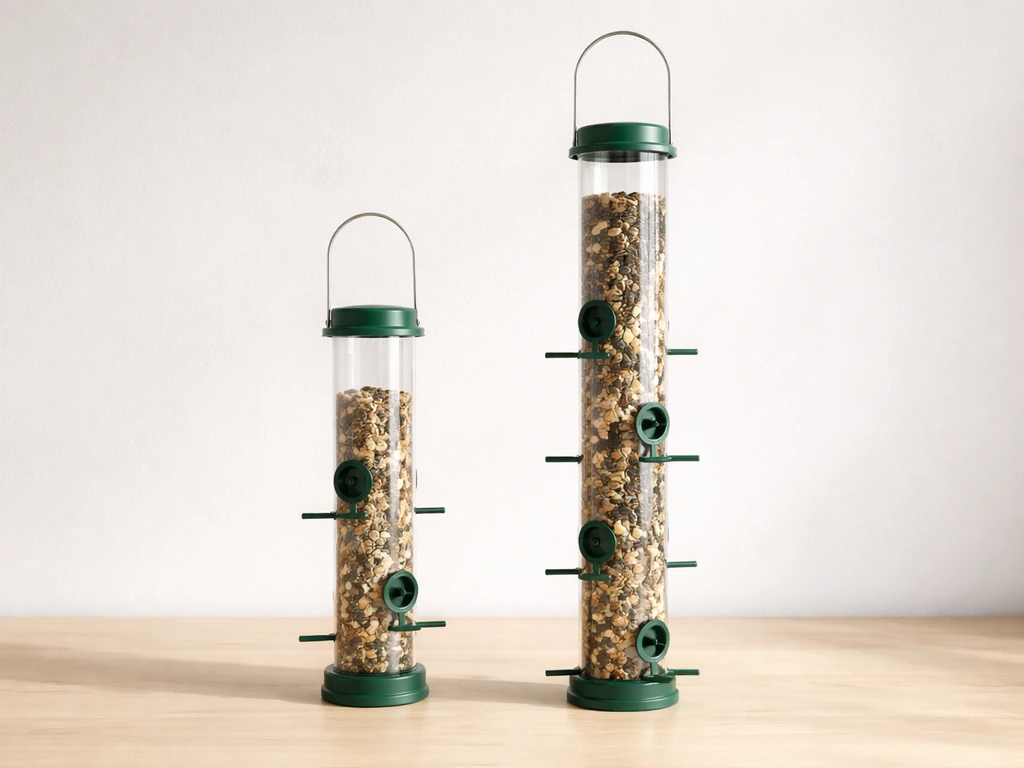
Tube feeder capacity typically ranges from about half a pound of seed for a small 2-port model up to 3 to 5 pounds for a long 8-port feeder. For light traffic (a quiet suburban yard), a 1- to 2-pound capacity feeder works fine and means you're refilling every few days, which naturally keeps seed fresh. For heavy traffic or winter feeding when birds are hitting the feeder hard all day, a larger capacity feeder saves time. That said, don't buy a massive feeder if your bird traffic is low. Seed sitting in a tube for weeks will go stale, absorb moisture, and mold. Match capacity to your actual bird volume.
Material and durability
Most tube feeders are made from polycarbonate plastic, and quality varies enormously. Cheap feeders yellow and crack within a season, especially in direct sun. Look for UV-stabilized polycarbonate, which resists sun degradation significantly longer. Droll Yankees, for example, specifically markets UV-stabilized tubes and backs them with a lifetime warranty on defective parts.
Metal tube feeders (stainless or powder-coated steel) are more durable and harder for squirrels to chew through, though they cost more and can get hot in direct summer sun. If you want the best metal bird feeder, prioritize a durable metal tube with secure ports, a good baffle, and easy cleaning access Metal tube feeders (stainless or powder-coated steel).
For most people, a UV-stable polycarbonate tube with metal ports, perches, and end caps is the sweet spot of durability versus cost. All-metal construction is worth the upgrade if you're dealing with persistent squirrel chewing.
Squirrel-proofing and pest resistance
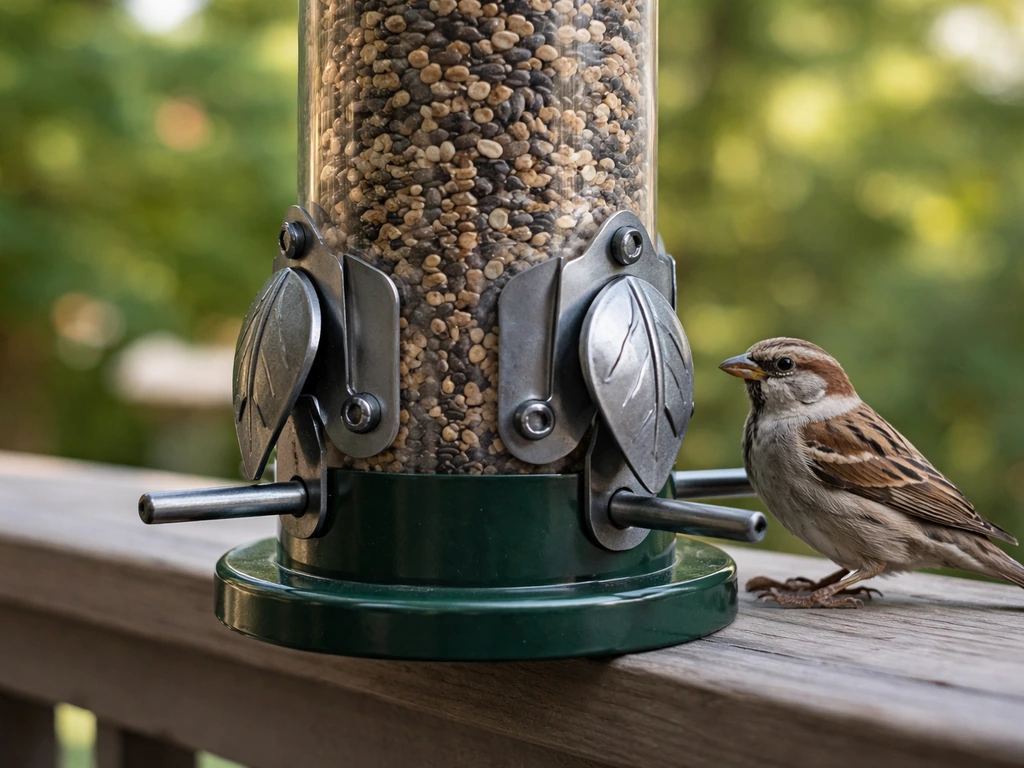
There are two main approaches to squirrel-proofing on tube feeders. The first is a weight-activated system, where metal shutters or leaves cover the ports when something heavier than a songbird (like a squirrel) lands on the perch. Perky-Pet's Squirrel-Be-Gone III uses this approach well. The second approach is a cage feeder, where a metal mesh cage surrounds the tube and physically blocks squirrels while allowing small birds to pass through the openings.
Cage feeders are often more reliable than weight-activated systems for determined squirrels. Some feeders, like the Stokes Select line, are also designed to be compatible with separate pole baffles (such as the Squirrel-X 15- or 18-inch baffle), which is a smart design feature since baffle placement is often the most reliable squirrel deterrent of all.
The Stokes Select squirrel-proof tube feeder listing notes compatibility with Squirrel-X baffles, underscoring the importance of matching the feeder port or cage style with a compatible baffle system for squirrel reduction Stokes Select line.
Ease of cleaning
This one is non-negotiable. Cornell Lab's Project FeederWatch is direct about it: tube feeders should be easy to take apart and should be washed frequently. Feeders that require tools to disassemble or have ports you can't reach with a bottle brush will collect moldy seed and spread disease. Look for feeders with a removable base, a removable top cap, and ports wide enough to clean with a standard bottle brush or tube brush. If a feeder advertises being dishwasher-safe, that's a genuine bonus. Internal seed baffles (like those Droll Yankees uses on their 6-port models) help keep seed flowing evenly and reduce the dead zones where seed gets stuck and rots, but they need to be removable for cleaning.
Weather resistance and winter use
In wet climates or winter, look for feeders with a good weather hood or dome over the ports, tight-fitting end caps, and drainage holes in the base tray if one is included. A small attached tray at the bottom of a tube feeder can catch spilled hulls and shells, which improves hygiene around the feeding station. In heavy snow, a wide dome on top keeps seed accessible and dry. Copper-topped tube feeders offer weather resistance with a good aesthetic, and copper develops a natural patina that holds up well outdoors over years. Copper top bird feeders can be a great option if you want a durable tube feeder with extra weather resistance.
Best cylinder feeder picks by situation
| Situation | Best Feeder Type | Seed to Use | Key Feature to Prioritize |
|---|---|---|---|
| Small birds only (goldfinches, siskins, redpolls) | Nyjer tube feeder, 4–6 ports, small ports | Nyjer (thistle) | Perches above ports, fine mesh or sock option |
| Mixed small birds (chickadees, nuthatches, house finches) | Standard tube feeder, 4–6 ports, mid-size ports | Black-oil sunflower | UV-stable tube, removable base, metal hardware |
| Cardinals and larger birds included | Large-port tube feeder with tray attachment, or cage feeder | Black-oil sunflower or safflower | Longer perches or tray, weight-activated option |
| Heavy squirrel pressure | Cage-style tube feeder or weight-activated tube feeder + pole baffle | Black-oil sunflower or safflower | Metal cage or weight-activated shutters, baffle compatibility |
| Budget pick | Basic polycarbonate 4-port tube feeder (Perky-Pet, Nature's Way) | Black-oil sunflower | Removable base, wide port access for cleaning |
| Premium/long-term investment | Droll Yankees UV-stabilized 6-port with lifetime warranty, or metal tube feeder | Black-oil sunflower or nyjer | Lifetime warranty, UV-stable, dishwasher-safe parts |
| Winter/cold climates | Tube feeder with dome/weather guard, metal hardware | Black-oil sunflower or safflower (oil-rich seed) | Wide dome, tight caps, drainage tray, rust-resistant hardware |
For woodpeckers, doves, and blue jays, a standard tube feeder is not the best match. These birds struggle with small ports and thin perches. If those are your target birds, a hopper or platform feeder will serve them much better. Tube feeders are genuinely built for songbirds in the chickadee, finch, nuthatch, and titmouse size range. If you want to feed a broader mix, consider running a tube feeder alongside a platform feeder rather than trying to force a tube feeder to do everything.
How to place and set up your cylinder feeder
Placement is where most people lose the battle against squirrels before it even starts. The rule is simple but strict: your feeder pole needs to be at least 8 to 10 feet away from any launch point, which means tree trunks, overhanging branches, fences, deck railings, and the roof edge. Squirrels are capable jumpers and will clear a shorter gap easily. The 8- to 10-foot rule isn't a suggestion. It's the minimum for a baffle to have any chance of working. If your yard doesn't have a spot that meets this requirement, a cage-style feeder becomes more important.
Mount the feeder on a smooth metal pole, ideally at 5 to 6 feet off the ground, and install a cylindrical or dome baffle on the pole below the feeder. The baffle needs to be positioned high enough (at least 4 feet off the ground) that squirrels can't jump over it from below. A baffle that's too low, or a pole that's too close to a fence, will fail. Audubon's honest assessment is that no setup is 100% squirrel-proof, but a correctly placed baffled pole comes very close.
For bird attraction, place the feeder within sight of nearby cover, like shrubs or trees, so birds feel safe approaching. Around 10 to 15 feet from a shrub gives birds a quick retreat without giving squirrels an easy jump. Put feeders where you can see them from a window, both for enjoyment and so you'll notice problems (empty feeder, pest activity, sick birds) quickly.
Cleaning and keeping seed fresh
Clean your tube feeder every two weeks as a baseline. During warm, wet weather or if you're seeing heavy bird traffic, clean weekly. Disease spreads fast at feeders and most of it starts with moldy seed and feces-contaminated ports. The cleaning process is straightforward: disassemble the feeder completely (remove the base, top cap, and any internal components), rinse off loose debris, then soak in a dilute bleach solution of 1 part bleach to 9 parts water for about 10 minutes. Rinse thoroughly, and let the feeder air dry completely before refilling. Never put seed back into a damp tube feeder.
A bottle brush is essential for reaching inside the tube and scrubbing the ports. You can also run dishwasher-safe feeders through a hot dishwasher cycle, which does a good job sanitizing plastic parts. The Virginia DWR recommends the bleach soak specifically for tube feeders, and the Cornell Lab's guidance aligns: soap plus boiling water or dilute bleach, thorough rinse. If your feeder smells musty or you can see dark spots inside, that's mold. Clean it the same day you notice it, not on your next scheduled cleaning.
Seed management matters as much as cleaning. Only fill the feeder with as much seed as birds will eat in about 3 to 5 days. Seed left in a tube for longer than a week in warm weather can go rancid or mold, especially if any moisture gets in. Buy seed from a store with high turnover so it's fresh to begin with, and store your seed in a sealed metal or hard plastic container to keep it dry and rodent-free.
Troubleshooting the most common problems
Low bird traffic
If birds aren't visiting, start with these checks: Is the seed fresh? Old or low-quality seed with a lot of filler like milo or red millet is frequently ignored by the birds tube feeders attract. Switch to straight black-oil sunflower or nyjer and see if traffic improves within a few days. Is the feeder in a spot where birds feel safe? A feeder in the middle of an exposed open lawn with no shrubs nearby may feel too risky for small birds. And is the feeder actually accessible? Check that ports aren't clogged with compacted seed or debris.
Messy seed and hulls under the feeder
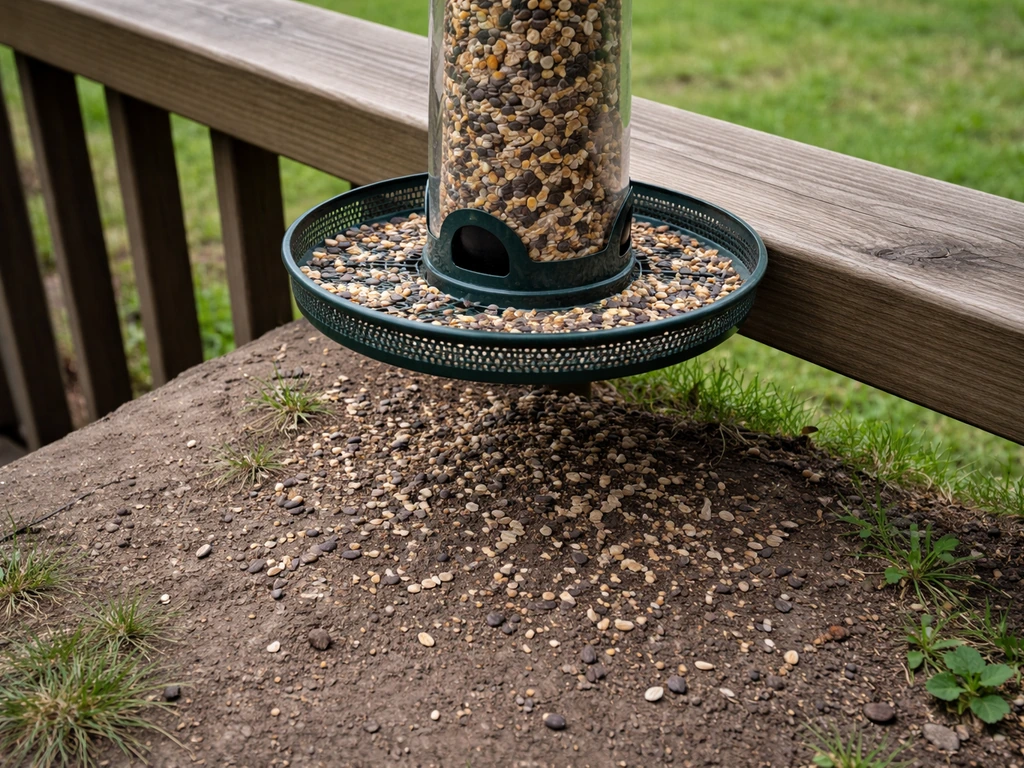
Seed hulls, uneaten seed, and bird droppings under the feeder attract rodents fast. A small catch tray attached to the bottom of the tube feeder reduces ground debris considerably. You can also switch to hulled sunflower (sunflower chips) or nyjer, which produce almost no shell mess. Rake or sweep under the feeder regularly. Don't let a pile of wet seed hulls build up on the ground since that pile is a rat and mouse magnet.
Ants
Ants climbing the pole or hanger wire to reach the feeder are a classic problem in summer. The fix is an ant moat: a small cup-shaped device filled with water that fits onto the hanging wire or hook above the feeder. Ants can't cross the water barrier. Cornell Cooperative Extension and Texas Parks and Wildlife both recommend this as the standard solution. The moat needs to stay filled with water, so check it every few days and refill as needed. It's low-maintenance and genuinely effective.
Squirrels and rats
Squirrels on the feeder: go back to placement first. Is the pole truly 8 to 10 feet from every launch point? Even a single branch at 7 feet that you overlooked can be the entry point. If placement is correct and squirrels are still getting in, upgrade to a cage-style feeder or a weight-activated port-closer feeder.
A good baffle on the pole in combination with a cage feeder gives you two layers of protection. Rats are a different problem. They're mostly attracted to spilled seed on the ground, not the feeder itself. Reduce spills (use a tray, switch to hulled seed), clean under the feeder regularly, and store your seed in a sealed container off the ground.
King County public health guidance specifically calls out ground-level spilled seed as the primary rat attractant at bird feeders.
DIY upgrades, baffles, and when to switch feeder types
You don't need to buy a purpose-built squirrel-proof feeder to get effective protection. A smooth metal pole plus a commercial cylindrical pole baffle (such as the Squirrel-X or Audubon Society baffles) costs less than a premium squirrel-proof feeder and is often more reliable over time. The baffle is a separate purchase from the feeder, which means you can pair any tube feeder you like with a solid baffle system. This approach also makes it easier to swap out feeders for cleaning or replacement without changing your pole setup.
If you want to improve seed flow inside an older tube feeder, you can make a simple DIY seed baffle by cutting a small disc from a plastic container lid and placing it at the midpoint inside the tube. This pushes seed toward the ports as it settles, similar to what Droll Yankees builds in from the factory. It's a minor upgrade but it helps with long feeders where seed in the bottom half never reaches the lower ports.
On seed choices: switching from mixed seed to straight black-oil sunflower is the single easiest upgrade most people can make. It reduces waste, attracts more desirable birds, and keeps the feeder cleaner since birds aren't picking through fillers and throwing seed to the ground. For finch feeders specifically, fresh nyjer seed is critical. Nyjer goes stale faster than sunflower and finches will ignore a feeder filled with old nyjer even if they're abundant in your yard.
Finally, know when a tube feeder isn't the right tool. If your primary target birds are cardinals, blue jays, mourning doves, or woodpeckers, a hopper feeder or a platform feeder will outperform any tube feeder for those species. Tube feeders are at their best with small to medium songbirds.
A well-rounded feeding station often pairs a tube feeder for finches and chickadees with a hopper or platform for larger birds, giving you coverage across a wider range of species without asking any single feeder to do too much. If you're interested in exploring the range of tube-style options more broadly, comparing tube and cylinder feeders across different materials and configurations (including copper and metal builds) can help you find the right combination for your specific yard.
FAQ
Can I put my cylinder bird feeder in the dishwasher instead of using bleach?
Yes, but only for true feeding ports that are sealed and reachable. If your tube feeder has internal baffles, weight-activated shutters, or non-removable perches, the dishwasher can leave residues in crevices. After any dishwasher cleaning, air-dry completely before refilling, because trapped moisture inside the tube can still grow mold.
Why do birds stop feeding even though the feeder isn’t empty?
If ports look fine, check for “micro-clogs” where seed husks swell and pack around the port openings. In that case, switch to seed that matches the port size (nyjer for small ports, black-oil sunflower for larger ports), then scrub the ports with a tube brush and remove any husk buildup from the inside baffle area.
What should I do with leftover seed if bird traffic is slow?
Run a shorter feeder schedule. For tube feeders, a practical rule is to refill only what birds will finish in about 3 to 5 days, then discard any leftover seed that has sat longer (especially in warm, humid weather). Stale seed is a frequent reason for declining visits, even when seed amount looks adequate.
Do I still need a cage or weight-activated protection if I use a separate baffle?
If you use a separate pole baffle with a tube feeder, the baffle height on the pole matters as much as the feeder height. Ensure the baffle’s top edge is high enough that squirrels cannot jump up and reach the underside of the feeder, and keep the feeder at the required distance from any launch point like branches or fences.
Is it safe to just rinse a moldy tube feeder and refill it?
Replace seed as soon as mold or musty odor appears, and do not rinse-and-refill without fully scrubbing. Tube feeders can hold residue in the seams and around internal components, so the safe approach is complete disassembly, bleach soak, thorough rinse, then full air-dry before adding fresh seed.
Can I swap seeds (like nyjer and sunflower) in the same cylinder feeder?
It usually is, but mixing can be a trap. If you fill a small-port nyjer feeder with larger seed types (like sunflower), seed can jam and rot, and the port closers (if present) may not operate smoothly. The best practice is to keep seed type and port size aligned, and keep the feeder dedicated to a single seed.
How do I know if my tube feeder is still contaminated after cleaning?
Don’t assume “clear plastic” means “easy to see.” Tube interiors can hide slimy film and dark spots near the bottom and around perches. Use a flashlight and inspect the inside near the internal baffle and port edges after cleaning, so you catch remaining residue before it turns into mold.
What’s the most reliable way to stop ants from reaching a tube feeder?
For ants, an ant moat works best when placed on the correct support point, with the moat kept topped up so ants cannot bridge the water. If ants are still reaching the feeder, check for nearby vegetation touching the pole, and trim any branches or overhangs that create a bypass route.
Will a tube feeder work for cardinals, doves, or woodpeckers?
Yes, especially if you’re trying to feed birds that struggle with small perches or tight openings. If you regularly see doves, blue jays, or woodpeckers at your setup, expect lower success with tube feeders and consider pairing a hopper or platform feeder nearby for those species.
How do perch height and perch design affect which birds visit tube feeders?
Use the “matching ports to seed” approach, then adjust perch height to target bird behavior. Taller perches above the ports tend to favor cling-and-balance feeders, while below-port perches can broaden the species mix. Also ensure perches are individually rigid rather than a single ring, since aggressive birds can monopolize ring-style perches.
Is it better to buy a large-capacity tube feeder to avoid frequent refills?
Choose capacity based on consumption speed, not just how full you want it to look. If the feeder sits longer than about a week in warm conditions, seed can absorb moisture and go stale. For low traffic, smaller capacity plus more frequent refills usually produces better results than large capacity that waits for birds.
Can I add a DIY internal baffle to improve seed flow in a long tube feeder?
You can, but be cautious with DIY seed baffles. Make sure the inserted disc stays centered, does not block port openings, and is placed where it won’t trap seed around the baffle edge. After installing, test seed flow by running a small amount of seed and checking for uneven buildup at the lower ports before leaving it unattended.