A good bird feeder stand is one that stays put in wind and rain, sits at the right height for the birds you want to attract, keeps squirrels off your seed, and doesn't turn into a rusty wobbling mess after one winter. The best all-around setup for most yards is a powder-coated steel pole system (like Wild Birds Unlimited's Advanced Pole System or a similar modular steel pole) paired with the feeder type that matches your target birds, hopper or tube for cardinals and finches, suet cage for woodpeckers, platform for ground-feeding doves and juncos. Get the height, baffle placement, and pole-to-obstacle distance right, and you'll solve most of the common problems in one go.
Best Bird Feeder Stands: Buying Guide for Stand-Alone Setups
Marcus Hendricks
29 May 2026
What actually counts as a bird feeder stand
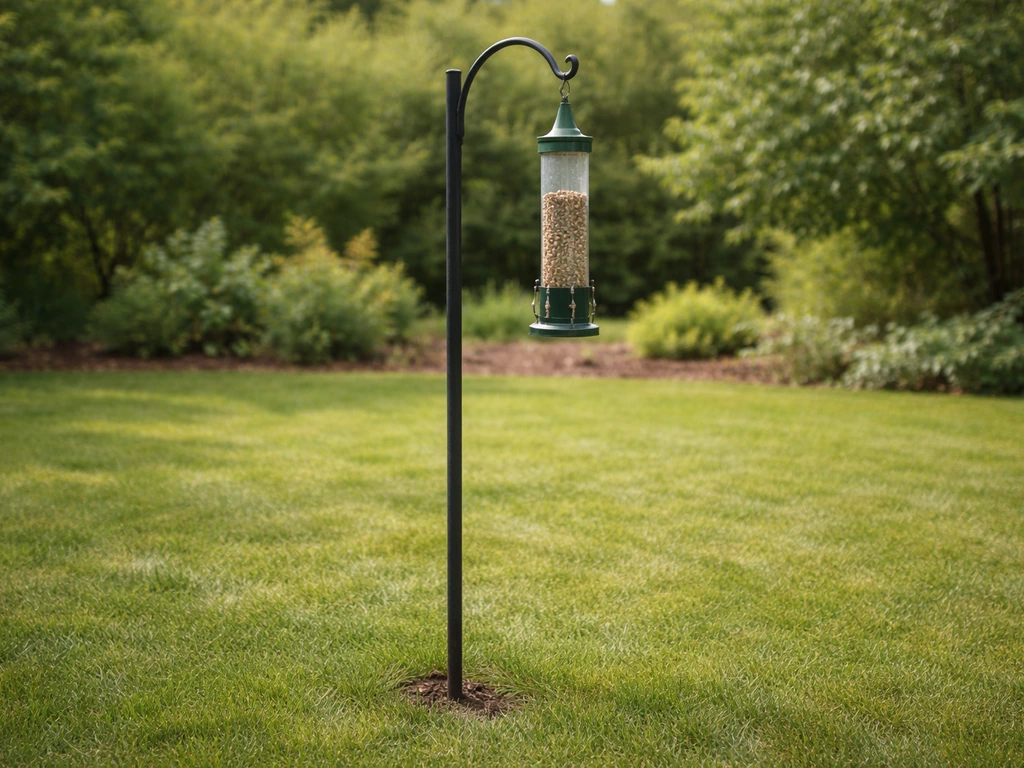
A bird feeder stand (sometimes called a free-standing or stand-alone feeder setup) is any system where the feeder is supported by a pole or post that goes into the ground independently, not hung from a tree branch, not clamped to a deck railing, not stuck to a window with suction cups. That distinction matters because stand-alone setups give you full control over placement, height, and pest-proofing in a way that hanging feeders and deck-mounted options simply don't. You can position the pole exactly where you want it, blank" rel="noopener noreferrer">add baffles above and below, and move it if birds aren't responding or if squirrels figure out a new launch angle.
Stand-alone setups range from a single shepherd's hook pounded into the lawn, to a full modular pole system with multiple arms that holds four or five feeders at once, to a heavy base-weighted stand designed for patios and balconies where you can't drive a spike into the ground. If you're comparing this against hanging feeders or deck-mounted options, the main trade-off is flexibility versus convenience: a stand gives you more placement freedom and better pest control options, while hanging and deck-mounted setups are quicker to install if your yard layout already works for them.
How to choose the right stand: stability, height, and materials
Stability on different ground types
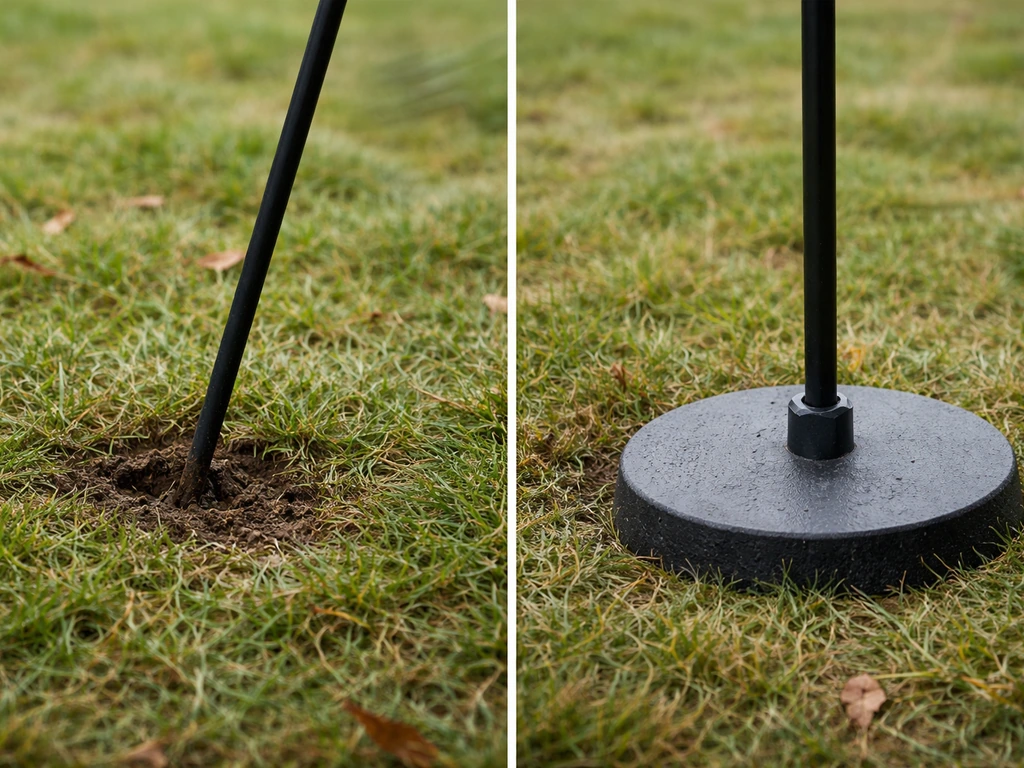
Stability is the first thing to think about, and it's almost entirely a function of how the pole meets the ground. A simple step-in shepherd's hook works fine in dense, damp lawn soil but will lean, wobble, or pull out entirely in sandy soil, loose fill, or dry summer ground. For those conditions you want a pole with a screw-in auger tip (which bites into looser soil much better), or a two-piece spike system where a short anchor rod goes in first and the main pole slides over it. If you're on a hard surface like a patio or balcony, a weighted base stand is your only real option, look for bases that weigh at least 15–20 lbs when filled, because lightweight plastic bases tip in any meaningful wind.
Getting the height right for your target birds
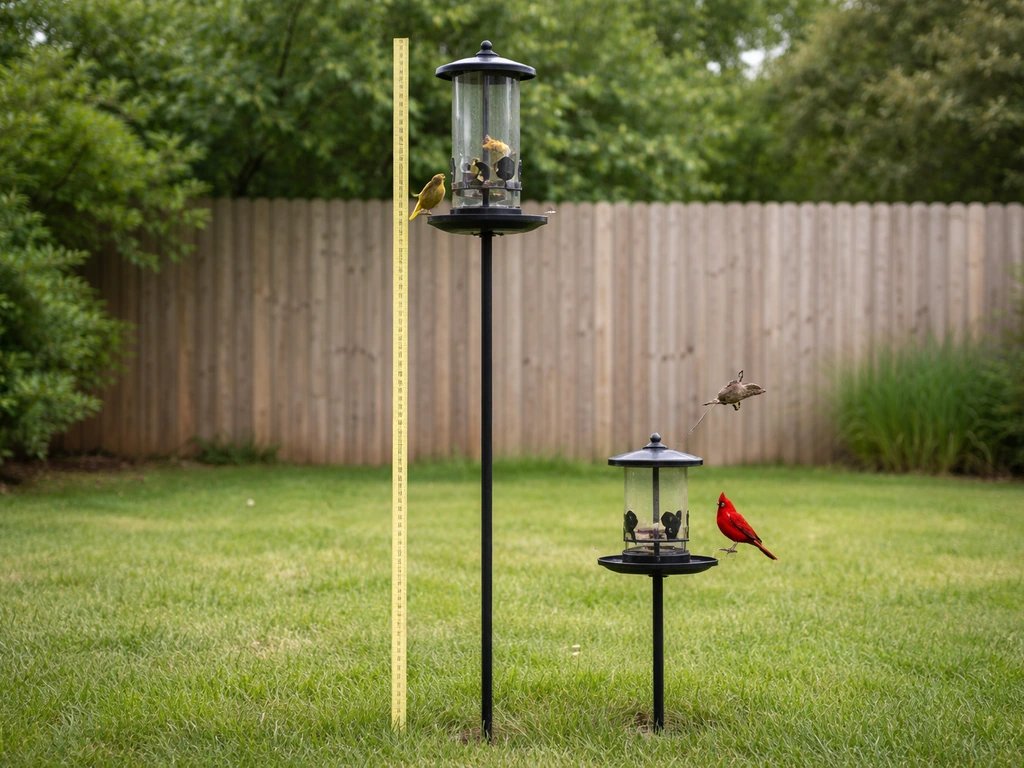
Height matters more than most people realize, and the numbers are pretty specific. Cardinals and finches are comfortable feeding at roughly eye level, around 5 to 6 feet off the ground. Woodpeckers, nuthatches, and orioles prefer feeders placed higher, ideally 6 to 10 feet up. Ground-feeding birds like doves, sparrows, and juncos obviously want a platform close to ground level, 1 to 3 feet at most. A solid general rule from Chewy's placement guidance is the 5-7-9 rule: feeder at 5 feet high, 7 feet from any fence or vertical structure, and 9 feet away from overhanging branches. That combo keeps most birds comfortable and gives squirrels a harder puzzle to solve.
Materials: what actually holds up
Powder-coated steel is the clear winner for pole material. It resists rust far better than bare or galvanized steel, handles freeze-thaw cycles without cracking the way plastic does, and stays looking decent after a few seasons. Wild Birds Unlimited's Advanced Pole System uses powder-coated steel throughout and has no-tools assembly, the components just fit together, which makes it practical to reconfigure. Avoid thin-gauge uncoated steel poles (common on cheap shepherd's hooks) because they bend and rust within a season or two. Aluminum is lighter and won't rust, but it dents more easily and thinner aluminum poles flex in wind. Heavy-gauge resin or composite bases are fine for weighted stands, but the pole itself should be metal.
Best stand-and-feeder combos by bird type
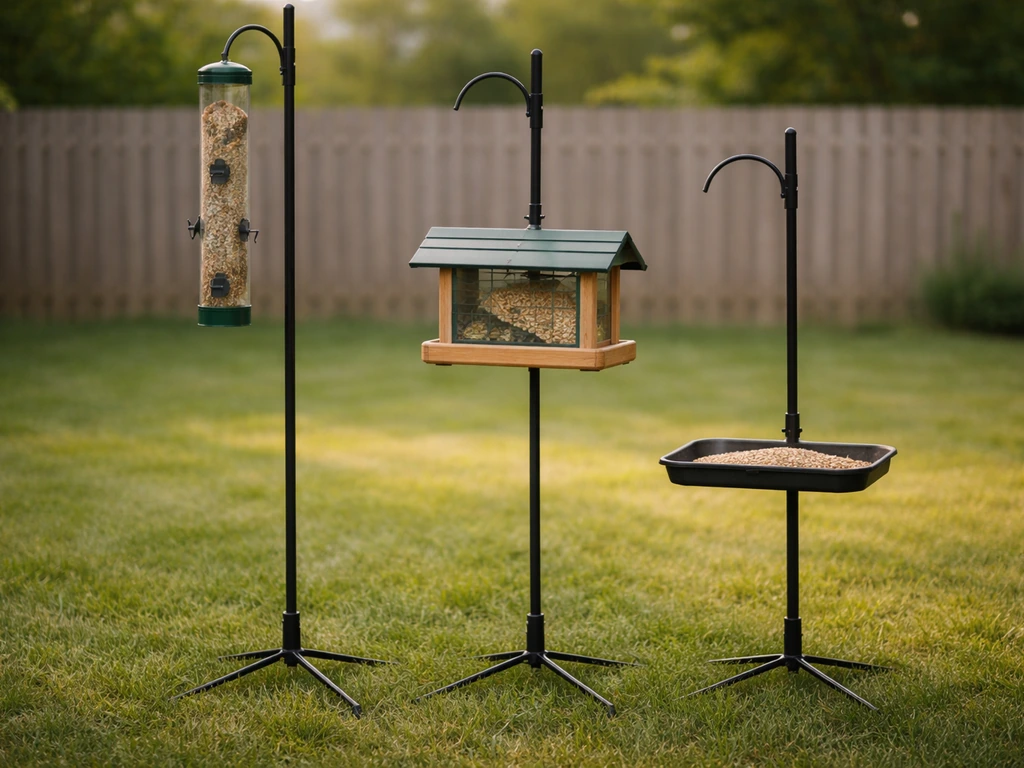
The stand is only half the equation. Which feeder you mount on it, and how you mount it, depends on the birds you want to see. Here's how to match the two.
| Target Birds | Best Feeder Type | Ideal Stand Height | Notes |
|---|---|---|---|
| Cardinals, finches, chickadees | Hopper or tube feeder | 5–6 ft | Hopper attracts larger birds like cardinals and blue jays too; tube keeps seed drier |
| Woodpeckers, nuthatches | Suet cage or suet feeder | 6–10 ft | Mount well off the ground; these birds prefer vertical clinging positions |
| Orioles | Oriole feeder (nectar/jelly tray) | 6–10 ft | Place in a more open, visible spot; orioles are wary of dense cover |
| Doves, sparrows, juncos | Platform or tray feeder | 1–3 ft | Low platform or ground-level tray; these birds naturally forage low |
| Blue jays, grackles | Hopper feeder with wide tray | 5–6 ft | Larger birds need more tray space; hopper handles higher seed volume |
| Bluebirds | Mealworm tray or bluebird feeder | 5–6 ft | Open location, away from dense shrubs; bluebirds prefer clear sight lines |
If you want to attract a mix of species, a modular pole system with multiple arms is genuinely useful, you can hang a tube feeder at 5 feet on one arm and a suet cage at 7 feet on another, all off the same pole. With the right stand setup, you can turn your yard into this is our happy place camper bird feeder for all the birds that visit. That said, more feeders on one stand means more squirrel motivation to crack the system, so baffle quality becomes even more important.
Weatherproofing and durability across seasons
Feeders and stands take a beating from weather, and winter is the hardest season of all. Standing water in a hopper feeder freezes and clogs the seed ports. Snow loads on a platform feeder add real weight to the pole and can torque a lightweight shepherd's hook right out of the ground. Suet goes rancid in summer heat but holds up well in winter, which is actually when woodpeckers rely on it most.
For the stand itself, powder-coated steel handles all four seasons well. Check the pole joints and arm connections before winter, loose connections that wiggle in fall will be frozen open by January and will eventually crack or strip. Tighten everything down before the first hard freeze. If you're using a weighted base stand on a patio, those bases can crack in deep freezes if the fill material (water or sand) expands inside a thin plastic reservoir. Sand-fill bases handle this better than water-fill ones.
For the feeder itself, tube feeders generally keep seed driest because the seed is enclosed, Audubon notes this as one of their practical advantages. Hopper feeders are more exposed to moisture and need regular cleaning to prevent mold in the seed tray, especially in wet springs. Suet feeders are nearly maintenance-free in cold weather but should be swapped to no-melt suet cakes in temperatures above 70°F or the fat will go soft and rancid.
Keeping squirrels (and rats) off your stand
This is where stand design directly changes your outcomes. Squirrels can jump roughly 6 feet straight up from the ground and can launch themselves horizontally up to about 10 feet from a tree, fence, or roof edge. That means a pole with no baffle, placed anywhere near a launch point, is basically a squirrel buffet. Audubon is pretty blunt about this: the only genuinely reliable approach is a pole at least 20 feet from any branch or structure combined with a metal baffle mounted below the feeder. Audubon’s winter-feeding guidance similarly emphasizes protecting feeders from squirrels with a special baffle.
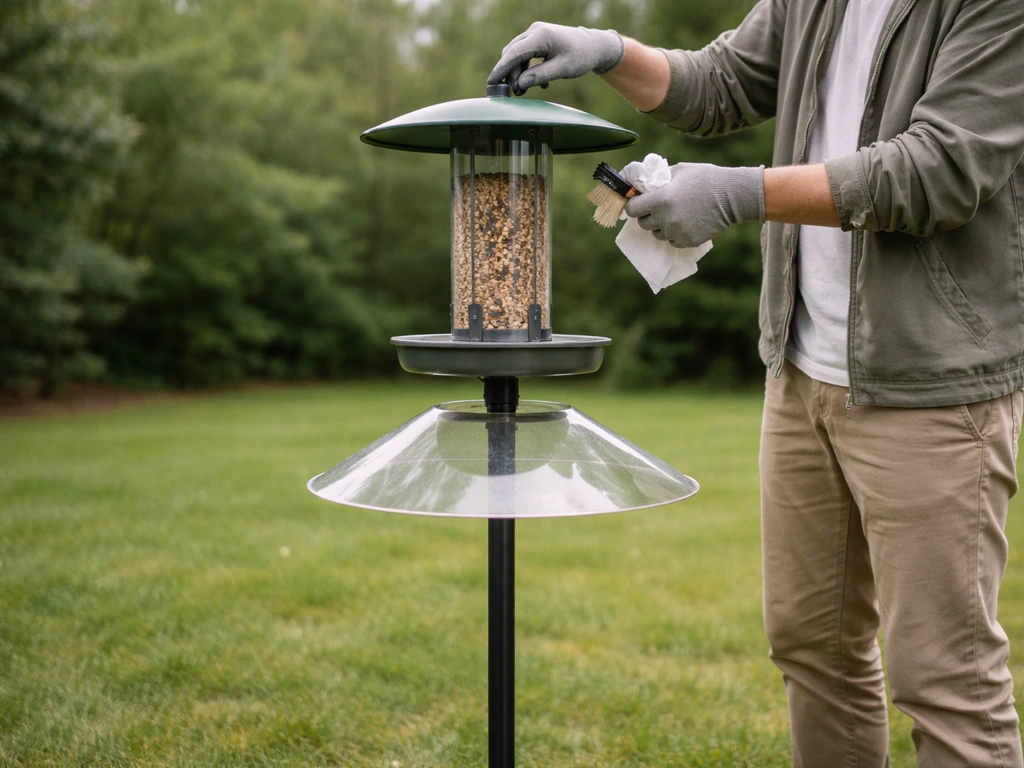
In practice, most yards can't get 20 feet of clearance, so a good baffle becomes non-negotiable. The two types that actually work are the stovepipe-style cylindrical baffle (a 6-inch diameter metal tube that wraps the pole and makes it impossible for a squirrel to get a grip) and the cone or dome baffle (a wide flared shield mounted below the feeder that squirrels can't climb past).
Position the baffle at least 4 feet off the ground so squirrels can't simply jump above it. Some feeders like the Droll Yankees Jagunda have a built-in bottom baffle and an adjustable seed valve, which is a genuinely useful design if you want squirrel resistance built into the feeder rather than added as an afterthought.
For rats, the approach is slightly different. Rats are ground foragers first, they're after spilled seed under the feeder as much as seed in the feeder. A stand-alone setup actually helps here because you can use a seed-catching tray to reduce ground spillage, keep the area under the pole raked clean, and avoid leaving seed out overnight. No-waste seed mixes (hulled sunflower, shelled peanuts) also reduce the shell litter that draws rats in the first place.
Refilling, cleaning, and day-to-day usability
The honest truth is that a feeder you find annoying to refill or clean will stop getting maintained, and an unmaintained feeder grows mold and can actually harm birds. So ease of access matters practically, not just as a convenience.
For refilling: a stand with a fixed-height pole is much easier to work with than one where the feeder arm is set at 8 feet and you need a stepladder. Some modular pole systems let you adjust arm height, which is worth paying attention to. For tube feeders on stands, make sure the fill port is accessible without removing the feeder from the pole, some cheap tube feeders require you to unclip the whole feeder, fill it on the ground, and reattach, which gets old fast.
For cleaning: hopper feeders like the Jagunda have disassembly instructions that walk you through removing the seed chamber and tray, that design makes monthly cleaning realistic rather than just recommended. Platform feeders on stands are the easiest to clean (wipe down the tray, done) but also the most exposed to weather and droppings. Tube feeders need a bottle brush to clean the interior properly. A general rule: scrub feeders with a 10% bleach solution, rinse thoroughly, and let them dry completely before refilling. Do this monthly in summer, every six weeks in winter.
- Check that the feeder fill port is reachable at the pole's mounted height before you buy
- Modular pole systems with adjustable arm height make refilling much more practical
- Hopper and tube feeders with removable trays are the easiest to clean thoroughly
- Platform feeders are fastest to clean but need it most often due to weather exposure
- No-waste seed mixes reduce cleanup under the feeder and lower pest pressure
Top setups by yard type, and what to measure before you buy
Small or urban yard
If you're working with limited space, a single-pole setup with one hopper or tube feeder is the right call. Keep it simple, get a quality baffle, and focus on placement over adding more feeders. A weighted base stand works well here if you're on a patio or can't stake a pole. If you want the best free standing bird feeder with a weighted base, focus on stability first, then choose a pole-and-feeder combo that matches the birds you feed best free standing bird feeder with weighted base. For seed, stick to black oil sunflower seed or a no-waste hulled mix, it attracts the widest range of birds without creating a mess that draws pests.
Medium yard with lawn and some trees
This is where a modular pole system really pays off. A setup with two or three arms lets you run a hopper for cardinals and jays, a tube feeder for finches and chickadees, and a suet cage for woodpeckers, all off one pole with one baffle system to maintain. Position the pole at least 7 feet from any fence and 9 feet from overhanging branches. This is the scenario where the 5-7-9 rule is most useful as a practical checklist.
Large yard or bird-heavy property
With more space you can run multiple stand setups in different zones, a low platform feeder near a brush pile for ground-feeding birds, a tall suet setup near a tree line for woodpeckers, and a hopper or tube setup in the open for general songbirds. If you want the best choice products bird feeder, focus on a stand-and-feeder combo that matches your yard size, includes real squirrel protection, and is easy to clean. Space the stands far enough apart that dominant species (like blue jays) at one feeder don't monopolize everything. Multiple stands also mean multiple baffle points to maintain, so stick with one baffle style you know works and replicate it.
What to measure before you buy anything
- Ground hardness and soil type: determines whether you need a spike pole, auger tip, or weighted base
- Distance to the nearest tree branch, fence, or roofline: needs to be 7–9 feet minimum, 20 feet ideally for squirrel resistance
- Overhead clearance: measure the height of any overhang to know the maximum safe pole height
- Distance from windows: keep feeders either within 3 feet of a window (so birds don't build up dangerous flight speed) or more than 10 feet away to reduce window strike risk
- Your own comfortable reach height: if you can't comfortably reach 6 feet without a step stool, set arm height accordingly
- Feeder capacity vs. refill frequency: a 6 lb hopper feeder in an active yard needs refilling roughly every 2–3 days in peak season — factor that into how often you want to be out there
If a commercial stand doesn't fit your space, maybe your yard is too small to hit the clearance numbers, or you're renting and can't stake anything, there are practical alternatives worth considering. A deck-mounted feeder pole is an option if you have a railing. A best deck mounted bird feeder setup pairs a sturdy deck rail mount with a strong baffle so squirrels cannot reach the feeding area deck-mounted feeder pole.
A free-standing feeder with a weighted base works on patios. And a well-placed hanging feeder from an existing shepherd's hook can be squirrel-baffled just as effectively as a ground-stake setup. If you want the best hanging bird feeder, focus on choosing one with a sturdy hook and a baffle system that blocks squirrel access.
The goal is matching the setup to your actual yard, not finding the theoretically perfect stand and forcing it into a space that doesn't suit it.
FAQ
How can I tell if my stand will actually hold up in my yard’s soil and wind conditions?
Test for pull-out risk first. If you have sandy, dry, or loose-fill soil, a step-in shepherd’s hook often leans or backs out, even if it seems stable at install. In those conditions, prioritize a screw-in auger tip or a two-piece spike where an anchor rod goes in first. Also check for tipping leverage, if your base or spike is tall, small wind gusts create big side forces, so choose heavier poles and secure ground contact.
What’s the safest way to measure placement distance from fences and branches?
Measure from the exact squirrel launch points, not from the edge of the feeder itself. Use the pole center as your reference, then confirm the 7-foot clearance from vertical structures and the 9-foot clearance from overhanging branches in the direction squirrels can approach. If a branch overhangs from a slanted angle, use the closest possible approach distance.
Can I use a baffle without putting it at least 4 feet off the ground?
Usually no. If the baffle sits too low, squirrels can jump up and climb past it or reach the feeder from below. Aim for the baffle to be at least 4 feet above ground, and position it so it interrupts climbing access between the launch point and the feeder. When clearance is tight, a properly sized cone or stovepipe baffle matters more than moving the feeder a little.
Do I need to buy a multi-feeder modular pole if I already have one good feeder?
Not necessarily, adding arms often increases squirrel pressure and cleaning workload. If you already attract target birds with one feeder, consider upgrading only the stand parts that affect pest resistance and access, like the baffle and pole stability. Multi-arm setups are most worth it when you can keep baffle quality consistent and you will actually clean each feeder on schedule.
What feeder type should I choose if I’m mostly dealing with wet weather and mold?
Tube feeders tend to stay driest because the seed is enclosed, which reduces mold risk and keeps ports from clogging. Hopper feeders are more exposed to moisture and usually require more frequent emptying and tray cleaning, especially after rainy stretches. If you use a hopper, plan on shorter cleaning intervals and remove the seed tray regularly rather than “spot cleaning.”
How often should I refill and clean a stand-mounted feeder in winter versus summer?
A practical schedule is to clean monthly in summer, and every six weeks in winter, but adjust based on weather. In winter, clogs often come from standing water and freeze-thaw cycles in hopper feeders, so look for wet seed or crusting around the ports. In summer, focus on fat breakdown for suet, and watch for softened, leaking, or rancid residue near the mounting area.
Is 15 to 20 pounds of base weight really necessary for weighted stands?
If the stand is on a patio or balcony, yes, especially if it’s near shrubs, a wall, or you get meaningful gusts. Lightweight plastic bases can tip when wind pushes the pole sideways, even if they feel solid when you install them. Also confirm how the base is filled, sand-fill bases handle freezing expansion better than water-fill in deep cold.
What should I do if squirrels keep learning my setup and still get the feeder?
Treat it like a placement and access problem, not just a “buy a better baffle” problem. Recheck that the baffle is the right style and positioned correctly, confirm there is no nearby ladder effect like a fence top, planter edge, or low tree limb, and verify the pole-to-obstacle distance. If your feeder is within the squirrel approach line, even a strong baffle can fail because squirrels find a new entry path.
How can I reduce rat activity under a stand without stopping bird feeding?
Control spillage and cleanup. Use a seed-catching tray and raked-clear area beneath the pole, then avoid leaving seed out overnight. Switch to no-waste mixes like hulled sunflower or shelled peanuts so there’s less shell litter on the ground, and make sure the area under the stand is not piled with old shells.
What matters most for easy refilling if I don’t want to use a ladder?
Choose a fixed-height pole or a system with adjustable arm height you can reach comfortably from ground level. Also check the feeder’s refill design, some tube feeders require removing the entire unit to fill, while better designs allow filling through a reachable port without detaching from the pole. If you dislike ladder work, prioritize accessibility at your target height over adding more feeders.
Is it okay to use bleach to clean feeders on a schedule?
Yes, if you mix it properly and rinse thoroughly. Use a 10% bleach solution for scrubbing, then rinse until there’s no bleach odor and let feeders dry completely before refilling. Incomplete drying can leave moisture behind, which increases mold risk, especially for hopper trays and tube interiors.
Which stand-and-feeder combo is best if I want only one or two bird species?
Match feeder type to diet and positioning rather than buying everything at once. For example, tube feeders are best aligned with finches and similar small seed-eaters, hopper feeders can bring in larger seed-feeding songbirds, and suet cages target woodpeckers. Keep the height aligned with those birds, then focus your budget on a sturdy pole and reliable squirrel protection instead of extra feeder arms.
Next Articles
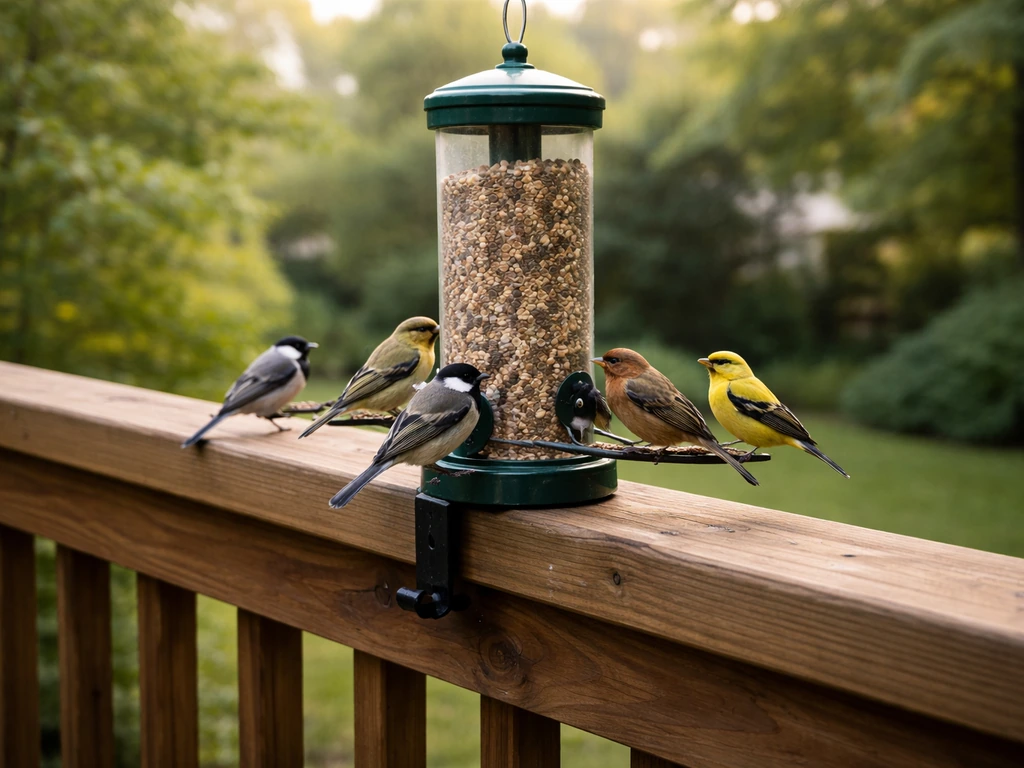
Best Deck Mounted Bird Feeder: Pick the Right One
Choose the best deck mounted bird feeder by bird type, yard setup, seed fit, weather durability, and pest-proofing.
Best Hanging Bird Feeder Guide: Pick the Right Outdoor Feeder
Choose the best hanging bird feeder by yard, weather, cleaning ease, seed type, and bird targets like finches and cardin
High Quality Bird Feeder Guide: Choose the Best Feeder
Learn what makes a high quality bird feeder: materials, weatherproofing, cleaning, pest control, and the best style for