Droll Yankees makes genuinely durable, well-engineered bird feeders that have earned a loyal following since the brand launched in 1969. Their polycarbonate tube feeders, motorized squirrel-proof spinners, and classic hopper designs hold up better than most budget alternatives, and the Lifetime Warranty Against Squirrel Damage on the Yankee Family models is a real promise, not fine print. That said, the brand has gone through ownership changes (now sold under the Perky-Pet umbrella), replacement parts can be frustrating to track down, and the motorized Yankee Flipper's motor and clutch assembly has a documented failure rate that you should know about before spending $100. This guide walks through every feeder type Droll Yankees makes, gives you honest model-by-model assessments, and tells you exactly which feeder fits your yard, your birds, and your winter setup.
Droll Yankee Bird Feeder Reviews: Top Picks & Buying Guide
Top Picks at a Glance
Here are my top recommendations across the key categories most buyers search for. Full model details appear in the sections below.
| Category | Top Pick | Why It Wins |
|---|---|---|
| Best Overall | Droll Yankees A-6RP Ring Pull Tube Feeder | Solid UV-stabilized polycarbonate build, tool-free Ring Pull cleaning, 1 lb capacity, $56.19, 4.4-star average |
| Best Value | Droll Yankees Classic Tube Feeder (A-Series) | Straightforward design, low entry price, widely available replacement parts via Perky-Pet |
| Best for Winter | Droll Yankees Hopper Feeder | Covered seed reservoir keeps seed dry; holds sunflower mix for cardinals, jays, and chickadees in cold weather |
| Best Squirrel-Resistant | Droll Yankees Yankee Flipper (YF-M) | Weight-activated spinning perch, 5 lb capacity, lifetime warranty on feeder body against squirrel damage |
| Best for Cameras | A-6RP with third-party camera mount | Feeder's clean cylindrical shape works well with clip-on trail cameras; no integrated camera option from Droll Yankees |
| Best Tube Feeder | A-6RP Ring Pull | Ring Pull disassembly is the fastest clean-up in the lineup |
| Best Hopper Feeder | Droll Yankees Classic Hopper | Solid powder-coated metal roof, good capacity for mixed seed |
| Best Platform/Tray | Droll Yankees A-6T Seed Tray (as feeder or accessory) | Doubles as ground tray or tube-feeder conversion, attracts cardinals and doves |
How I Evaluate Droll Yankees Feeders
I use eight criteria when I assess any feeder in this lineup. These come from hands-on time in the yard, cross-checking against Perky-Pet product specs and downloadable manuals, and aggregating real user feedback from retailer review sections and birding forums.
| Criterion | What I Look For | Why It Matters |
|---|---|---|
| Build Quality | UV-stabilized polycarbonate vs. standard plastic; powder-coated vs. painted metal | Cheap plastic yellows and cracks within a season; UV-stabilized polycarbonate lasts years |
| Seed Capacity | Volume in lbs; port count | Higher capacity means fewer refills; port count determines how many birds feed simultaneously |
| Seed Flow | Port opening size; jam frequency in wet conditions | Nyjer and safflower ports clog quickly in rain if not sized correctly |
| Weatherproofing | Roof overhang, drainage holes, gasket seals on hoppers | Standing water triggers mold; a good roof overhang prevents soaking |
| Pest/Squirrel Resistance | Weight-activated mechanics, cage guards, baffle compatibility | Squirrels can empty a 5 lb feeder overnight without deterrence |
| Camera/Tech Compatibility | Mount points, feeder shape, sightlines for cameras | Droll Yankees has no native smart-camera option; third-party mounts needed |
| Cleaning Ease | Tool-free disassembly (Ring Pull system), dishwasher safety, bleach tolerance | A feeder that's hard to clean will spread mold and fungus to visiting birds |
| Winter Performance | Port freeze-up, seed caking, weight tolerance under ice/snow load | Feeders that hold moisture in the reservoir become unusable in hard freezes |
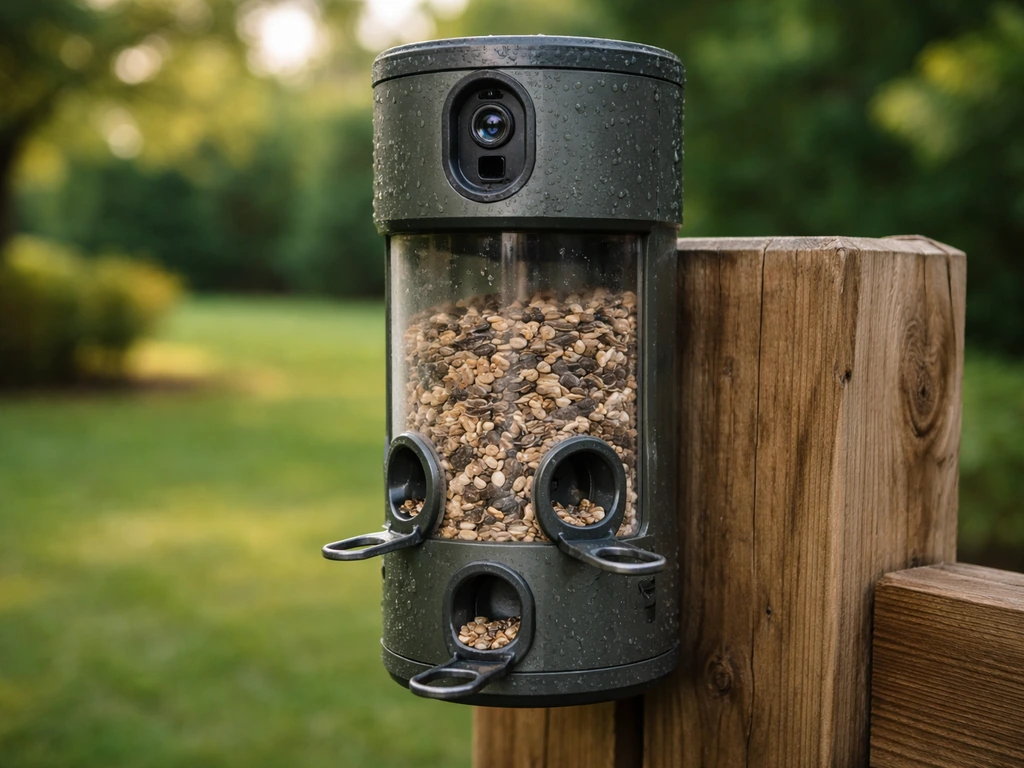
One thing I want to be upfront about: Droll Yankees has no camera-equipped or Wi-Fi-enabled feeders in its current lineup. If smart features are your priority, brands like Netvue, Vinguys, FeatherSnap, and Coolfly are worth comparing. If you want camera features, check coolfly bird feeder reviews for models with integrated cameras and Wi‑Fi. Droll Yankees competes on old-school durability, not tech integration. For detailed comparisons of camera-equipped options, see our FeatherSnap bird feeder reviews for feature-by-feature analysis.
Droll Yankees Tube Feeders
Tube feeders are the core of the Droll Yankees lineup and where the brand built its reputation. The defining construction detail is the UV-stabilized polycarbonate tube: it resists discoloration and cracking far better than the clear but brittle plastic you find on $12 feeders, and you can actually see seed levels without removing anything. Droll Yankees – Premium Bird Feeders for Every Backyard - Official Website lists their tube feeders, motorized squirrel‑proof spinners, hopper designs, window feeders, and trays, and notes materials like UV‑stabilized polycarbonate and powder‑coated metal while linking to its catalog and Amazon storefront. Metal parts (port rings, base, hanger) are powder-coated for rust resistance.
A-6RP Ring Pull Tube Bird Feeder
The A-6RP is my go-to recommendation for anyone new to Droll Yankees. It stands 16 inches tall, 5.25 inches wide, and 2.6 inches deep, holds 1 lb of seed, and uses the Ring Pull system that lets you disassemble the entire feeder without tools in about 20 seconds. That matters enormously for cleaning frequency. Perky-Pet lists it at $56.19, and it carries a 4.4-star average from verified buyers.
| Spec | Detail |
|---|---|
| Model | A-6RP |
| Dimensions | 16" H × 5.25" W × 2.6" D |
| Seed Capacity | 1 lb |
| Construction | UV-stabilized polycarbonate tube, powder-coated metal parts |
| Disassembly | Tool-free Ring Pull system |
| Mounting | Pole-mountable via threaded base; hanging hook included |
| Compatible Accessories | A-6T seed tray (sold separately) |
| Retail Price | $56.19 (Perky-Pet) |
| User Rating | 4.4 stars |
- Pros: Fastest clean-up in the Droll Yankees lineup; UV-stabilized tube holds up in full sun; compatible with A-6T tray to attract ground-feeding species like cardinals
- Pros: Threaded base allows pole mounting, which is important for squirrel management when combined with a baffle
- Cons: 1 lb capacity is low for busy yards; you will refill it every 1-2 days during peak season
- Cons: No built-in squirrel resistance; requires a separate baffle or pole system
- Best for: Chickadees, nuthatches, house finches; small to medium backyard setups; buyers who prioritize cleaning speed
A-Series Classic Tube Feeders
The broader A-Series includes longer tube models with 4 to 8 ports and capacities scaling up to around 1.5 lbs. Construction is the same UV-stabilized polycarbonate with metal parts. These are the versions worth considering if you have heavy finch traffic or want to run nyjer (thistle) seed, which requires the smaller port variants. Port clogging is the main real-world complaint: in wet weather, nyjer seed compacts against the ports and stops flowing. The fix is simple but consistent maintenance (clean every two weeks in humid conditions) and positioning the feeder under eave cover where possible.
- Pros: Multiple port counts to match traffic volume; same durable polycarbonate and metal construction as A-6RP
- Cons: Nyjer/thistle ports clog in wet conditions; longer tubes are harder to dry completely after cleaning
- Best for: American goldfinches, house finches, pine siskins (nyjer versions); chickadees and nuthatches (sunflower chip versions)
Droll Yankees Hopper Feeders
Droll Yankees hopper feeders use a covered reservoir design with a powder-coated metal roof and a polycarbonate body. Seed feeds by gravity to a trough perch where birds stand and pick. This design naturally accommodates a wider variety of species than a tube feeder, because the open perch suits larger birds like cardinals, blue jays, and mourning doves who struggle to grip narrow tube ports.
The roof overhang on Droll Yankees hoppers is one of the better designs I have tested for keeping seed dry. The powder-coated metal resists rust through a full winter better than painted alternatives. Capacity is typically in the 2-4 lb range depending on model, which strikes a reasonable balance between refill frequency and seed freshness. One important note: hopper feeders are inherently harder to keep pest-free unless you pair them with a pole-and-baffle system, because squirrels can land directly on the tray. Droll Yankees does not make a motorized hopper.
| Feature | Droll Yankees Hopper | Notes |
|---|---|---|
| Seed capacity | 2-4 lbs (varies by model) | Good for medium-traffic yards |
| Roof material | Powder-coated metal | Rust-resistant; better than painted metal |
| Body material | UV-stabilized polycarbonate | Visible seed level |
| Squirrel resistance | None built-in | Needs baffle/pole system |
| Species suitability | Cardinals, jays, chickadees, doves | Open tray perch fits larger birds |
| Winter performance | Good (roof overhang keeps seed dry) | Still needs drainage monitoring in heavy snow |
- Pros: Wide species appeal; durable roof; visible seed level helps you refill proactively
- Pros: Gravity-fed trough is clog-resistant with sunflower and mixed seed
- Cons: No integrated squirrel resistance; requires external baffle to be effective in squirrel-heavy yards
- Cons: Trough design can accumulate wet seed and debris faster than tube feeders in heavy rain
- Best for: Mixed-species yards; anyone targeting cardinals and blue jays; winter feeding with sunflower hearts or safflower seed
Droll Yankees Platform (Tray) Feeders
Droll Yankees offers platform feeding primarily through the A-6T Seed Tray accessory, which mounts to the threaded base of any A-Series tube feeder. You can also use the A-6T as a standalone tray by attaching it to a pole or setting it on a deck rail. It is not a full-sized dedicated platform feeder in the way that some other brands offer, but it works well as a supplement to a tube feeder and makes the overall setup more attractive to ground-feeding species that would not otherwise visit a hanging tube.
| Spec | Detail |
|---|---|
| Model | A-6T Seed Tray |
| Primary use | Accessory tray for A-Series tube feeders or standalone pole-mount tray |
| Material | UV-stabilized polycarbonate |
| Drainage | Drain holes in base |
| Species attracted | Cardinals, mourning doves, dark-eyed juncos, sparrows |
| Compatibility | Threaded to A-Series tube feeders; pole-mountable independently |
- Pros: Converts a tube feeder into a multi-level feeding station; attracts species that won't use tube ports
- Pros: Drainage holes reduce wet seed pooling
- Cons: Small surface area compared to dedicated platform feeders; limited seed capacity as a standalone unit
- Cons: Not a true platform feeder replacement if you have high dove or sparrow traffic
- Best for: Buyers who already own an A-Series tube feeder and want to attract cardinals or juncos without buying a second feeder; compact balconies and deck setups
If you need a large, dedicated platform feeder for a wide open yard, Droll Yankees is not the right brand for that specific purchase. A DIY wooden tray on a post with hardware cloth flooring for drainage is genuinely a better option for that use case and costs about $15 in materials.
Droll Yankees Suet Feeders
Droll Yankees' suet offerings are straightforward wire-cage designs with powder-coated metal frames sized to hold standard suet cakes. They are not the most feature-rich suet feeders on the market, but they are solidly built and resist the bending and warping that cheap wire suet cages develop after a season or two of woodpecker use. The cage openings are sized for clinging birds: downy woodpeckers, hairy woodpeckers, white-breasted nuthatches, and starlings (unfortunately, starlings will visit any suet cage).
| Feature | Detail |
|---|---|
| Frame material | Powder-coated metal wire |
| Suet cake size | Standard single cake |
| Mounting | Hanging chain; some models pole-mountable |
| Primary species | Downy woodpecker, hairy woodpecker, white-breasted nuthatch, red-breasted nuthatch |
| Starling resistance | None; standard open-cage design |
| Winter performance | Suet hardens in cold, which is actually preferred by woodpeckers |
- Pros: Durable powder-coated frame; standard cake sizing (easy to find suet anywhere); simple to fill and clean
- Cons: No starling deterrent; if European starlings are a problem in your yard, an upside-down suet cage design (which Droll Yankees does not currently offer) is more effective
- Cons: Limited product differentiation vs. cheaper suet cage competitors
- Best for: Woodpecker-focused setups; winter feeding with high-fat no-melt suet; yards where starlings are not a significant pest problem
One practical tip: suet goes rancid quickly in temperatures above 70°F. In summer, switch to a no-melt suet formulation or pull the cage down between Memorial Day and Labor Day in warmer climates. Droll Yankees does not make a temperature-controlled or shaded suet cage, so positioning the feeder in a shaded north-facing spot extends suet life significantly.
Droll Yankees Window Feeders
The W-1 Window Feeder is Droll Yankees' answer to close-up bird watching. It mounts directly to a window pane using suction cups and holds a modest amount of seed in a clear polycarbonate tray. The official installation manual (available as a PDF via Perky-Pet) covers suction cup placement, weight limits, and cleaning procedures.
| Spec | Detail |
|---|---|
| Model | W-1 Window Feeder |
| Mounting | Suction cups on window glass |
| Material | UV-stabilized polycarbonate |
| Seed type | Mixed seed, sunflower chips, safflower |
| Capacity | Small (designed for daily or every-other-day refills) |
| Installation time | Under 5 minutes |
Installation Tips for the W-1
- Clean the window glass thoroughly with rubbing alcohol before attaching suction cups; oil and grime cause early suction cup failure
- Position the feeder at eye level from your interior seating if you want the best viewing experience; birds adapt to human movement through glass faster than you might expect
- Avoid mounting on south-facing windows in summer; direct afternoon sun heats the seed tray and degrades seed quality within hours
- Check suction cup integrity every two weeks; re-wet and press firmly to maintain adhesion, especially in cold weather when rubber firms up
- Clean the tray with the 9: 1 water-to-bleach solution recommended in the Perky-Pet cleaning guidance; rinse completely before refilling
- Pros: Exceptional close-up bird viewing; no pole or hanging hardware required; works in apartments and rentals
- Pros: Easy to clean with Ring-style disassembly
- Cons: Small capacity means frequent refills; suction cups can fail in extreme cold or on textured window glass
- Cons: Window placement makes squirrel resistance nearly impossible without additional deterrents
- Cons: Birds striking the window is a real risk; placing the feeder within 3 feet of the glass (which is the recommended practice for window-mount feeders) reduces collision injury compared to placement at 10-30 feet
- Best for: Apartment dwellers; birders with limited outdoor space; anyone wanting close-up views of chickadees, nuthatches, and finches
Droll Yankees Pole-Mounted and Hanging Systems
Droll Yankees does not sell a branded pole system as a standalone product line the way some competitors do, but most of their tube feeders (including the A-6RP) have a threaded base that accepts standard 1/2-inch pole hardware. This means you can mount an A-6RP or A-Series feeder on a Squirrel Stopper, Erva, or any generic threaded-mount shepherd hook. The A-6T tray accessory also threads directly onto the same base, so a tube feeder plus tray plus pole-and-baffle is a clean, well-engineered setup.
For hanging, all Droll Yankees tube and hopper feeders come with a metal hanging hook rated for the feeder's filled weight. The hook gauge on A-Series feeders is robust enough that I have not seen reports of hook failure under normal conditions. Where hanging systems get complicated is the Yankee Flipper: the motorized spinner adds weight, and the charging cord (for the NiCad battery system) needs to run cleanly without tangling. The YF-M manual explicitly shows the Power Stick and charging setup, and it is worth reading before you hang the unit.
| Feeder Model | Pole Mount | Hanging | Baffle Compatible | Notes |
|---|---|---|---|---|
| A-6RP Ring Pull Tube | Yes (threaded base) | Yes | Yes (standard 1/2" pole) | Most flexible mounting of any Droll Yankees feeder |
| A-Series Classic Tube | Yes (threaded base) | Yes | Yes | Same compatibility as A-6RP |
| Yankee Flipper YF-M | No (hanging only) | Yes (included hook) | Pole-hang adapter possible | Heavy at full seed load; check hook and branch strength |
| Hopper Feeder | Limited (check model) | Yes | Yes with pole system | Heavier when full; use a sturdy shepherd hook |
| W-1 Window Feeder | No | Window only | N/A | Suction cup mount; no pole or hanging option |
| A-6T Seed Tray | Yes (threads to A-Series or independent pole) | No | Yes when pole-mounted | Useful ground-level tray on a short post for ground feeders |
Stability and Mounting Notes
- For squirrel resistance, hanging from a wire alone is not sufficient; squirrels can shimmy down most lines. A pole-and-baffle system (baffle positioned at least 4 feet high and 8 feet from any jumping surface) is the most reliable approach for A-Series feeders
- The Yankee Flipper's motorized spinning perch provides mechanical squirrel deterrence when hung from a smooth wire or chain at the correct height; the manual specifies minimum hang height for the mechanism to engage properly
- In windy areas, tube feeders on thin shepherd hooks swing significantly. A heavier gauge post or a ground anchor stabilizer reduces seed spillage
- For winter use: check that pole connections are not corroding or binding; apply a thin coat of petroleum jelly to threaded connections to prevent freeze-seize
- If you want to run multiple Droll Yankees feeders, a multi-arm pole station (third-party hardware) with individual baffles is more effective than multiple separate poles at close range, which just gives squirrels more routes to attempt
The Yankee Flipper in Detail: Squirrel-Proof Spinner
The Yankee Flipper (YF-M) is Droll Yankees' most famous product and the one most buyers search for when they land on the brand. It works on a weight-activated spinning mechanism: when a squirrel lands on the perch ring, its weight triggers a motor that spins the ring, physically removing the squirrel from the feeder. The concept is genuinely effective when it works. It holds 5 lbs of seed, has 4 feeding ports, uses a UV-stabilized polycarbonate tube with metal components, and runs on a rechargeable NiCad battery (Power Stick). The feeder body carries a Lifetime Warranty Against Squirrel Damage. The Power Stick and AC/DC adapter carry a 1-year limited warranty.
| Spec | Detail |
|---|---|
| Model | YF-M (Yankee Flipper) |
| Capacity | 5 lbs |
| Ports | 4 |
| Squirrel deterrence | Weight-activated motorized spinning perch |
| Power | Rechargeable NiCad battery (Power Stick) with AC/DC adapter |
| Body warranty | Lifetime against squirrel damage (feeder body only) |
| Power Stick warranty | 1-year limited |
| Materials | UV-stabilized polycarbonate, metal |
| Retail price | $99.99 (Perky-Pet and Chewy) |
| User rating (Perky-Pet) | 3.5 stars (112 reviews) |
That 3.5-star average is important context. The Yankee Flipper is a polarizing product. Buyers who have never had a motor or battery failure love it and report years of reliable squirrel-free feeding. Buyers who encounter a motor failure, clutch failure, or broken perch spring describe serious frustration, partly because replacement parts are hard to source since the brand transitioned to Perky-Pet ownership. Forum discussions and Reddit threads document real difficulties getting warranty service and parts, with some long-time users switching to alternative feeders entirely. My honest assessment: the Flipper is worth the $100 if you go in understanding that the mechanical components are the weak link, keep the warranty information, and have a contingency plan if the motor fails after year one. See our Yankee Flipper bird feeder reviews for hands-on testing, failure-mode footage, and parts-sourcing tips. Droll Yankees Yankee Flipper Motorized Bird Feeder, Chewy listing (price & reviews) shows the Yankee Flipper priced at $99.99 with customer reviews Droll Yankees Yankee Flipper Motorized Bird Feeder — Chewy listing (price & reviews).
Cleaning, Maintenance, and Troubleshooting
How to Clean Droll Yankees Feeders
- Disassemble the feeder using the Ring Pull system (A-6RP) or standard disassembly for other models; do this outdoors to contain seed debris
- Soak all polycarbonate and metal parts in a 9: 1 water-to-bleach solution; the recommended soak guidance appears on Perky-Pet product pages
- Scrub ports and tube interior with a bottle brush to remove compacted seed and mold
- Rinse thoroughly under running water; any bleach residue is harmful to birds
- Allow parts to air dry completely before reassembling; a damp interior grows mold faster than a dirty one
- Do not run Droll Yankees feeders through a dishwasher; the heat degrades polycarbonate clarity and can warp metal fittings
- For the motorized Yankee Flipper, disconnect the Power Stick before cleaning and keep the motor housing dry; the manual documents which components are water-safe
Common Problems and Fixes
| Problem | Cause | Fix |
|---|---|---|
| Nyjer/thistle port clogging | Wet seed compacts against small port openings | Clean ports weekly in humid weather; position feeder under eave; use fresh dry seed |
| Yankee Flipper motor failure | Motor/clutch wear over time; battery not maintaining charge | Recharge Power Stick fully before first use and regularly; contact Perky-Pet warranty support within 1 year for Power Stick failures |
| Squirrels chewing tube ports | Squirrels gnawing polycarbonate near port openings | Covered under Lifetime Warranty on Yankee Family models; also add a baffle to prevent access in the first place |
| Seed caking in hopper in winter | Moisture enters seed reservoir; freezing locks seed | Use dry sunflower hearts (hulled) which absorb less moisture; tap base to break loose; clean and dry thoroughly before winter |
| Suction cup failure on W-1 | Oil residue on glass; cold weather stiffening rubber | Re-clean glass with alcohol; warm cups in hand before pressing; replace cups if rubber is hardened |
| Broken perch springs (Whipper model) | Spring fatigue after repeated squirrel loading | Source replacement springs from Perky-Pet; or upgrade to the motorized Flipper for full mechanical deterrence |
| Difficulty finding replacement parts | Brand ownership change to Perky-Pet has disrupted some SKU availability | Check Perky-Pet website directly; contact customer service with model number; community forums often have workaround sourcing advice |
Species Targeting: Which Droll Yankees Feeder for Which Bird
| Target Bird | Best Droll Yankees Feeder | Seed Type | Notes |
|---|---|---|---|
| American goldfinch | A-Series tube with nyjer ports | Nyjer (thistle) | Small port variants; clean frequently in wet weather |
| House finch / purple finch | A-6RP or A-Series tube | Sunflower chips, nyjer | Medium ports; high traffic in spring and fall migration |
| Black-capped chickadee | A-6RP Ring Pull tube | Sunflower hearts, sunflower chips | Comfortable clinging; visits tube ports readily |
| Northern cardinal | Hopper feeder or A-6T tray | Sunflower seed, safflower | Cardinals prefer a wide perch; tube ports are marginal for them |
| Blue jay | Hopper feeder | Peanuts in shell, sunflower | Large perch needed; hoppers suit them better than tubes |
| Downy / hairy woodpecker | Suet cage feeder | Suet cake (high-fat) | Clinging vertical feeders; suet preferred in winter |
| Mourning dove | A-6T tray (ground level) or hopper tray | Mixed seed, millet | Ground or low-tray feeders only; doves do not cling to tube ports |
| White-breasted nuthatch | A-6RP tube or suet cage | Sunflower hearts, suet | Comfortable at any angle; visits both tube and suet setups |
| Pine siskin | A-Series nyjer tube | Nyjer | Seasonal winter visitor; nyjer tubes see heavy traffic in irruption years |
Winter Feeding with Droll Yankees
Droll Yankees feeders perform well in winter, with a few caveats. The UV-stabilized polycarbonate does not become brittle in cold the way cheaper plastic does, and the powder-coated metal parts resist rust through wet snow seasons. The biggest practical issue is moisture management: seed that gets wet and then freezes in the reservoir or ports becomes useless and can damage tube walls when it expands. Here is how I handle winter setup specifically.
- Switch to hulled (shell-free) sunflower hearts in tube feeders over winter; they absorb less moisture and leave no shell debris that traps wet and freezes solid
- For hopper feeders, check the seed reservoir every few days after rain or wet snow; remove and discard any caked seed before it freezes
- The Yankee Flipper's NiCad battery loses capacity in extreme cold; in temperatures below 20°F, the motor may not engage reliably. Bring the feeder inside during extreme cold snaps or accept reduced squirrel-deterrence performance
- Position tube feeders with the port openings facing away from prevailing wind; this significantly reduces moisture intrusion into ports
- Cardinals, chickadees, nuthatches, and dark-eyed juncos are active all winter and will reliably visit well-maintained feeders; white-throated sparrows and American tree sparrows are excellent winter guests for tray feeders
- Empty and dry feeders before the first hard freeze if you plan to stop feeding mid-winter; wet seed left in a sealed tube through a freeze-thaw cycle can crack the polycarbonate near the base
Droll Yankees vs. Competing Brands
Droll Yankees sits in a specific niche: durable traditional feeders with strong materials and mechanical squirrel deterrence (on the Yankee Family models). When you compare them against the current generation of smart-camera feeders and tech-integrated options, the trade-offs become clear quickly.
| Brand / Type | Camera/Smart Features | Squirrel Resistance | Build Durability | Price Range | Best For |
|---|---|---|---|---|---|
| Droll Yankees (Yankee Flipper) | None | Excellent (motorized spinner) | Excellent (UV poly + metal) | $99.99 | Squirrel-heavy yards; traditional birders |
| Droll Yankees (A-6RP Tube) | None | None built-in | Excellent | $56.19 | Close-up tube feeding; low-tech reliability |
| Netvue Birdfy | AI camera, Wi-Fi, app | None | Good | $99-$179 | Tech-first users who want bird ID and notifications |
| Vinguys V-Feeder | Camera with app | Cage guard | Moderate | $60-$90 | Camera + some pest resistance in one unit |
| FeatherSnap | Camera, solar | None built-in | Moderate | $80-$120 | Solar-powered camera feeding station |
| Coolfly | Camera | Limited | Moderate | $50-$80 | Budget camera feeder option |
| HARYMOR | Camera | None | Moderate | $50-$70 | Entry-level camera feeder |
| Yankee Whipper YCPW-180 | None | Spring-loaded (perch) | Very Good | ~$60-$80 | Budget squirrel resistance without a motor |
The honest comparison is this: if you want to watch birds through an app, get alerts when a new species visits, or capture photos automatically, Droll Yankees is simply not the right choice. See our video bird feeder reviews for camera-equipped options and real-world footage. Brands like Netvue and Vinguys have built an entirely different category of product. For a detailed look at Vinguys' camera-equipped feeders, see the Vinguys bird feeder review. See Netvue bird feeder reviews for comparisons of camera-equipped models and app features. But if you want a feeder that will still be working in five years without an app update, battery replacement for a camera module, or a firmware issue, Droll Yankees tube and hopper feeders have a strong track record. See the Onlyfly bird feeder review for a comparison with a more budget-oriented, camera-equipped option. The Yankee Flipper's squirrel-deterrence mechanism is still one of the most satisfying to watch in action, and there is no camera feeder on the market today that replicates its mechanical approach.
It is also worth noting that the Yankee Flipper has its own detailed review page on this site, which goes deeper into the motorized mechanism, real-world squirrel encounter footage, and the specific failure modes documented in user reviews. For an alternative perspective on squirrel-resistant designs, see our harymor bird feeder review.
DIY Alternatives to Droll Yankees Feeders
If budget is the primary constraint or you want to fill a specific niche that Droll Yankees does not cover, there are solid DIY options that cost a fraction of the retail price.
- DIY platform feeder: A 12x16 inch piece of exterior-grade plywood with hardware cloth stapled to the base for drainage, mounted on a 4x4 post with a baffle, costs about $15-20 in materials and attracts every ground-feeding species that a Droll Yankees tray does
- DIY suet cage: A folded piece of 1/2-inch hardware cloth formed into a cage and hung with wire costs under $3; not as durable as powder-coated metal but perfectly functional for a season
- PVC tube feeder: 2-inch PVC pipe with drilled ports and a wooden base is a classic DIY project; it will not match the UV-stabilized polycarbonate of a Droll Yankees tube for longevity, but it works and is rebuilable
- DIY window tray: A basic wood tray with suction cup hardware from a hardware store achieves the same close-up viewing as the W-1 Window Feeder at about 1/4 the cost, though cleaning is more manual without the Ring Pull design
DIY is a real option for tray and suet feeders. For tube feeders, the Ring Pull system and UV polycarbonate genuinely justify the price premium over homemade versions if you want low-maintenance, long-lasting results. For motorized squirrel-proofing, there is no practical DIY equivalent to the Yankee Flipper's spinning perch mechanism.
Should You Buy a Droll Yankees Feeder?
Droll Yankees earns its reputation for durability and materials quality. The A-6RP is one of the easiest-to-clean tube feeders I have used, and the hopper line handles winter weather reliably. The Yankee Flipper is uniquely effective when the motor works, and the Lifetime Warranty on the feeder body against squirrel damage is a genuine commitment. The concerns are real too: motor and clutch failures on the Flipper, parts availability under the new Perky-Pet ownership, and the complete absence of camera or smart-home features. If those things matter to you, Droll Yankees is not trying to compete in that space. Buy Droll Yankees for old-school reliability and mechanical ingenuity. Buy a Netvue, Vinguys, or FeatherSnap if you want app-connected, camera-equipped smart feeding. For many backyard birders, the answer is one of each.
FAQ
What primary manufacturer and product documentation should I gather to authoritatively cover every Droll Yankee feeder type?
- Official Droll Yankees website product pages (all categories: tube, hopper, platform/tray, suet, window, pole-mounted, Yankee family motorized models). - Official downloadable product manuals and installation/maintenance PDFs (Yankee Flipper YF, Whipper, Tipper, Dipper, Ring‑Pull tube A‑6RP, A‑6T tray, W‑1 window, etc.). - Official warranty statements (Lifetime Yankee Family feeder-body warranty, Power Stick/charger 1‑year limited warranty) and parts lists. - Manufacturer parts diagrams and replacement‑part SKU lists (to evaluate serviceability and spare parts availability). Why: these sources provide authoritative specs (materials, capacity, dimensions), warranty coverage, disassembly/cleaning instructions, and official claims about squirrel resistance and materials (UV‑stabilized polycarbonate, powder‑coated metal).
Which retailer and marketplace sources are essential for pricing, availability, and aggregated user feedback?
- Major retailers and marketplaces (Perky‑Pet product pages, Chewy, Amazon product listings). - Retailer review sections (aggregate star ratings, review counts, recent user comments). - Historical and current MSRP/price snapshots across multiple sellers to show pricing variance. Why: retailer listings provide real-world availability, multiple SKUs, buyer reviews that reveal recurring issues (motor failures, clogging, part wear), and price context.
What independent hands‑on reviews and multimedia tests should I source?
- YouTube hands‑on videos and demonstrations (operation under real squirrel pressure, motor tests, installation). - Long‑form written reviews from birding blogs and hobbyist sites that include teardown photos and operational notes. - Field trial reports with time‑lapse or extended‑use data where available. Why: independent testing reveals real-world durability, failure modes, seed flow behavior, and user experience beyond spec sheets.
What community and forum sources are useful for troubleshooting, real failure modes, and parts/service experience?
- Reddit threads (r/birdfeeding, r/birdwatching) documenting parts availability, warranty experiences, and DIY fixes. - Specialist bird feeding forums and Facebook groups with threads on Droll Yankees failures and repairs. - Retailer Q&A and review reply threads where the brand or sellers respond. Why: these sources capture patterns (motor/clutch failures, perch spring breakage, chewing of ports, replacement part difficulty) and customer service interactions.
What technical competitor and alternative product information should I collect for practical comparisons?
- Product pages, specs and manuals for named competitors: FeatherSnap, Onlyfly, Harymor, Netvue (Birdfy), Vinguys (V‑Feeder), Coolfly, Yankee Flipper (as a Droll variant historically). - Smart feeder/camera feeder specs (resolution, connectivity, power/solar options) from Netvue, Vinguys, FeatherSnap, Coolfly. - Construction materials, squirrel‑proofing mechanisms, capacities, pricing and warranty differences. Why: to compare build quality, tech integration, and feature tradeoffs (mechanical vs motorized squirrel solutions, camera integration options).
What avian and ecological references are necessary for species targeting and seasonal feeding guidance?
- Authoritative bird species seed/food preference guides (Cornell Lab of Ornithology, state wildlife agencies) for finches, chickadees, nuthatches, cardinals, grosbeaks, woodpeckers, etc. - Seasonal feeding guidance (winter energy needs, safe seed types in cold/wet conditions) from ornithology resources. - Local nuisance wildlife guidance (state extension services) for pest/squirrel control best practices. Why: to give accurate species‑targeting recommendations and sound seasonal feeding advice (e.g., nyjer/finch tube considerations, winter suet use).
Harymor Bird Feeder Review: Best Setup, Performance, Pros
Harymor bird feeder review with setup tips, performance in rain wind and winter, birds attracted, and maintenance plus v