
No bird feeder is 100% rat-proof. That's the honest answer. But the right feeder, installed the right way, can make your setup so difficult and unrewarding for rats that they stop bothering. If you're still shopping, start with the best rat proof bird feeder and then make sure you pair it with proper baffles and seed management. The key is understanding that rat resistance isn't just about the feeder itself. It's about the combination of feeder design, placement, baffles, and seed management working together. Get all four right and you'll have a yard where birds eat well and rats move on.
Bird Feeders That Are Rat Proof: Buy and Set Up Guide
Marcus Hendricks
10 Apr 2026
What 'rat-proof' should (and shouldn't) mean
When a feeder is marketed as rat-proof, it usually means it has features that make it harder for rodents to access seed directly. Weight-activated shutters that close under anything heavier than a small songbird, metal construction that resists chewing, and enclosed seed compartments all count. What it doesn't mean is that a rat will never find a way to get something. Rats are smart, persistent, and motivated by food.
If spilled seed, seed husks, or loose millet lands on the ground beneath a feeder, rats will find it regardless of how clever the feeder design is. King County Public Health actually flags this directly: [bird feeders increase rat activity because bird seed is food for rats, full stop. ](https://kingcounty. gov/en/-/media/king-county/depts/dph/documents/health-safety/environmental-health/getting-rid-rats-mice/bird-feeders-and-rats.
pdf) So 'rat-proof' should really mean 'rat-discouraging at the feeder itself,' combined with 'no free food on the ground. ' That framing will save you a lot of frustration.
It's also worth separating rats from squirrels in your thinking. Many feeders marketed as squirrel-proof offer decent rat resistance too, because the mechanisms overlap. But rats are smaller and more agile than squirrels in some ways, so a feeder that stops a grey squirrel won't automatically stop a Norway rat. Metal construction and weight-activated closures are the features that matter most specifically for rats.
Which feeder types actually resist rodents
Not every feeder style is equally resistant to rodents. Here's a practical breakdown of the main types and how they perform against rats, along with the birds each one serves best.
Tube feeders
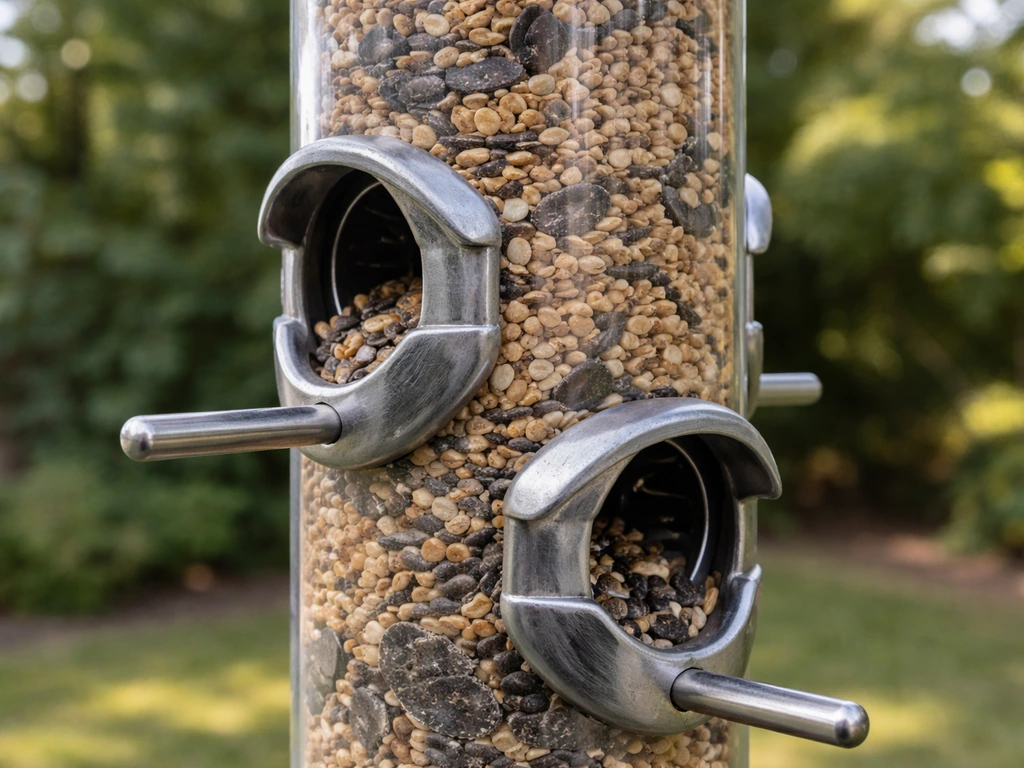
Tube feeders are one of the better options for rodent resistance. Seed is enclosed in a cylinder, dispensed only through small ports, and if those ports have metal surrounds (not just plastic), rats can't easily chew their way to the seed. Look for tubes with a metal cage surround or a weight-activated outer sleeve that closes the ports under heavier animals. Tube feeders work especially well for finches, chickadees, nuthatches, and sparrows. They're not ideal for larger birds like doves or cardinals, who prefer wider perches and more accessible seed.
Hopper feeders
Hopper feeders (the classic house-shaped design) hold more seed and serve a wide range of birds including cardinals, blue jays, and finches. They're decent for rodent resistance if the seed reservoir is fully enclosed and the feeding tray is weight-activated. The weak point is the tray itself, which often catches and spills seed. If you're going with a hopper, pair it with a no-mess seed mix (hulled seeds, no millet, no filler) to cut down on what lands on the ground.
Platform feeders
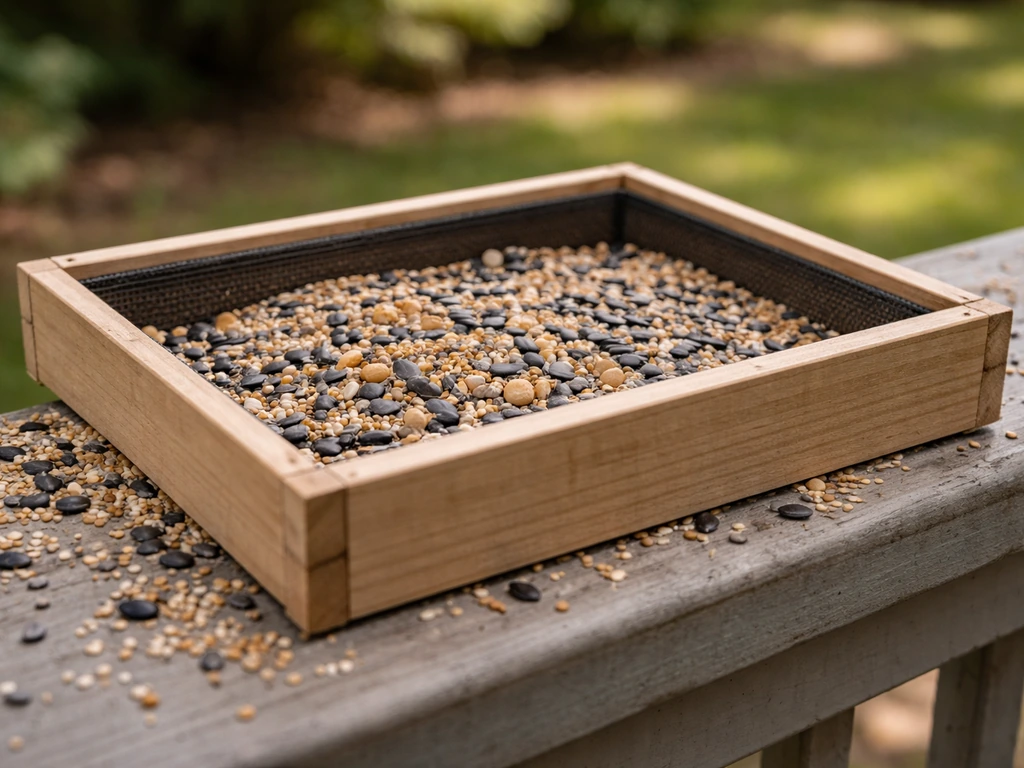
Platform feeders are genuinely the worst design choice if you have a rat problem. Open trays offer easy access from any direction, seed spills constantly, and there's no enclosure to prevent a rat from just walking up and eating. If you love platform feeding for ground-feeding birds like doves, the only way to make it work is by mounting it high on a pole with a quality baffle and committing to cleaning up any seed that falls below it every single day. Even then, it's a risk.
Suet feeders
Suet feeders are a mixed bag. Suet is fatty and calorie-dense, which rats love. A basic wire cage suet feeder hung from a tree is practically a rat invitation if there's a branch anywhere nearby. The better approach is a metal suet feeder mounted on a pole with a baffle, or a feeder with a built-in cage surround that limits access by body size. Woodpeckers, nuthatches, and starlings all use suet feeders, and while starling-proof suet feeder designs focus on upside-down access for clinging birds, that same design actually reduces rat access too since rats aren't great at hanging upside down.
Window feeders
Window feeders attach directly to glass with suction cups and sit right at the window surface. In practice, they're actually reasonably good at keeping rats away because mounting a window above ground level removes the easy climbing paths. The bigger issue is that window feeders tend to be small, hold less seed, and can create spillage on windowsills or decks below. If your window is above the first floor and there's no nearby structure a rat could use to reach it, this style works well.
Pole-mounted feeders
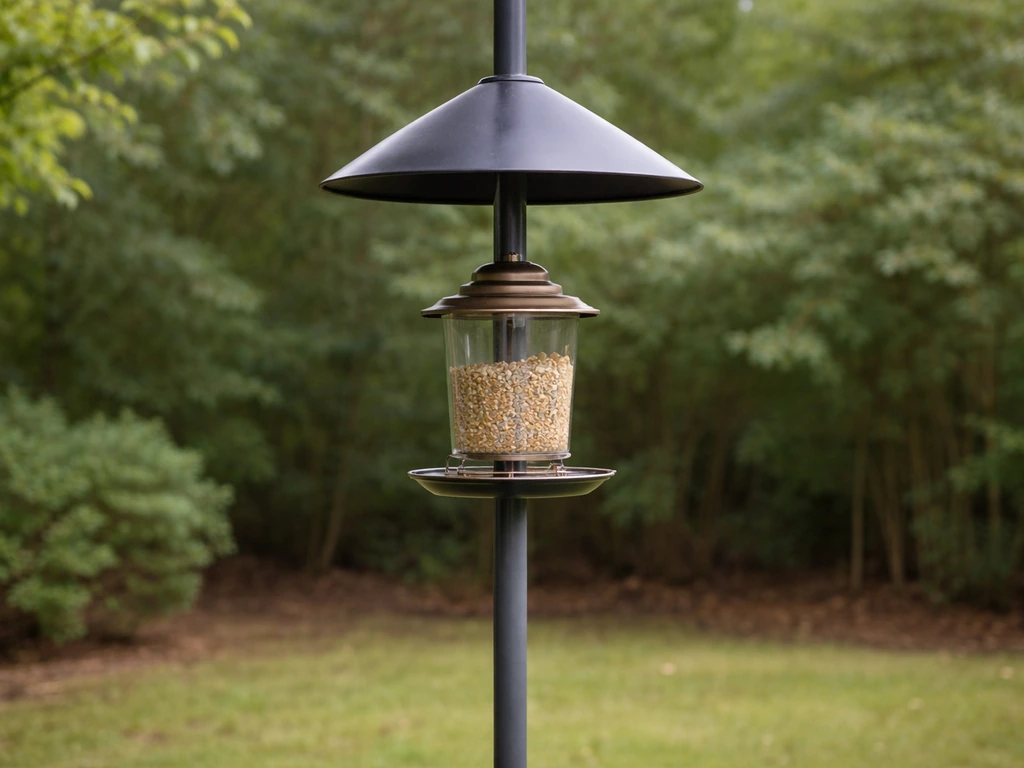
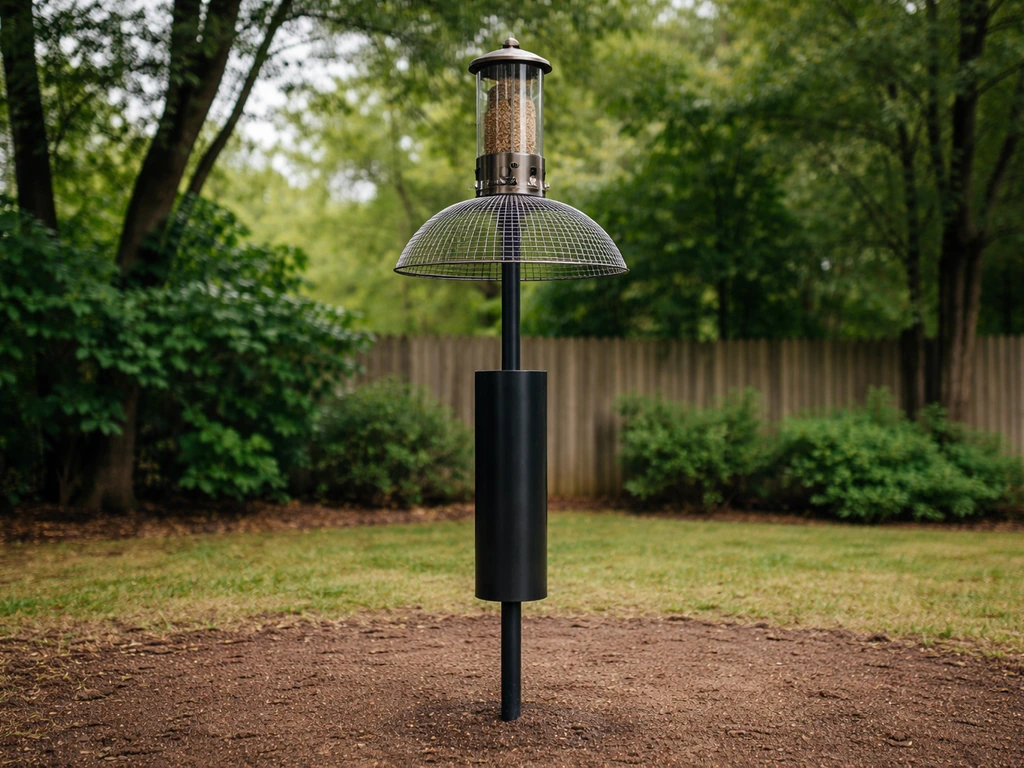
Pole-mounted feeders with a proper baffle system are the gold standard for rodent resistance. A smooth metal pole, baffled at the right height, with no overhanging branches, fences, or structures nearby gives rats essentially nothing to work with. This is the setup I'd recommend to anyone dealing with a serious rat problem. The feeder type on top can be almost anything, because the pole-and-baffle system does the heavy lifting.
| Feeder Type | Rodent Resistance | Best For (Birds) | Main Weakness |
|---|---|---|---|
| Tube (caged/weight-activated) | High | Finches, chickadees, nuthatches | Seed can spill at ports if not maintained |
| Hopper (enclosed, weight-activated) | Medium-High | Cardinals, blue jays, finches | Open tray catches and spills seed |
| Platform (open tray) | Low | Doves, sparrows, juncos | No enclosure, constant spill risk |
| Suet (upside-down or caged) | Medium | Woodpeckers, nuthatches | Suet is highly attractive to rats |
| Window (suction-mount) | Medium-High | Small songbirds, chickadees | Spillage on ledge or deck below |
| Pole-mounted with baffle | Very High | Any species (depends on top feeder) | Requires proper installation to work |
Must-have anti-rodent features to look for
When you're shopping for a rat-resistant feeder, these are the features that actually matter versus the ones that are just marketing language.
- All-metal or metal-reinforced construction: Rats chew through plastic with ease. Look for powder-coated steel, aluminum, or at minimum metal-reinforced port surrounds and seed compartments.
- Weight-activated closing mechanism: A spring-loaded sleeve or shutter that closes seed ports when anything heavier than a target songbird lands on the perch. Adjustable weight sensitivity is a bonus.
- Enclosed seed reservoir: Seed should be fully inside the feeder body, not exposed in an open tray or accessible from underneath.
- Integrated seed catcher or no-mess tray: A tray that catches seed but can be removed and cleaned easily prevents spill accumulation without creating a feeding platform at the base.
- No-waste seed compatibility: The feeder should work well with hulled sunflower, nyjer, or no-mess blends. Feeders designed only for whole sunflower or millet generate far more debris.
- Smooth outer surface: No footholds, ledges, or texture a rat can grip to hang from the feeder body and gnaw into it.
- Cage or shroud option: A metal cage surrounding the main feeder body physically excludes large-bodied animals by size. This works well for squirrels and rats alike, and if sized right still lets small songbirds through.
One feature worth calling out specifically: if you're dealing with rats and you're also frustrated by large birds taking over, look at what a grackle-proof feeder setup looks like. The cage surrounds and weight-activated designs used to block large, heavy birds overlap almost perfectly with what blocks rats. You get dual protection without buying two different products.
Placement and installation: baffles, pole height, and distance from cover
This is where most people undermine an otherwise good feeder. You can buy the most well-engineered rat-resistant feeder on the market and still end up feeding rats if you install it wrong. Placement is arguably as important as the feeder itself.
The Washington Department of Fish and Wildlife recommends attaching baffles above and below feeders as a primary method for keeping rats off. A baffle is a cone or cylinder of smooth metal that wraps around the pole or hangs above the feeder, making it impossible for a climbing animal to get past. The ICWDM specifies that cone baffles should be attached at a minimum of 4 feet off the ground and extend at least 2 feet in diameter to prevent animals from reaching around them. That 4-foot minimum height is critical: a rat can jump, so any baffle mounted too low just gets leapt over.
The other major installation mistake is placing feeders too close to cover. Overhanging tree branches, fence tops, shed roofs, and even stacked garden furniture all give rats a launch point to bypass a pole and baffle entirely. The ICWDM makes this point clearly: a squirrel (or rat) can access a feeder hanging from a tree branch regardless of how the feeder is designed, because the pathway is overhead, not below. The general rule is to keep feeders at least 10 feet away horizontally from any structure, branch, or surface a rat could launch from, and at least 5 feet off the ground for the feeder itself.
- Use a smooth metal pole (not wood, not PVC with gaps) at least 5 feet tall.
- Mount a cone or cylinder baffle on the pole, at minimum 4 feet off the ground, extending at least 2 feet wide.
- Position the feeder at least 10 feet from the nearest fence, tree trunk, branch, or structure.
- If hanging a feeder from a line, ensure the line is at least 5 feet off the ground and has a baffle above the feeder on the line itself.
- Trim any branches that overhang the feeder area within 10 feet horizontally.
- Check the ground below regularly and clear any spilled seed before dark, when rats are most active.
Preventing seed spills and keeping feeders clean
Spilled seed on the ground is the single biggest driver of rat activity around bird feeders. A rat doesn't need to climb your pole or defeat your baffle if it can just eat what's already on the ground. Preventing spillage is non-negotiable if you want a genuinely rat-resistant setup.
The most effective change you can make to your seed choice is switching to a no-mess bird seed blend that uses hulled sunflower seeds, shelled peanut pieces, or nyjer. Hulled seeds don't create shell debris, generate less waste, and are eaten more completely by birds. Whole sunflower seeds and mixes with millet or milo generate large amounts of debris because birds crack them open and drop half of what they pick up. That debris lands below the feeder and becomes a rat buffet.
Cleaning the feeder itself also matters more than most people realize. Wet or moldy seed clogs ports, falls to the ground in clumps, and attracts rodents even faster than dry seed. A good cleaning schedule is a thorough wash (warm water, mild dish soap, rinse completely) every two to four weeks in summer, and every four to six weeks in winter when seed tends to stay drier. After rain or heavy humidity, check and empty the feeder sooner. Allowing the feeder to dry completely before refilling is important, especially for tube feeders where damp seed compacts and becomes difficult for birds to extract.
If your feeder doesn't have a built-in seed catcher tray, consider adding an aftermarket one. These clip below the feeder and catch seed that birds knock loose, preventing it from reaching the ground. Just commit to emptying and cleaning the catcher tray regularly, or it becomes its own problem.
Troubleshooting: why rats are still getting in
If you've already got what seems like a rat-resistant setup and you're still seeing evidence of rodents, here's a systematic way to diagnose what's going wrong.
- Check the baffle height: If the cone baffle is below 4 feet, or if rats can reach around it because it's too narrow, they're climbing past it. Raise it or replace it with a wider cone.
- Check for overhead access: Look up. Is there a branch, wire, gutter, or roof overhang within 10 feet of the feeder? Rats can leap from above and land on the feeder, bypassing the pole entirely.
- Check for nearby structures: Fences, deck railings, and stacked items like firewood or planters can all serve as launching pads. Move or remove them.
- Check the pole itself: Wooden poles, rough metal poles, and any pole with horizontal screws or hardware that sticks out gives rats grip points for climbing. Smooth metal poles, lightly coated with a thin layer of petroleum jelly at the base if needed, are much harder to climb.
- Check for food sources at ground level: If there are seed husks, spilled seed, or feeders that allow seed to accumulate on the ground, the rats are feeding there and you won't notice them at the feeder itself. Remove ground-level food and see if activity decreases.
- Check for other food attractants nearby: Compost bins, pet food left outside, fallen fruit, and open garbage are all more attractive to rats than bird seed. If those are present, your rat problem extends beyond the feeder.
- Check if the feeder's weight mechanism is calibrated correctly: Some weight-activated feeders have adjustable sensitivity. If it's set too light, the ports close for birds too. If it's set too heavy, rats can sit on the perch without triggering it.
One thing I've seen cause real frustration: people dealing with both rats and larger pest birds like pigeons or starlings at the same time, and buying a feeder optimized for one problem that doesn't address the other. If that sounds familiar, it's worth reading up on pigeon-proof bird feeder options alongside your rat-proofing strategy, because the cage-surround designs used for pigeons overlap well with rat resistance.
DIY rat-proofing: guards, caging, and hardware solutions
You don't always need to replace your feeder. There are a number of DIY modifications that can add serious rodent resistance to an existing setup.
Build or buy a baffle
A cone baffle can be made from a large metal mixing bowl or a piece of sheet metal bent into a cone shape and mounted on the pole below the feeder. The key is smooth metal, at least 18 to 24 inches in diameter, and positioned at that minimum 4-foot height. Pre-made baffles from brands like Woodlink or Squirrel Stopper are inexpensive (usually $15 to $30) and easier to install correctly than DIY versions.
Hardware cloth cage surround
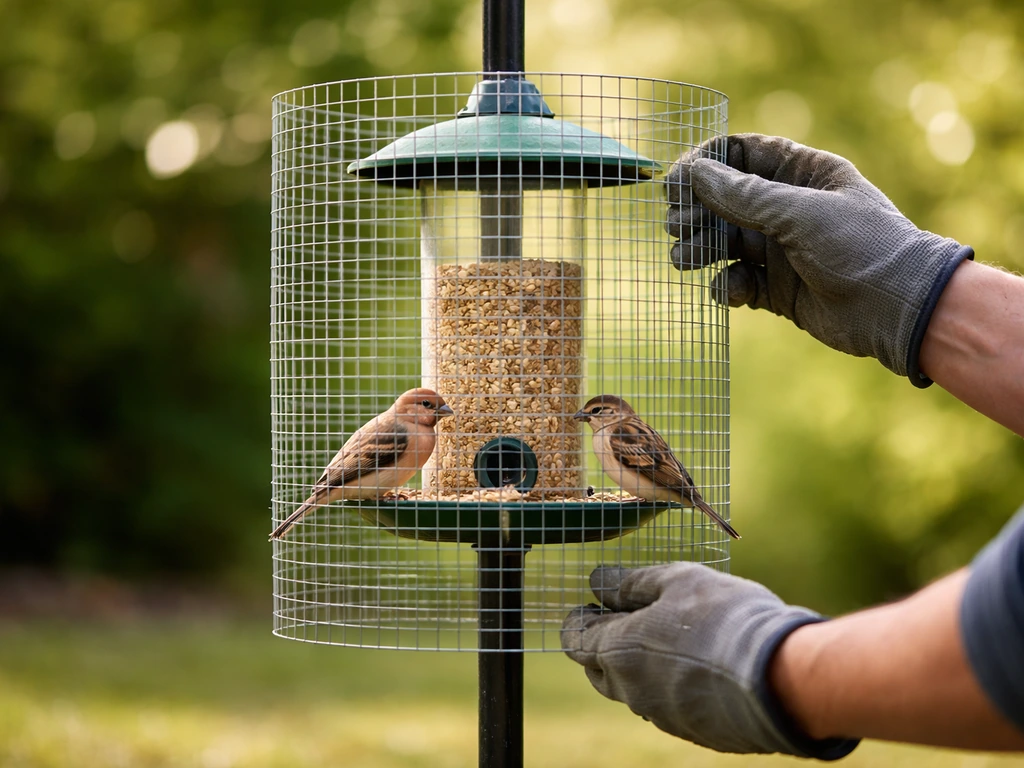
Wrapping an existing feeder in a hardware cloth cage with 1.5-inch or 2-inch mesh openings is a cheap and effective way to add physical exclusion. Small songbirds pass through easily, while rats (and larger pest birds) can't get in. You can form hardware cloth into a cylinder around a tube feeder with basic tools: wire cutters, pliers, and a few zip ties. The cage doesn't need to be pretty; it needs to be structurally rigid so rats can't bend it aside.
Pole sleeve and grease
A PVC pipe sleeve over a rough or wooden pole, with the PVC sitting loosely (so it spins when grabbed), is a classic squirrel and rat deterrent. Alternatively, a thin coating of petroleum jelly on the lower 18 inches of a smooth metal pole makes it nearly unclimbable. Just check and reapply after rain. Note: don't apply anything oily near the feeder itself where birds might contact it.
Seed tray with hardware cloth floor
If you need a seed catcher tray but don't want it to become a feeding platform, build one with a hardware cloth floor instead of a solid base. Birds can still land on it, but seed falls through to the ground (away from the main feeder) and you rake or collect it daily. This keeps the tray from becoming an easy rat platform while still reducing scatter under the feeder body.
It's also worth noting that if deer are visiting your yard alongside rats, the problem compounds quickly because deer knock feeders loose and create major seed spills. Addressing both at once is smart, and a look at deer-proof bird feeder designs will give you ideas for pole systems and mounting heights that work against both animals.
Supporting birds safely while managing rodents
The goal here is to keep feeding birds without creating a rodent problem in your yard or your neighbors' yards. That's a reasonable and achievable target, but it does require some ongoing commitment.
On the humane side of pest management: if you do reach the point of needing to manage rats directly, avoid rodenticides (rat poison) in any yard where birds feed. Raptors like hawks and owls, as well as corvids and other scavenging birds, will eat poisoned rats and die from secondary poisoning. This is a well-documented problem and one of the most avoidable ways to harm the birds you're trying to help. If trapping is necessary, snap traps inside enclosed bait stations (where birds can't reach them) are the standard humane and bird-safe recommendation from wildlife agencies.
Seasonally, winter is the highest-risk period for rodent activity around feeders. Birds need more calories in cold weather, so you're putting out more food, and rats are actively seeking high-calorie food sources to survive. This is when seed spill management and baffle integrity matter most. Check baffles for ice buildup (which can reduce their effectiveness), keep seed dry, and consider reducing the amount you put out to what birds will consume in a single day so nothing sits overnight.
For anyone managing a more complex pest situation, it's also worth knowing that dove-proof feeder strategies and rat-proofing share some common ground. Doves are ground feeders, and if you're feeding them you're almost certainly putting food in a location that rats can easily access. Deciding how to balance dove feeding with rodent management is a real trade-off that comes down to feeder placement and daily cleanup discipline.
Your rat-resistant feeder setup checklist
Use this as your final review before declaring your setup done. Every item here addresses a real failure point that lets rats in despite good intentions.
- Feeder is tube, hopper, or caged design with all-metal construction or metal-reinforced ports, not an open platform.
- Weight-activated closing mechanism is present and calibrated to close under a rat's weight (roughly 150 to 500 grams depending on species).
- Feeder is mounted on a smooth metal pole at least 5 feet tall.
- A cone or wrap-around baffle is attached to the pole at a minimum height of 4 feet off the ground and extends at least 2 feet in diameter.
- Feeder is positioned at least 10 feet horizontally from the nearest fence, tree trunk, branch, structure, or overhang.
- No overhead access point (branch, wire, gutter) is within 10 feet of the feeder.
- Seed type is hulled, no-mess blend with no millet or milo to minimize debris.
- Any spilled seed on the ground is cleared before dusk every day.
- Feeder is cleaned thoroughly every two to four weeks.
- No rodenticides are in use anywhere in the yard or nearby area.
- In winter, feeder is loaded with only as much seed as birds will consume in one day to avoid overnight accumulation.
FAQ
What does “rat-proof” really mean when choosing bird feeders?
Treat it as “rat-discouraging at the feeder,” not absolute protection. If your feeder design prevents access but any seed, husks, or fallen crumbs accumulate underneath, rats can still thrive. The practical test is whether you see cleanup needs drop, especially after rain when wet debris clumps.
How high should I mount a feeder to reduce rat access?
Aim to keep the feeding outlet at least about 5 feet off the ground, because rats can jump. Also ensure the baffle system is installed above the rat jump path, since a baffle that is too low becomes a climbable obstacle.
Do baffles have to be both above and below the feeder?
If you are serious about rats, yes, using baffles above and below is a stronger approach than relying on just one. Above-baffles block approach routes, below-baffles prevent rats from climbing past the feeder’s access area.
How far should feeders be from trees, fences, or sheds?
Keep feeders at least around 10 feet from launch points (branches, fence tops, roof edges, stacked items) and avoid any overhead pathway. Even if the pole is baffled, rats can bypass the barrier if something provides an approach from above.
What’s the fastest way to fix rat activity if I already bought a rat-resistant feeder?
Start with seed management for 7 to 14 days. Remove any seed on the ground, switch to hulled or shelled/no-mess blends, and add a seed-catcher only if you can empty it frequently. Often the “rodent problem” persists because spilled debris is the real food source.
Are tube feeders safe for rats if the ports have plastic parts?
Not necessarily. Plastic surrounds tend to be easier for rodents to damage. Prefer metal surrounds and mechanisms that close under heavier weight, and inspect regularly for chewed openings or loosened parts.
Will a hopper feeder work if it spills seed around the tray?
It can, but only if you control spillage. Hopper trays often catch and drop seed, turning the “delivery” area into a rat buffet. If you cannot reliably prevent drops with a weight-activated tray and daily cleanup, tube or pole-baffled designs usually perform better.
Can I use seed catcher trays without turning them into rat feeders?
Yes, but the tray must not function like a platform. A hardware-cloth floor that lets debris fall through (and can be raked or collected daily) is safer than a solid catch tray that rats can climb onto and access from below.
How often should I clean feeders to prevent rats?
Follow a seasonal schedule, and be extra aggressive after storms. Wet or moldy seed clogs ports and increases attractants. In humid periods, check sooner than the usual interval, rinse thoroughly, and fully dry before refilling.
Do rats show up more in winter because of the feeder?
Usually, yes. Cold weather increases both bird feeding and rat foraging, so any leftover debris overnight matters more. Consider putting out less per day, maintain baffle integrity (no ice), and remove seed spill quickly.
What if I have rats and squirrels at the same time?
Choose based on the shared blocking features, especially enclosed seed access and weight-activated closures, plus a smooth pole with a baffle. Squirrel-proof ratings may help, but confirm the specific closure mechanism prevents access by heavier or agile rodents, not just larger birds.
Are suet feeders a bad idea for rat problems?
They can be, because suet is extremely calorie-dense and rats find it quickly. If you use suet, prefer a metal pole-mounted design with a baffle and minimal access paths, and avoid any setup that relies on open wire cages or nearby climbing branches.
Can petroleum jelly or pole slick coatings help with rat proofing?
Sometimes, but only on the lower portion of a smooth pole and only if you can maintain it after rain. Keep oily substances away from areas birds can contact, and verify the pole is otherwise baffled, since slickness alone can fail if access routes exist.
Is it okay to use rodent poison if birds are around?
Avoid it. Poisoning rats creates a secondary poisoning risk for raptors, owls, hawks, and scavenging birds that may eat poisoned carcasses. If rodent control is necessary, use enclosed snap traps (so birds cannot reach them) and consider professional guidance.
Next Articles
Best Bird Feeder for Baltimore Orioles: Buyer Guide
Choose the best bird feeder for Baltimore orioles: styles, features, placement tips, and fixes for heat, pests, and acce
What Does a Bird Feeder Look Like? Types and Visual Cues
See common bird feeder silhouettes and visual cues, plus features for choosing and troubleshooting fast.
Best Oriole Bird Feeders: Buying, Setup, and Tips
Choose the best orioles feeders and set up jelly or nectar for backyard success, with pest-proofing and troubleshooting.